Write the equation of a line with a slope of 3/8 and a y-intercept of 9. Write your answer in slope-intercept form.
Write the equation of a line that passes through the points (-2, 10) and (2, 6). Write your answer in slope-intercept form.
Write the equation of a line parallel to y = 1/3x + 2 through the point (6, -8). Write your answer in slope-intercept form.
Write the equation of a line perpendicular to y = 4x + 2 through the point (8, -5). Write your answer in slope-intercept form.
Use the linear equation below for the next 3 questions.
What is the slope?
What is the y-intercept?
Using the graph provided, graph the equation.
Determine of the following pairs of lines are parallel, perpendicular, or neither:
Line 1: (-1, 4) and (2, 3)
Line 2: (0, 0) and (3, 1)
Determine of the following pairs of lines are parallel, perpendicular, or neither:
Line 1: (0, 1) and (1, 3)
Line 2: (3, 3) and (5, 2)
Use the diagram below for the next 6 questions.
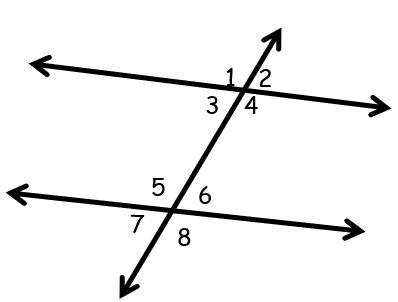
_______ and 3 are alternate interior angles.
_______ and 1 are vertical angles.
_______ and 6 are corresponding angles.
_______ and 7 form a linear pair.
Use the diagram below for the next 6 questions.
For each question, find the measure of the indicated angle. The angle measures will change for each question.
If
If
If
If
If
Use the diagram below for the next 4 questions.
For each question, identify each pair of segments as parallel, perpendicular, skew, or none.
Parallel lines intersect at exactly one point.
Skew lines are coplanar.
Parallel lines are coplanar.
Perpendicular lines have slopes that are opposite reciprocals of each other.
Skew lines never intersect.
Parallel lines have slopes that are opposites.
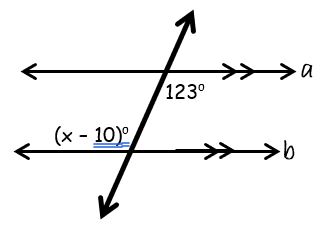
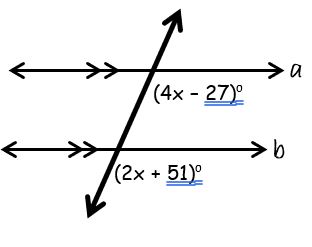
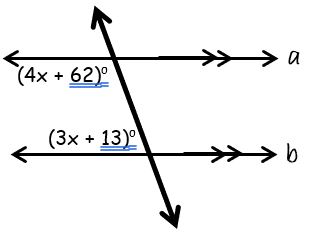
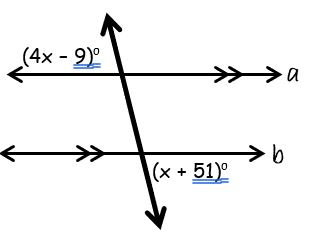
Using the diagram below, find the value of x.
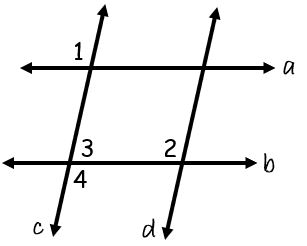
Use the diagram below for the next 2 questions.
For each question, name the parallel lines given the provided angle relationship.
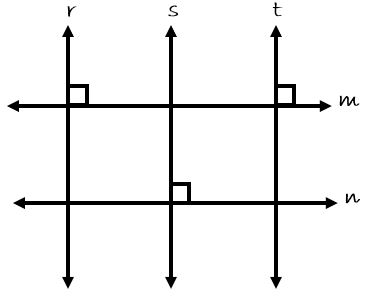
Use the diagram below for the next 4 questions.
Is m // n?
Is r // s?
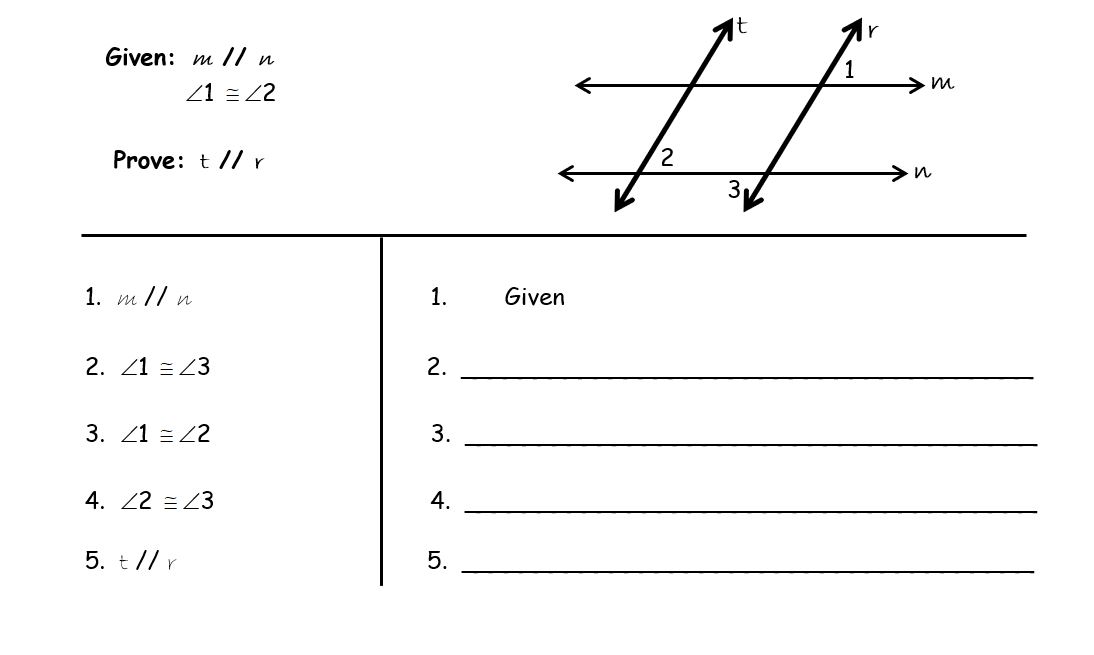
Use the proof below for the next 4 questions.
Reason #2
Reason #3
Reason #4
Reason #5
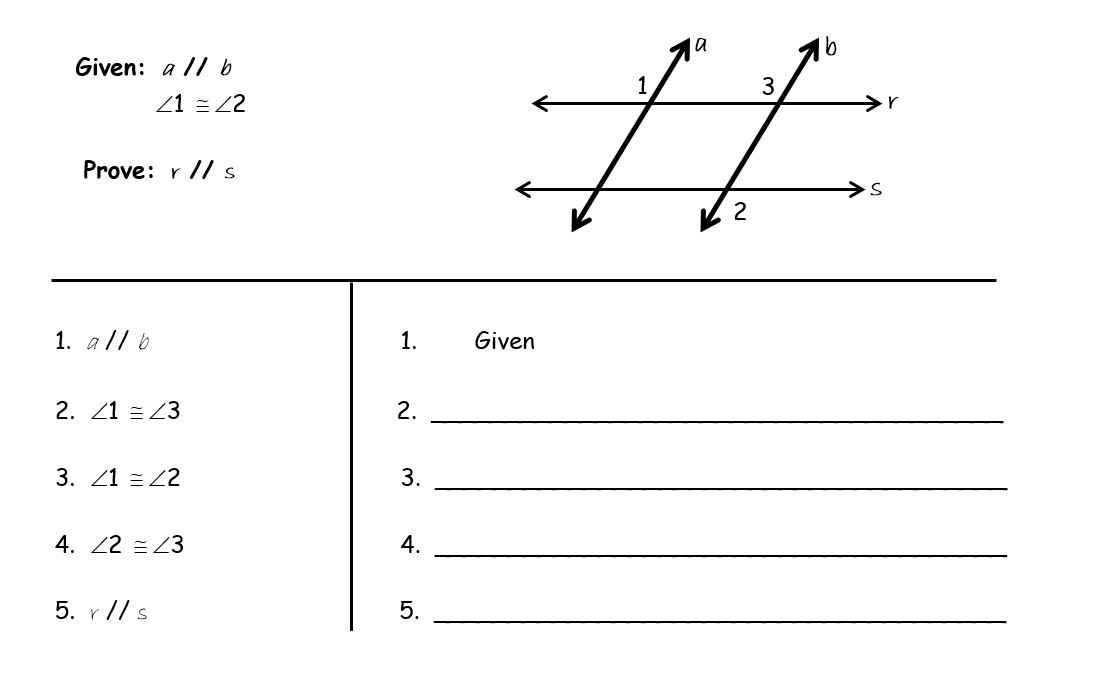
Use the proof below for the next 4 questions.
Reason #2
Reason #3
Reason #4
Reason #5
Use the proof below for the next 4 questions.
Reason #2
Reason #3
Reason #4
Reason #5
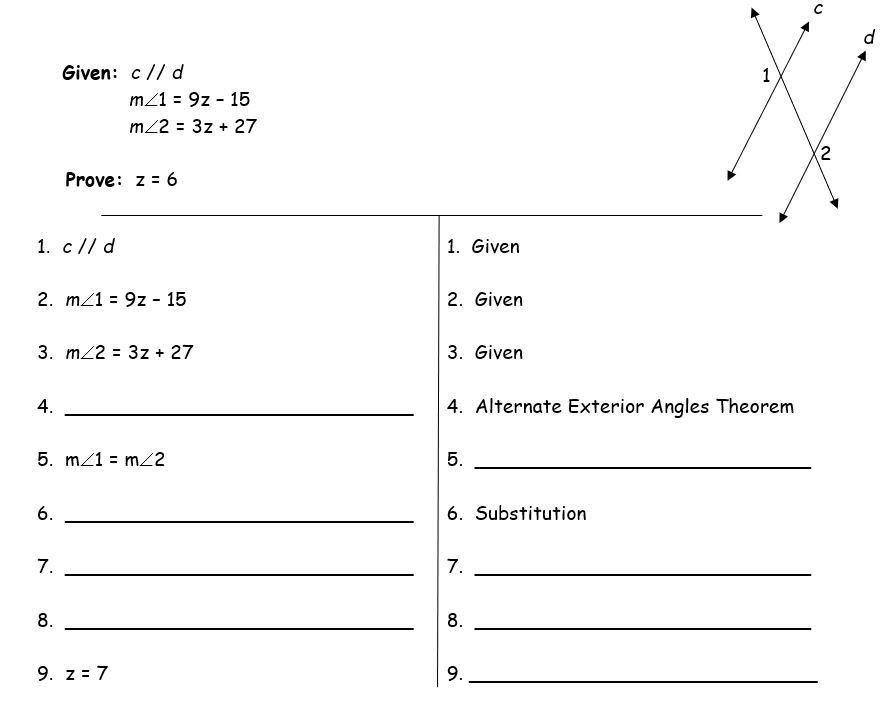
Use the proof below for the next 8 questions.
Reason #5
Statement #6
Statement #7
BONUS: Complete the following proof in the Show Your Work section. (3 points)
_______ and 2 are alternate exterior angles.
_______ and 6 are consecutive interior angles.
If
Is r // t?
If r // s and s // t, then ____ // ____?
Statement #4
Reason #7
Statement #8
Reason #8
Reason #9