Chapter 3 Review 2022
star
star
star
star
star
Last updated over 3 years ago
87 questions
1
Write the equation of a line with a slope of -1/2 and a y-intercept of 8.
1
Write the equation of a line that passes through the points (2, 3) and (5, -3).
1
Write the equation of a line parallel to y = 1/4x + 2 through the point (12, -5).
1
Write the equation of a line perpendicular to y = 1/4x + 2 through the point (12, -5).
Use the linear equation below for the next 2 questions.
1
What is the slope of this line?
1
What is the y-intercept of this line?
1
Which of the following is the graph of the equation?
Use the linear equation below for the next 2 questions.
1
What is the slope of this line?
1
What is the y-intercept of this line?
1
Which of the following is the graph of the equation?
1
Determine if the following pairs of lines are parallel, perpendicular, or neither:
1
Determine if the following pairs of lines are parallel, perpendicular, or neither:
1
Determine if the following pairs of lines are parallel, perpendicular, or neither:
1
Determine if the following pairs of lines are parallel, perpendicular, or neither:
Use the lines below for the next 2 questions.
Line 1: (10, 7) and (13, 9)
Line 2: (-4, 3) and (-1, 5)
1
What is the slope of Line 1?
1
What is the slope of Line 2?
1
Are these lines parallel, perpendicular, or neither?
Use the lines below for the next 2 questions.
Line 1: (2, -3) and (7, -1)
Line 2: (1, 9) and (3, 4)
1
What is the slope of Line 1?
1
What is the slope of Line 2?
1
Are these lines parallel, perpendicular, or neither?
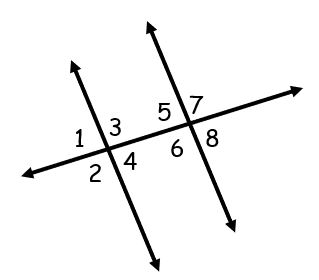
Use the diagram below for the next 5 questions.
1
\angle{1} and \angle{} _______ are Alternate Exterior Angles.
1
\angle{3} and \angle{} _______ are Consecutive Interior Angles.
1
\angle{3} and \angle{} _______ are Alternate Interior Angles.
1
\angle{2} and \angle{} _______ are Corresponding Angles.
1
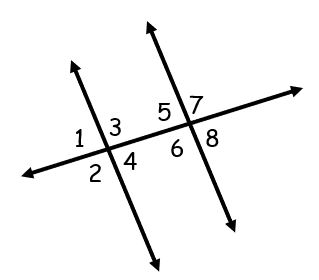
\angle{5} and \angle{} _______ are Vertical Angles.
1
Consecutive Interior Angles are _________________.
1
Corresponding Angles are _________________.
1
Alternate Interior Angles are _________________.
1
Alternate Exterior Angles are _________________.
1
Vertical Angles are _________________.
1
A Linear Pair is _________________.
Use the diagram below for the next 3 questions.
1
If m\angle{1} = 72o, then m\angle{5} = ________
1
If m\angle{4} = 66o, then m\angle{6} = ________
1
If m\angle{7} = 102o, then m\angle{2} = ________
1
If m\angle{3} = 112o, then m\angle{6} = ________
1
If m\angle{2} = 92o, then m\angle{3} = ________
1
If m\angle{7} = 96o, then m\angle{5} = ________
Use the diagram below for the next 4 questions.
For each question, identify each pair of segments as parallel, perpendicular, skew, or none.
1
\overline{RS} and \overline{QR}
1
\overline{QT} and \overline{YZ}
1
\overline{RQ} and \overline{YZ}
1
\overline{QR} and \overline{TZ}
1
Two lines that are not coplanar and do not intersect are called?
1
Which of the following is the difference between Parallel Lines and Skew Lines?
1
Perpendicular Lines have slopes that are _________________________________.
1
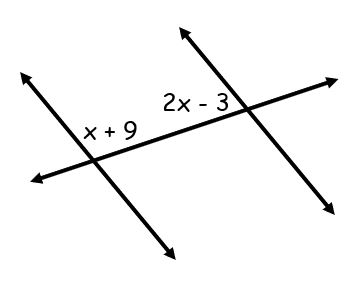
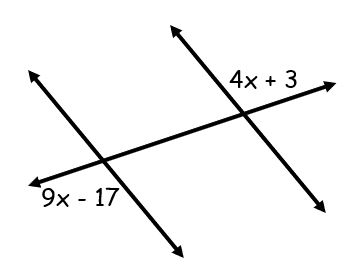
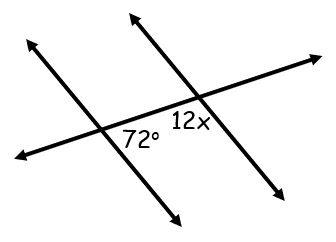
Using the diagram below, find the value of x.
1
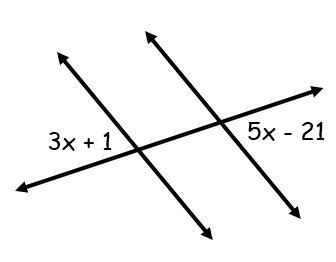
Using the diagram below, find the value of x.
1
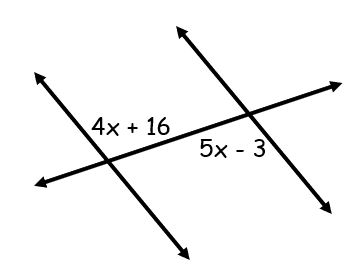
Using the diagram below, find the value of x.
1
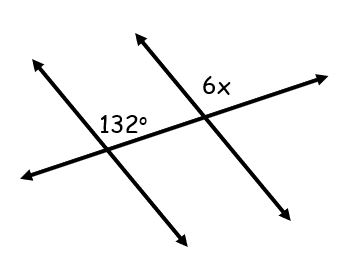
Using the diagram below, find the value of x.
1
Using the diagram below, find the value of x.
1
Using the diagram below, find the value of x.
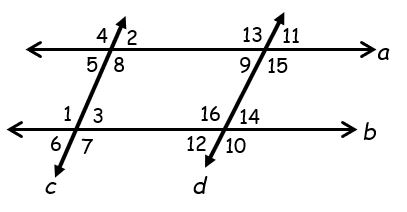
Use the diagram below for the next 8 questions.
For each question, determine which lines (a & b, c & d, or none), if any, must be parallel with the given information.
1
\angle{2} \cong \angle{9}
1
\angle{9} \cong \angle{12}
1
\angle{1} is supplementary to \angle{5}
1
\angle{4} \cong \angle{10}
1
\angle{11} \cong \angle{12}
1
\angle{7} is supplementary to \angle{12}
1
\angle{3} \cong \angle{6}
1
\angle{1} \cong \angle{16}
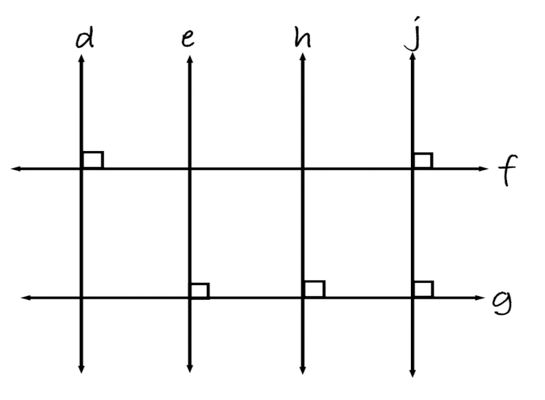
Use the diagram below for the next 6 questions.
1
Is d // e?
Is d // e?
1
Is e // h?
Is e // h?
1
Is d // j?
Is d // j?
1
Is g // f?
Is g // f?
1
If e // h and h // j, then ____ // ____?
1
If e \perp f and f \perp j, then ____ // ____?
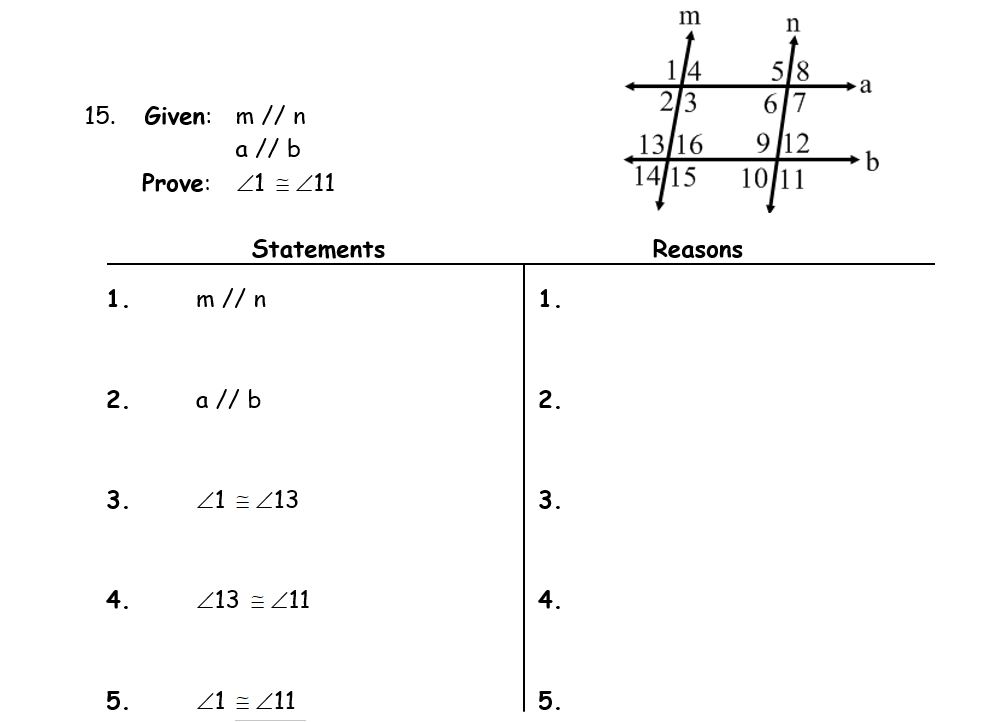
Use the proof below for the next 5 questions.
1
Reason #1
Reason #1
1
Reason #2
Reason #2
1
Reason #3
Reason #3
1
Reason #4
Reason #4
1
Reason #5
Reason #5
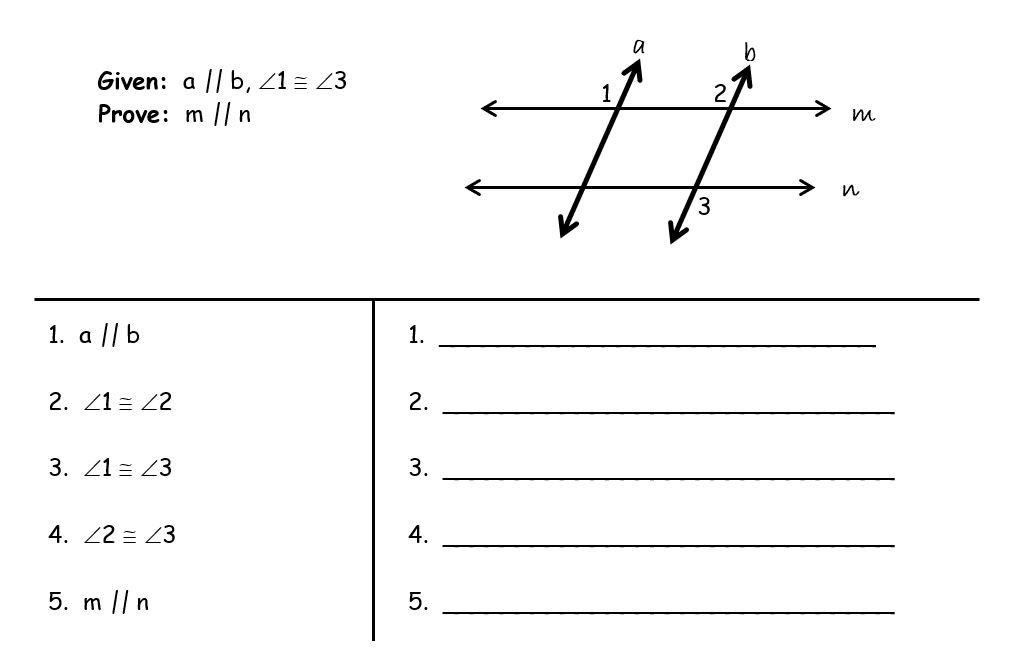
Use the proof below for the next 5 questions.
1
Reason #1
Reason #1
1
Reason #2
Reason #2
1
Reason #3
Reason #3
1
Reason #4
Reason #4
1
Reason #5
Reason #5
1
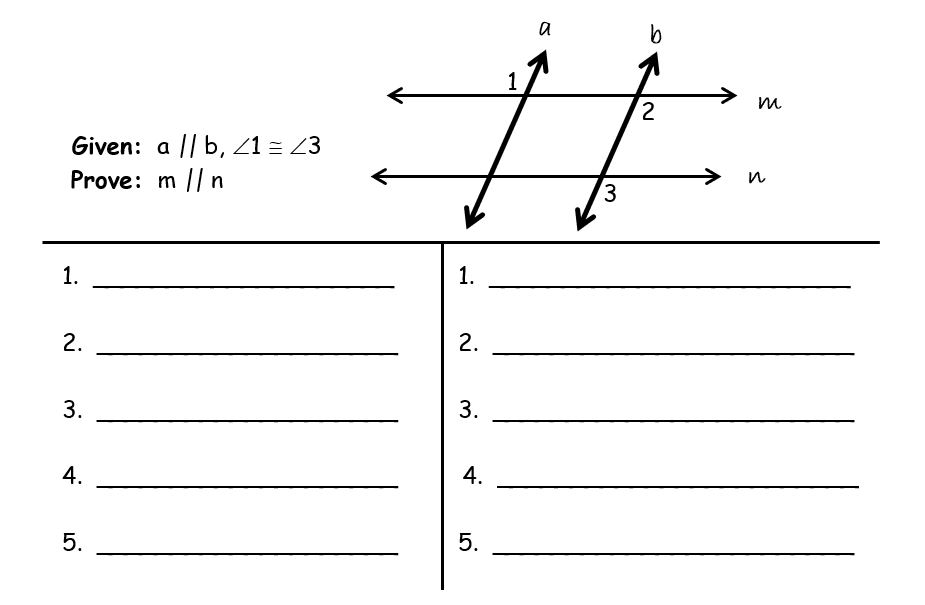
Put the statements in the correct order to complete the proof.
- \angle{1} \cong \angle{3}
- \angle{2} \cong \angle{3}
- a // b
- \angle{1} \cong \angle{2}
- m // n
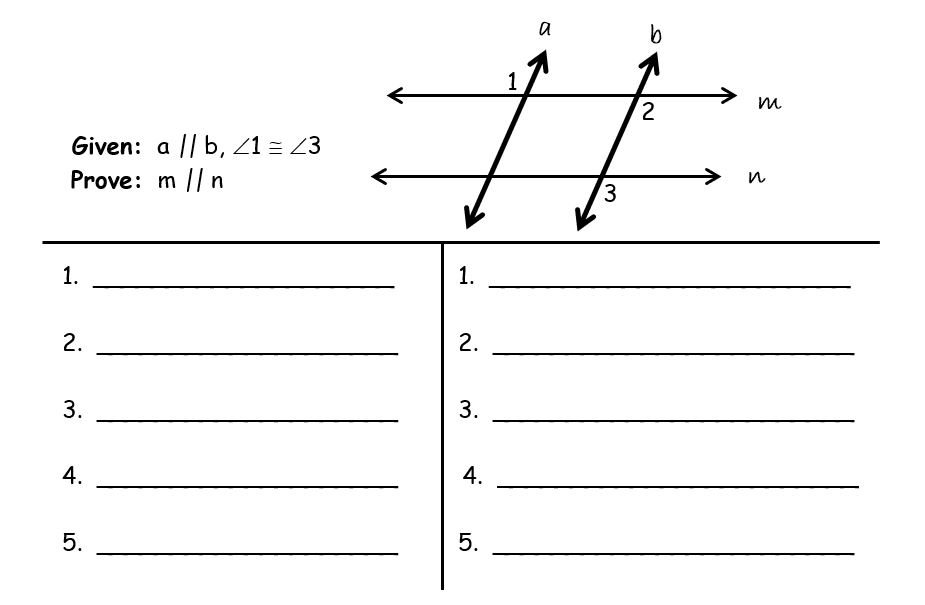
Using the correct order of the proof completed above, state the reasons for each step.
1
Reason #1
Reason #1
1
Reason #2
Reason #2
1
Reason #3
Reason #3
1
Reason #4
Reason #4
1
Reason #5
Reason #5
1
Put the statements in the correct order to complete the proof.
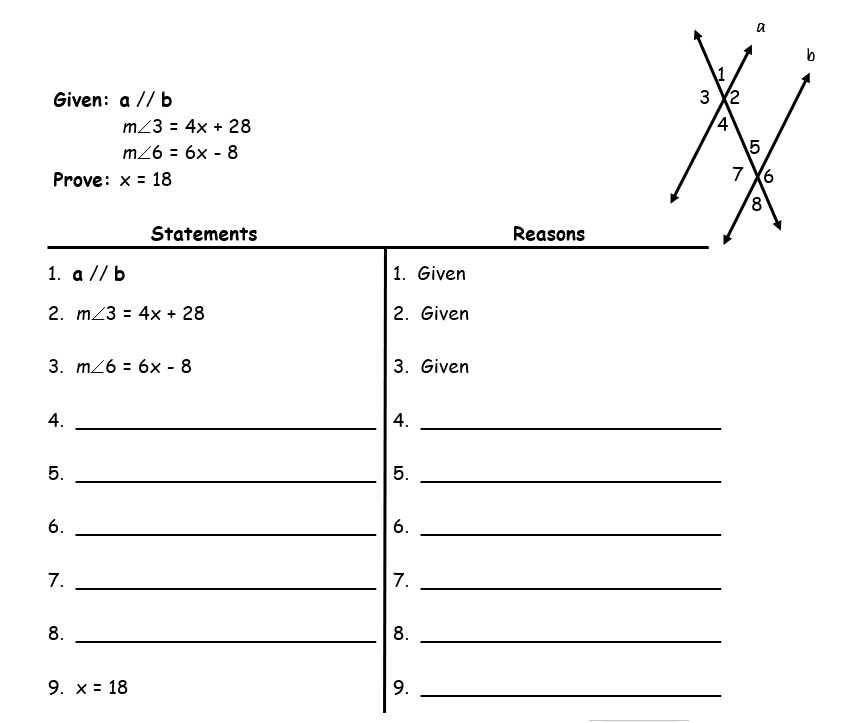
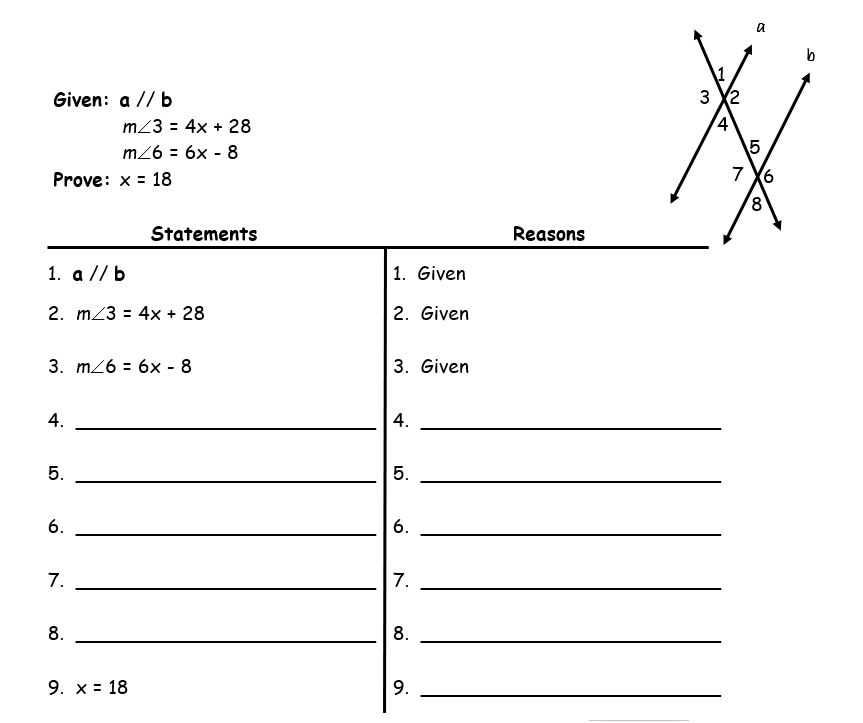
- \angle{3} \cong \angle{6}
- -2x = -36
- -2x + 28 = -6
- 4x + 28 = 6x - 8
- m\angle{3} = m\angle{6}
Using the correct order of the proof completed above, state the reasons for each step.
1
Reason #4
Reason #4
1
Reason #5
Reason #5
1
Reason #6
Reason #6
1
Reason #7
Reason #7
1
Reason #8
Reason #8
1
Reason #9
Reason #9