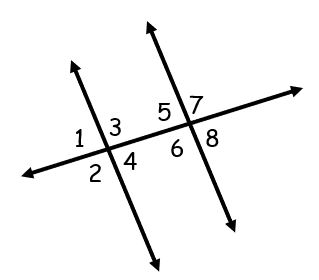
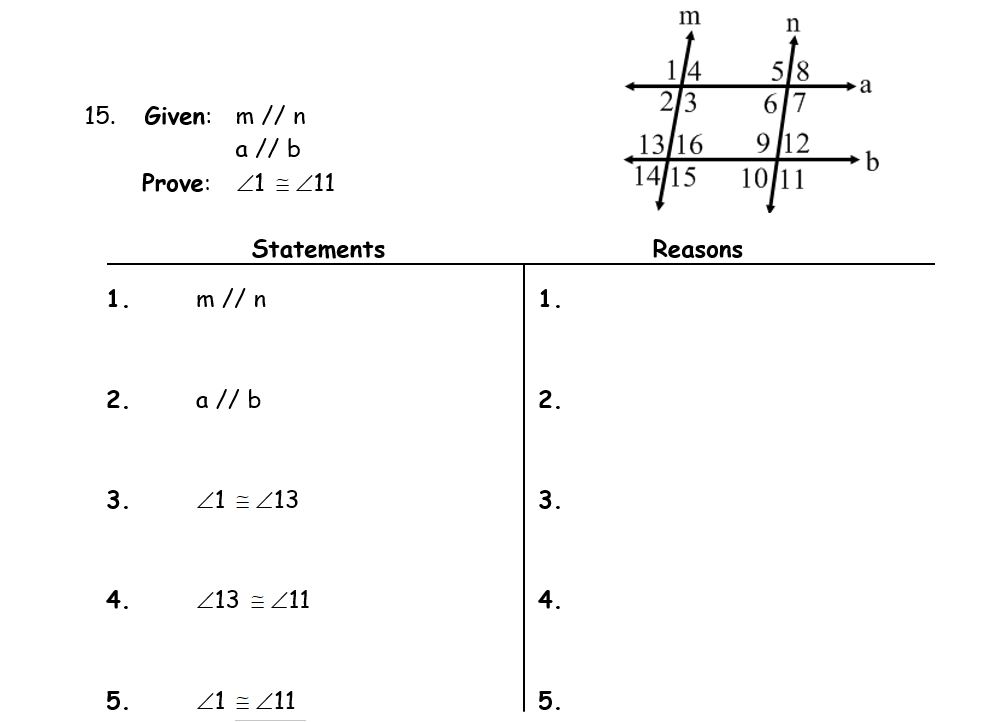
Use the diagram below for the next 5 questions.
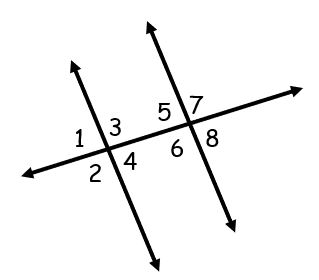
Consecutive Interior Angles are _________________.
Corresponding Angles are _________________.
Alternate Interior Angles are _________________.
Alternate Exterior Angles are _________________.
Vertical Angles are _________________.
A Linear Pair is _________________.
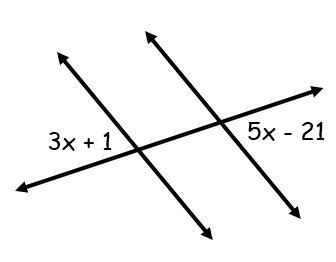
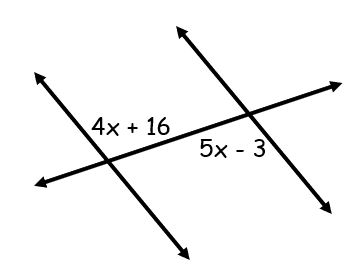
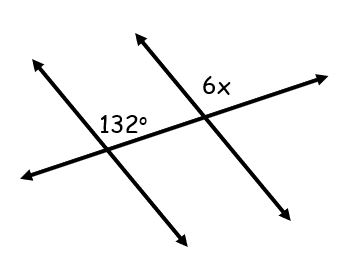
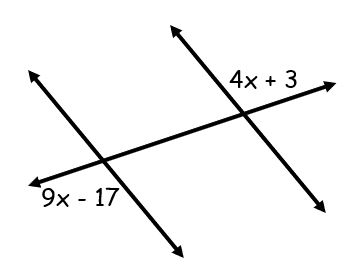
Use the diagram below for the next 3 questions.
If
If
If
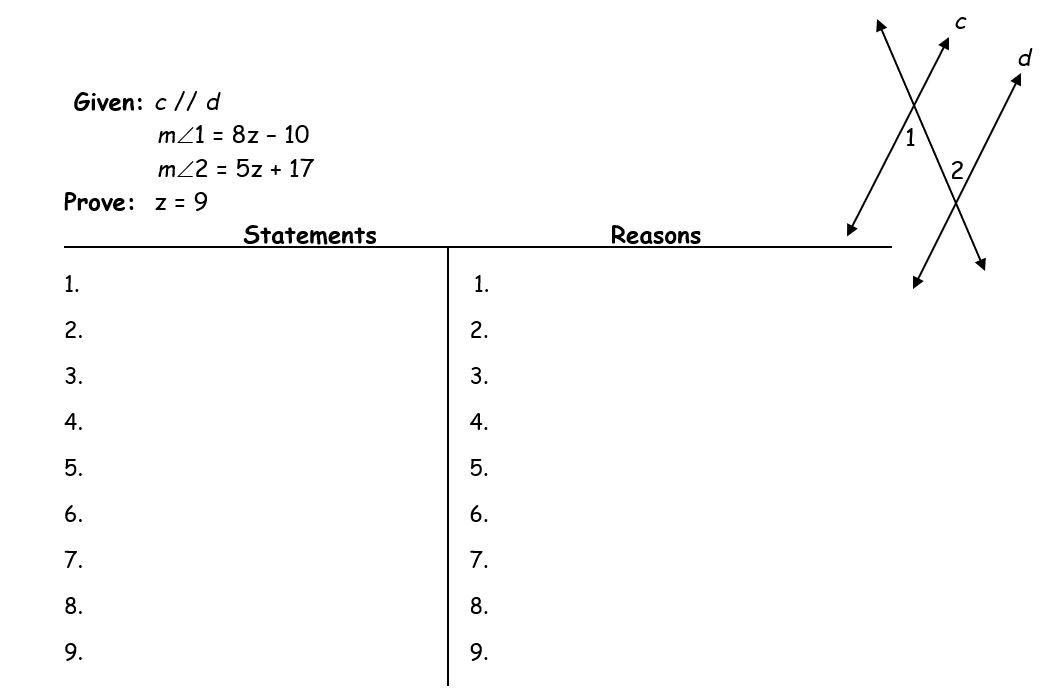
Use the proof below for the next 5 questions.
Reason #1
Reason #2
Reason #3
Reason #4
Reason #5
Two lines that are not coplanar and do not intersect are called?
Use the points below for the next 2 questions.
(2, 5) and (-4, 8)
What is the slope between these two points?
Determine the type of slope from your answer above.
Use the points below for the next 2 questions.
(-3, -7) and (-3, 4)
What is the slope between these two points?
Determine the type of slope from your answer above.
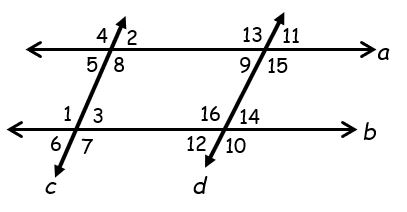
Use the diagram below for the next 8 questions.
For each question, determine which lines (a & b, c & d, or none), if any, must be parallel with the given information.
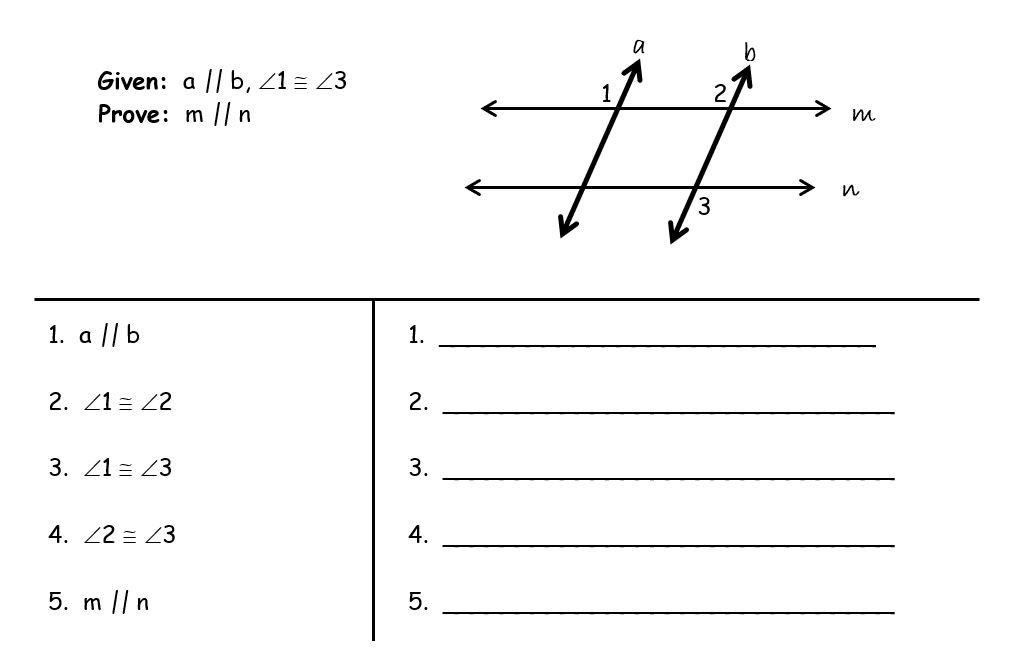
Use the proof below for the next 5 questions.
Reason #1
Reason #2
Reason #3
Reason #4
Reason #5
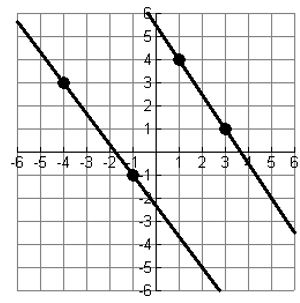
Use the diagram below for the next 3 questions.
What is the slope of the line on the left?
What is the slope of the line on the right?
Are the lines parallel?
Use the linear equation below for the next 2 questions.
What is the slope of this line?
What is the y-intercept of this line?
Use the linear equation below for the next 2 questions.
What is the slope of this line?
What is the y-intercept of this line?
Write the equation of a line with a slope of 8 and a y-intercept of -1/2.
Write the equation of a line that passes through the point (2, 3) and has a slope of -2.
Write the equation of a line parallel to y = 1/4x + 2 through the point (12, -5).
Write the equation of a line perpendicular to y = 1/4x + 2 through the point (12, -5).
Determine if the following pairs of lines are parallel, perpendicular, or neither:
Use the lines below for the next 2 questions.
Line 1: (10, 7) and (13, 9)
Line 2: (-4, 3) and (-1, 5)
What is the slope of Line 1?
What is the slope of Line 2?
Are these lines parallel, perpendicular, or neither?
Use the lines below for the next 2 questions.
Line 1: (2, -3) and (7, -1)
Line 2: (1, 9) and (3, 4)
What is the slope of Line 1?
What is the slope of Line 2?
Are these lines parallel, perpendicular, or neither?
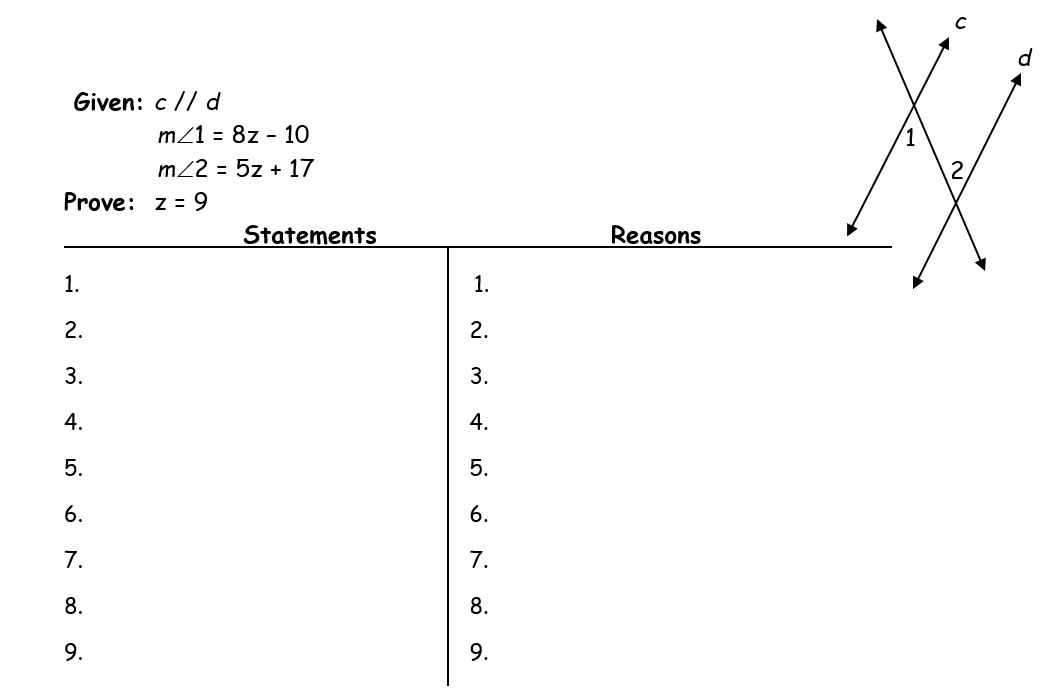
In the proof below, first reorder the statements to complete the left side of the proof. Then, provide the reasons for each statement.
Put the statements in the correct order to complete the proof.
3z - 10 = 17
3z = 27
8z - 10 = 5z + 17
z = 9
c || d
Using the correct order of the proof completed above, state the reasons for each step.
Reason #1
Reason #2
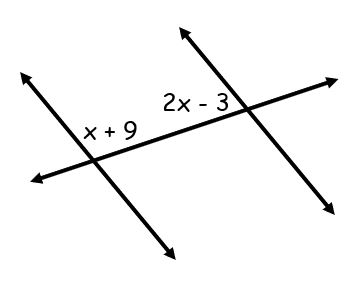
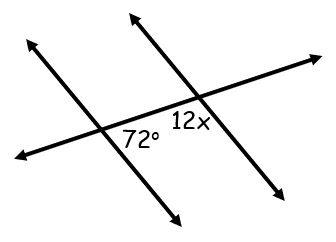
Using the diagram below, find the value of x.
Reason #3
Reason #4
Reason #5
Reason #6
Reason #7
Reason #8
Reason #9