Drag each solid to its appropriate category
Drag each solid to its appropriate category
Item 1
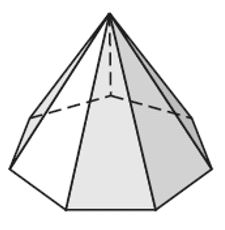
Item 2
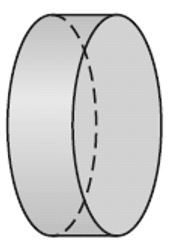
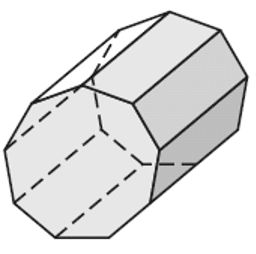
Polyhedron
Not a polyhedron
Match the term with its definition.
Icosahedron
Platonic Solids
Octahedron
Dodecahedron
Tetrahedron
Cross Section
Convex Polyhedron
Concave Polyhedron
Cube
Edge
Vertex
Face
Lateral Area
Prism
Pyramid
Cylnder
Euler
Sphere
A polyhedron with two polygon bases and rectangular lateral faces
A polyhedron made up of four equilateral triangles
A segment at which two faces of a polyhedron intersect
The intersection of three or more edges
A polyhedron made up of six squares
A polyhedron made up of one polygon base and triangular lateral faces that meet at one vertex
The intersection of a plane and a solid
The area of the sides of a polyhedron (Surface Area not including the base(s))
A polyhedron made up of twenty equilateral triangles
The polygon that makes up a side of a polyhedron
A polyhedron made up of twelve regular pentagons
A polyhedron made up of eight equilateral triangles
A solid with two circular bases
A polyhedron with all vertices pointing out
The person that discovered the formula F + V = E + 2
A polyhedron that has some vertices pointing in
A solid in which all points on its surface are equidistant from its center
The five regular polyhedra
Drag each solid to its appropriate category
Item 1
Item 2
Polyhedron
Not a polyhedron
What is the mathematical name of the solid below?
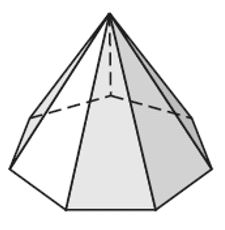
What is the mathematical name of the solid below?
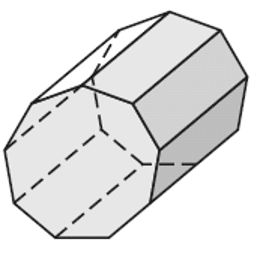
A polyhedron has 12 vertices and 16 edges. Using Euler's Theorem, determine how many faces it has.
A polyhedron has 14 faces and 24 vertices. Using Euler's Theorem, determine how many edges it has.
A polyhedron has 29 faces and 81 edges. Using Euler's Theorem, determine how many vertices it has.
How many faces does the polyhedron have?
How many vertices does the polyhedron have?
How many edges does the polyhedron have?
Check your answers above by plugging them into Euler's Theorem. Your answer should look like:
F+V=E+2
How many faces does the polyhedron have?
How many vertices does the polyhedron have?
How many edges does the polyhedron have?
Check your answers above by plugging them into Euler's Theorem. Your answer should look like:
F+V=E+2
How many faces does the polyhedron have?
How many vertices does the polyhedron have?
How many edges does the polyhedron have?
Check your answers above by plugging them into Euler's Theorem. Your answer should look like:
F+V=E+2
Determine whether the solid below is convex or concave.
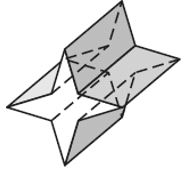
Determine whether the solid below is convex or concave.
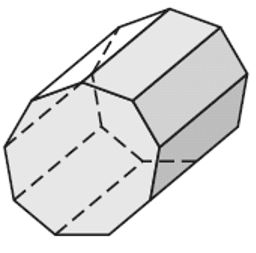
Describe the cross section formed by the intersection of the plane and the solid below.

Describe the cross section formed by the intersection of the plane and the solid below.
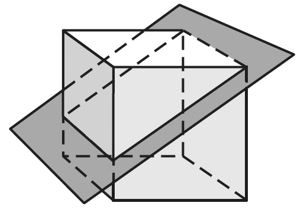
Name the solid that can be formed by the net shown below.
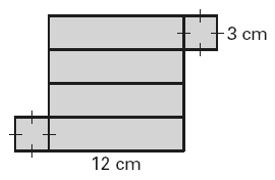
Name the solid that can be formed by the net shown below.
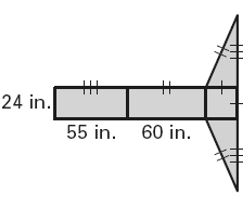
Name the solid that can be formed by the net shown below.
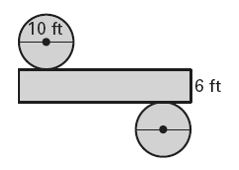
What is the surface area of the solid?
What is the volume of the solid?
What is the surface area of the solid?
What is the volume of the solid?
A right cylinder has a radius of 5 cm and a height of 15 cm.
What is the surface area of the solid?
A right cylinder has a radius of 5 cm and a height of 15 cm.
What is the volume of the solid?
A right cylinder has a radius of 1.1 ft and a height of 3.2 ft.
What is the surface area of the solid?
A right cylinder has a radius of 1.1 ft and a height of 3.2 ft.
What is the volume of the solid?
The surface area of the triangular prism below is 200 square feet. Solve for x.
The surface area of the cylinder below is 1000 square centimeters. Solve for x.
What is the surface area of the solid?
What is the volume of the solid?
What is the surface area of the solid?
What is the volume of the solid?
What is the surface area of the solid?
What is the volume of the solid?
The volume of the rectangular prism below is 1440 meters. Solve for x.
The volume of the cylinder below is:
Solve for x.
What is the surface area of the solid?
What is the volume of the solid?
What is the surface area of the solid?
What is the volume of the solid?
What is the surface area of the solid?
What is the volume of the solid?