Chapter 1 Vocabulary Test B

Last updated over 3 years ago
39 questions
For #1-13, selection the correct term for the defintion given. NOT all terms will be used.
13

Match the terms on the left with their definitions on the right. NOT all terms will be used.

Draggable itemCorresponding Item
Equiangular
The sum of the measure of two angles is 90o
Acute
Points that lie on the same line
Regular
An angle that is between 90o and 180o
Straight
A segment, ray, line, or plane that intersects a segment at its midpoint
Obtuse
This geometric figure requires three points to name it and it extends forever in two dimensions
Collinear
A polygon with all sides and angles congruent
Segment Bisector
Consists of two different rays that have the same initial point
Right
The point that divides the segment into two congruent segments
Angle
The ray that divides an angle into two congruent angles
Angle Bisector
Two angles that share a common vertex and side
Plane
A polygon with all sides congruent
Postulate
The sum of the measure of two angles is 180o
Equilateral
An angle whose measure is exactly 90o
Supplementary Angles

Complementary Angles

Line

Vertical Angles

Adjacent Angles

Point

Midpoint

Use the diagram below for the next 6 questions.
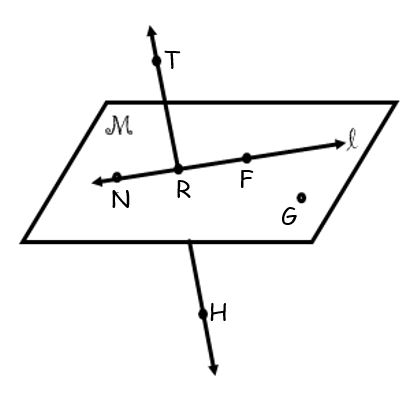
1

Name three collinear points

1

Name a point non-coplanar with Plane M

1

Name a pair of opposite rays. Separate your answers with a comma

1

Name line l another way.

1

Name \overrightarrow{NF} another way.

1

Name Plane M another way.

1

Using the workspace and points provided, sketch the following: \overrightarrow{BE}, \overleftrightarrow{CA}, and \overline{DA}

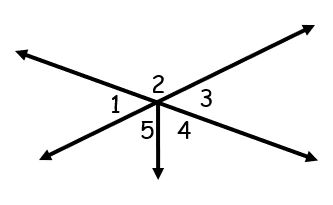
Use the diagram below for the next 3 questions.
1

What angle forms a linear pair with \angle{2}?

1

Name an angle vertical to \angle{1}?

1

Name an angle adjacent to \angle{5}?

For the next 5 questions, answer True or False
1

If 2 angles are complementary, then they are adjacent.

1

If 2 angles are vertical angles, then they are adjacent.

1

If 2 angles are complementary, then they are both acute.

1

If 2 angles are a linear pair, then they are adjacent.

1

If 2 angles are supplementary, then they are both obtuse.

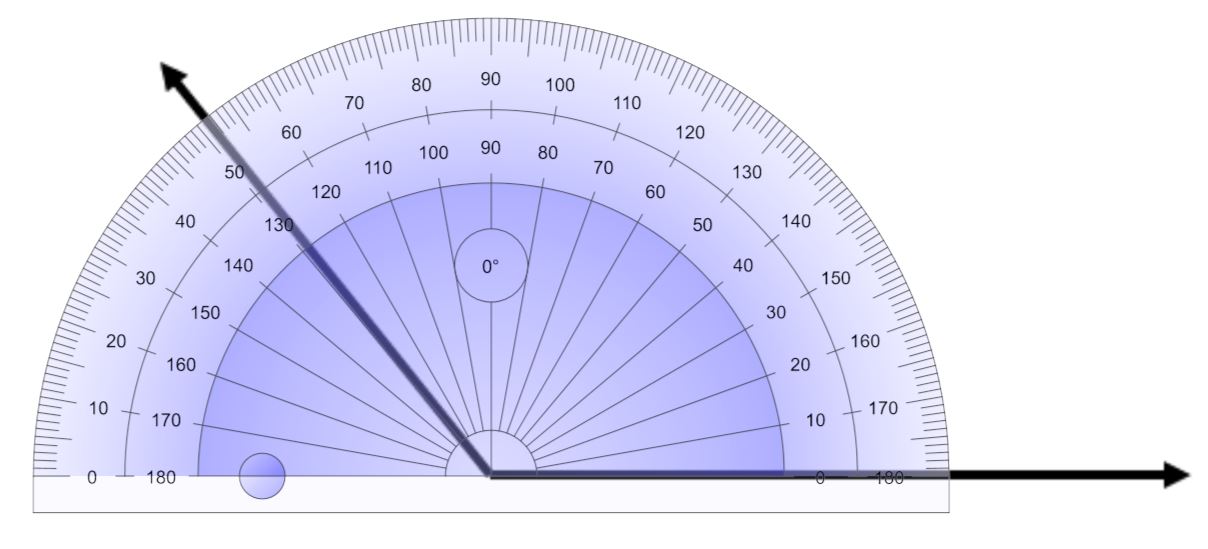
Use the angle below to measure and classify the angle.
1

What is the measure of the angle?

1

Classify the angle.

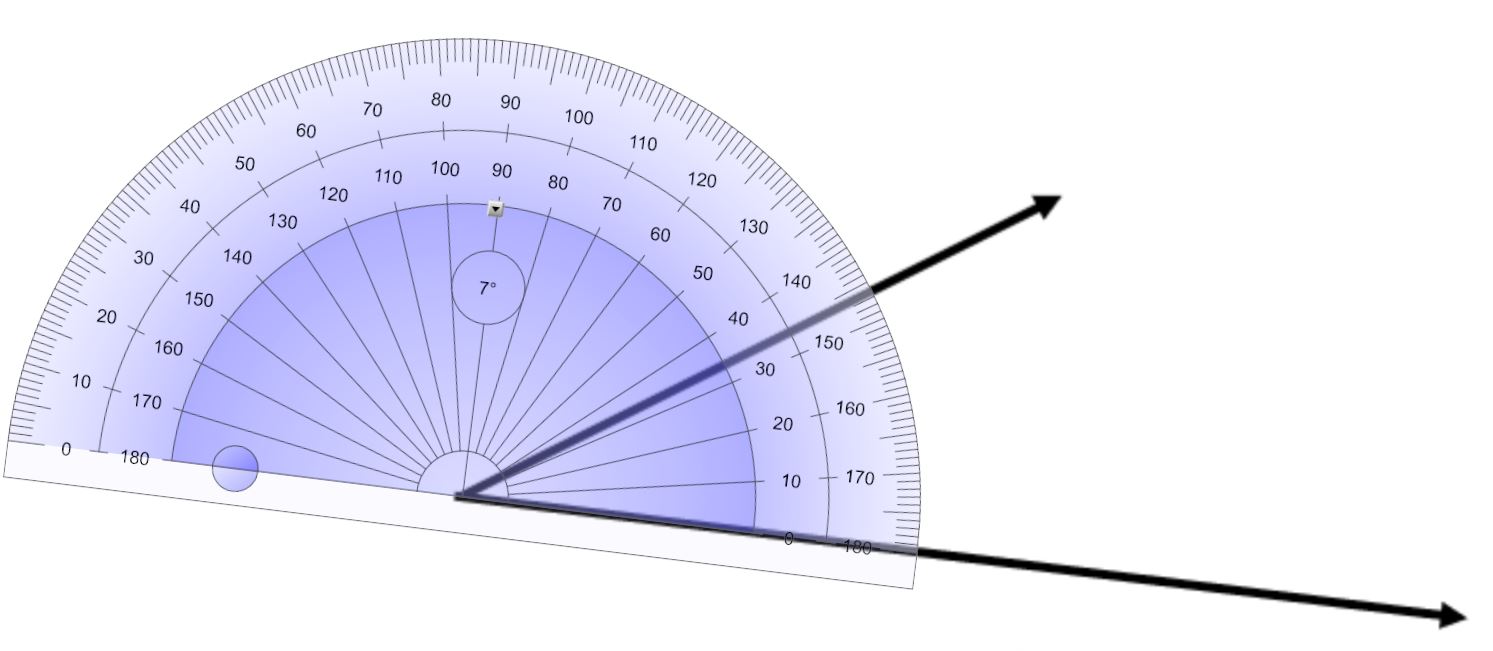
Use the angle below to measure and classify the angle.
1

What is the measure of the angle?

1

Classify the angle.

1

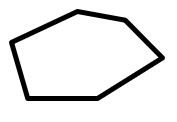
Determine if the figure is a polygon.

1

Determine if the figure is a polygon.

1

Determine if the figure is a polygon.

1

Determine if the figure is a polygon.

1

Name the polygon below, starting with vertex "T".

1

Determine if the following polygon is Convex, Concave, or Not a Polygon.

1

Determine if the following polygon is Convex, Concave, or Not a Polygon.

1

Determine if the following polygon is Convex, Concave, or Not a Polygon.

1

Determine if the following polygon is Convex, Concave, or Not a Polygon.

1

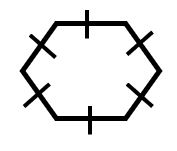
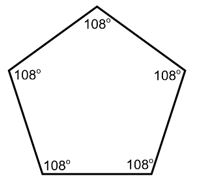
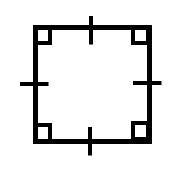
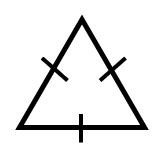
Determine if the following polygon is Equiangular, Equilateral, Regular, or None of the Above.

1

Determine if the following polygon is Equiangular, Equilateral, Regular, or None of the Above.

1

Determine if the following polygon is Equiangular, Equilateral, Regular, or None of the Above.

1

Determine if the following polygon is Equiangular, Equilateral, Regular, or None of the Above.

1

Classify a polygon with 3 sides.

1

Classify a polygon with 5 sides.

1

Classify a polygon with 7 sides.

1

Classify a polygon with 8 sides.

1

Classify a polygon with 10 sides.

1

Classify a polygon with 12 sides.