Imperialism #1

Last updated over 3 years ago
25 questions

Imperialism

  • Imperialism is the expansion of a nation’s authority over other nations through the acquisition of land and/or the imposition of economic and political domination.
  • The Age of Imperialism is typified by the colonization of the Americas between the 15th and 19th centuries, as well as the expansion of the United States, Japan, and the European powers during the late 19th and early 20th century.
  • Throughout history, many indigenous societies and cultures have been destroyed by imperialistic expansion.
Required
1
Imperialism happens when one nation expands its power over __________.
Required
1

What are were the two main parts of the Age of Imperialism? Check two boxes.

Required
1

Imperialism was generally a good thing for indigenous societies and cultures.

Required
1

In which years did U.S., Japan, and Europe all engage in imperialism at the same time?

Imperialism has evolved since the struggles between prehistoric clans for scarce food and resources, but it has retained its bloody roots. Throughout history, many cultures suffered under the domination of their imperialist conquerors, with many indigenous societies being unintentionally or deliberately destroyed.
Required
1

The idea of imperialism didn't exist until the 1400s.

Required
1

What do you think is meant by the phrase "it has retained its bloody roots"?

Required
1

When indigenous cultures were destroyed, it was always accidental (imperialist countries never meant to destroy other cultures).

The modern era would see three periods of vast imperialism and aggressive colonialism. From the 15th century to the middle of the 18th century, England, France, the Netherlands, Portugal, and Spain built empires in the Americas, India, and the East Indies. A strong negative reaction to imperialism led to almost a century of relative calm in empire building. The period from the middle of the 19th century and World War I (1914 to 1918) were again characterized by a rapid spread of imperialism.
Required
1

Check off all of the European countries who built large empires from the 15th to the 18th centuries.

Required
1

Which of the following events ended one of the main imperialist periods?

A broader definition of imperialism is the extension or expansion—usually by the use of military force—of a nation’s authority or rule over territories not currently under its control. This is accomplished through the direct acquisition of land and/or economic and political domination.
Required
1
Countries usually use _______ to expand their power and aggressively take over other countries.
Required
1

Check off the main ways that imperialism occurs.

While the European empires established footholds on the coasts of Africa and China following the first wave of imperialism, their influence over local leaders was limited. Not until the “Age of New Imperialism” had started in the 1870s did the European states begin to establish their vast empires—mainly in Africa, but also in Asia and the Middle East.
Required
1

European empires had small amounts of control in Africa and China after the first wave of imperialism.

Required
1

In what decade did European empires really start to expand their control over Africa, Asia, and the Middle East?

Driven by their need to deal with the over-production and under-consumption economic consequences of the Industrial Revolution, the European nations pursued an aggressive plan of empire building. Instead of merely setting up overseas trading settlements as they had during the 16th and 17th centuries, the new imperialists controlled the local colonial governments for their own benefit.
Required
1
During the Industrial Revolution, European powers experienced both _______ and _______, which led them to seek control over more land and people in other countries.
Required
1

In your own words, explain what "over-production and under-consumption" means.

Required
1
Rather than set up simple overseas __________ settlements, the European powers decided to control the __________ of different places around the world.
The rapid advances in industrial production, technology, and transportation during the “Second Industrial Revolution” between 1870 and 1914 further boosted the economies of the European powers and thus their need for overseas expansion. As typified by the political theory of imperialism, the new imperialists employed policies that stressed their perceived superiority over “backward” nations. Combining the establishment of economic influence and political annexation with overwhelming military force, the European countries—led by the juggernaut British Empire—proceeded to dominate most of Africa and Asia.
Required
1

Which three aspects of the Second Industrial Revolution boosted European economies and their desire to expand overseas?

Required
1

Many imperialists believed that they were superior compared to other "backward nations."

Required
1

Which European country dominated the imperialist movement in the late 1800s?

Required
1

Which two continents were the main targets of European imperialists in the late 1800s?

By 1914, along with its successes in the so-called “Scramble for Africa,” the British Empire controlled the largest number of colonies worldwide, leading to the popular phrase, “The sun never sets on the British Empire.”
Required
1

What do you think is meant by the phrase "the sun never sets on the British Empire"?

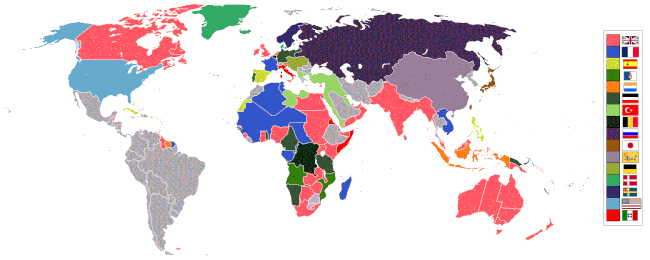
Click on the magnifiying glass icon to make the map larger so that you can answer the questions.
Required
1

Which continent was hardly controlled by any imperialist powers?

Required
1

Which country controlled much of southern Africa, India, and Australia?

Required
1

Which country controlled much of northwestern Africa and Vietnam?

While generally profitable, imperialism, combined with nationalism, began to have negative consequences for European empires, their colonies, and the world. By 1914, an increasing number of conflicts between competing nations would erupt into World War I.
Required
1

Imperialism was one of the reasons why World War I broke out.