01/10 Review of Linear, Quadratic and Exponential Functions
star
star
star
star
star
Last updated over 3 years ago
22 Nsɛmmisa
2
2
2
1
2
2
2
1
1
1
1
1
1
1
1
1
1
1
1
1
2
2
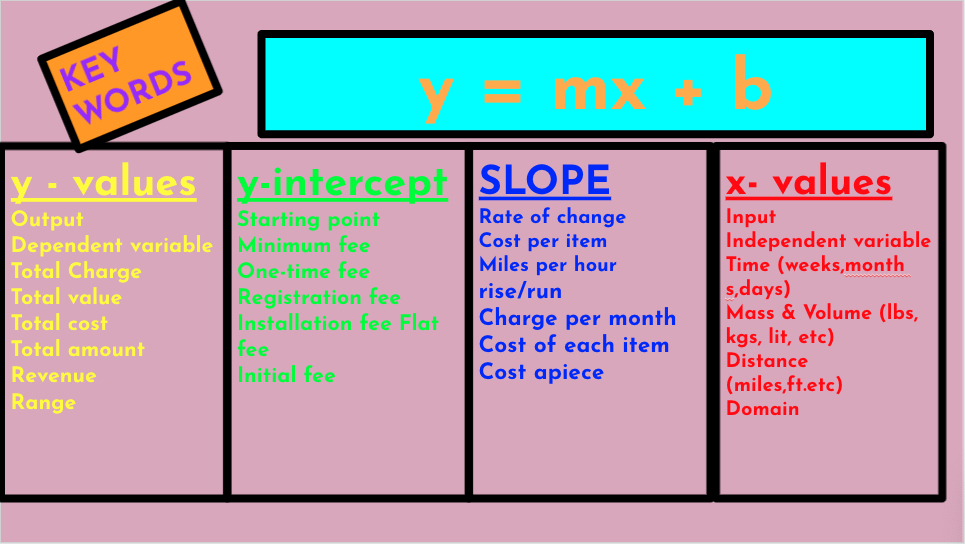
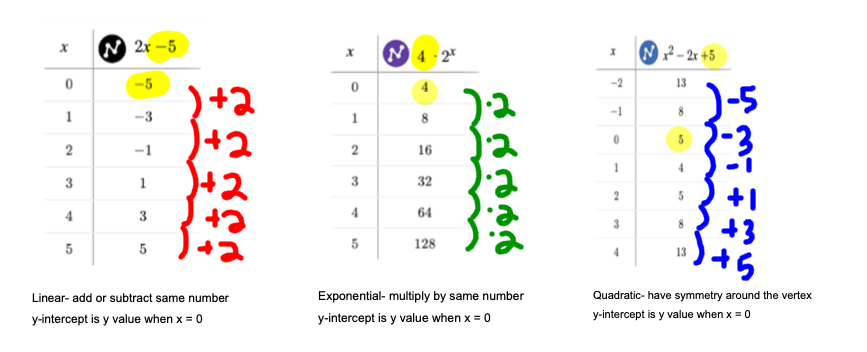
Linear Situations always ADD or SUBTRACT a constant amount each time.
Quadratic Situations always have an x^2 in the equation. Their graphs have a turning point called a vertex. A common application of a quadratic is the height above the ground versus time of an object(projectile) that has been thrown. In a table, the second difference is the same.
Exponential Situations always MULTIPLY by the same amount each time. Common examples of exponential situations include percent increase or decrease (population growth, interest rates, etc.). Other words that will indicate multiplication (and thus exponential situations) are doubling, tripling, quadrupling, and increase by a factor of.
Decide if each situation would be linear or exponential and drag the situation to the appropriate category.
There are 10 pieces of bacteria. After a
cleaner is applied the bacteria is halved each minute
A baseball is thrown from a starting height of 5 feet and with initial velocity 48 ft/sec.
There are 15 people in a room. 5 new
people join each minute
There are 2 friends with a secret. They each tell 3 friends that each tell 3 more and so on
Michael has $2, he makes $3 an hour
A soccer ball is kicked from the ground with an initial velocity 70 ft/sec
Linear Situation
Exponential Situation
Quadratic Situation
Given the following table, identify the following:
1) Is it Linear, Quadratic, or Exponential?
2) What is the Starting Point (the y-intercept)?
3) What is the rate of change (if it's linear) or the rate of change factor (if it's exponential)?
4) Write the equation (if it is linear or exponential)
Given the following table, identify the following:
1) Is it Linear, Quadratic, or Exponential?
2) What is the Starting Point (the y-intercept)?
3) What is the rate of change (if it's linear) or the rate of change factor (if it's exponential)?
4) Write the equation (if it is linear or exponential)
Given the following table, identify the following:
1) Is it Linear, Quadratic, or Exponential?
2) What is the Starting Point (the y-intercept)?
3) What is the rate of change (if it's linear) or the rate of change factor (if it's exponential)?
4) Write the equation (if it is linear or exponential)
Complete the table with the values found from the graph. What is the equation? Check all that apply.
Complete the table with the values found from the graph. What is the equation? Check all that apply.
Complete the table with the values found from the graph. What is the equation? Check all that apply.
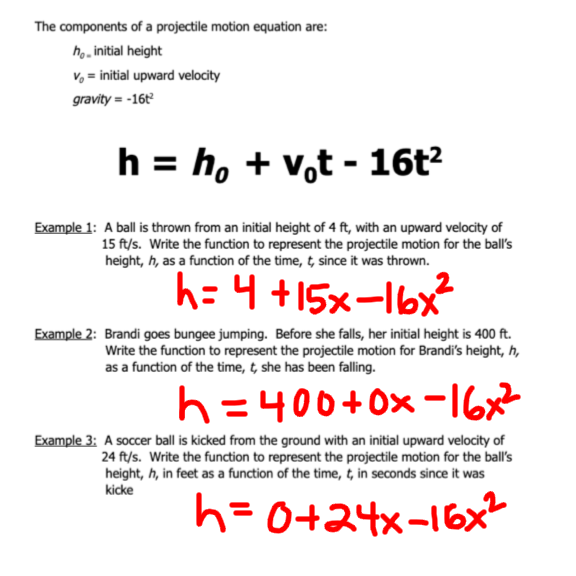
Form the ground, a baseball is thrown up into the air with upward velocity of 68 ft/sec. Write the equation.
A baseball is thrown up into the air with upward velocity of 15 ft/sec. The starting height of the ball was 6 ft. Write the equation.
Linear Situations always ADD or SUBTRACT a constant amount each time.
Exponential Situations always MULTIPLY by the same amount each time. Common examples of exponential situations include percent increase or decrease (population growth, interest rates, etc.). Other words that will indicate multiplication (and thus exponential situations) are doubling, tripling, quadrupling, and increase by a factor of.
A science experiment involves periodically measuring the number of mold cells present on a piece of bread. At the start of the experiment, there are 50 mold cells. Each time a periodic observation is made, the number of mold cells doubles. Write the equation to represent the number of mold cells, y, after each observation, x.
A water tank already contains 55 gallons of water when Baxter begins to fill it. Water flows into the tank at a rate of 8 gallons per minute. Write the equation.
Nicki is studying the growth of a beetle population. She observes that the beetle population triples every month. Nicki begins the project with 5 beetles. Write the equation.
Anthony owns a food truck and drives around town selling pizzas. The equation P = -400 + 6n represents Anthony’s profit, P, as a function of the number of pizzas, n, he sells. What is the y-intercept? What does it represent in the context of this problem?
Anthony owns a food truck and drives around town selling pizzas. The equation P = -400 + 6n represents Anthony’s profit, P, as a function of the number of pizzas, n, he sells. What is the slope? What does it represent in the context of this problem?
Kylie is saving up for a car. The function y = 15x + 200 represents the money she has saved where y is total money saved and x is time in weeks. What is the y-intercept? What does it represent in the context of this problem?
Kylie is saving up for a car. The function y = 15x + 200 represents the money she has saved where y is total money saved and x is time in weeks. What is the slope? What does it represent in the context of this problem?
The freshman class is holding a fundraiser. The equation P = 1/5x - 250 models the class profit, P, based on how many T-shirts, x, they sell. What is the y-intercept? What does it represent in the context of this problem?
The freshman class is holding a fundraiser. The equation P = 1/5x - 250 models the class profit, P, based on how many T-shirts, x, they sell. What is the slope? What does it represent in the context of this problem?
The slope of this line is
The equation for this line is
(don't type any spaces in your answers)
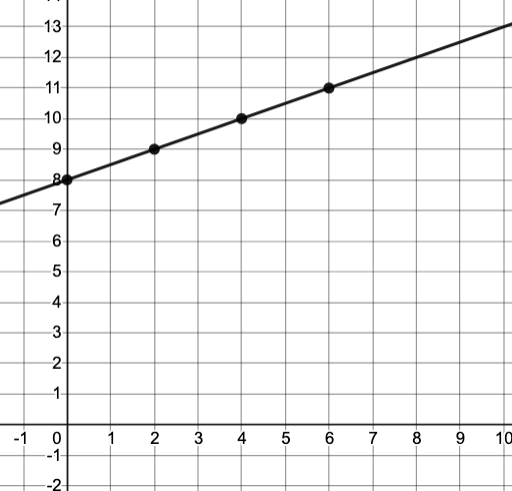
Select all of the stories that could match the graph.
The slope of this line is
The equation for this line is
(don't type any spaces in your answers)
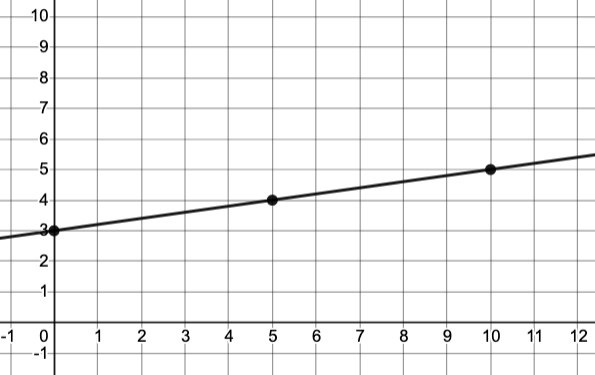
Complete the table and create a story for the following graph.