Log in
Sign up for FREE
arrow_back
Library

Circuits and Electromagnets Quiz

star
star
star
star
star
Last updated about 3 years ago
8 questions
Required
5
Required
6
Required
2
Required
1
Required
1
Required
2
Required
2
Required
1
Question 1
1.

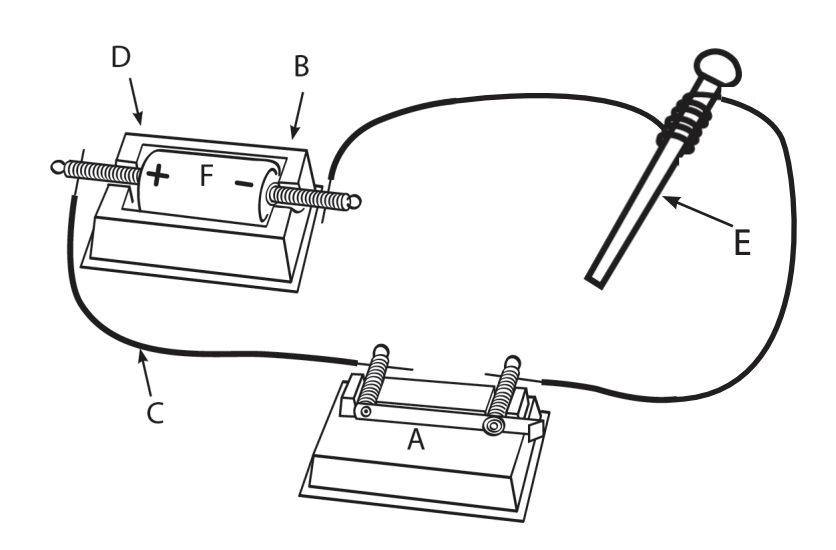
Draw the Direction that Electricity flows in this Circuit.

Explain in 1-2 sentences why Electricity flows in that direction. You must use the vocab terms Electron, Charge, Attract, and Repel in your answer at least once.

Question 2
2.
Drag the statements to each point within the drawing
Other Answer Choices:
Pathway to carry the electrons
Starting point for electrons to flow
Control flow of Electrons turning on/off
Has potential energy to run the circuit
Becomes a temporary magnet
End point where Electrons want to move
Question 3
3.

Question 4
4.

Question 5
5.

Question 6
6.

Question 7
7.

Question 8
8.

Select ALL Answers that apply.
We know that electricity flows through components because of some evidence. Which of the following provide evidence that electricity is flowing?
A component gets hot.
A motor in a circuit is not moving.
The switch is closed.
A lightbulb shines.
Select ALL the circuits where the Lightbulb WILL light up.
What is the power source for the circuits we built in our classroom?
The Bulb Casing
The D-Cell (Battery)
The Bulb Filament
The Wire
SELECT ALL ANSWERS THAT APPLY
Select each statement that describes where ELECTRONS flow in an Electromagnet.
Electrons flow THROUGH the rivet (core).
Electrons flow THROUGH the switch when it is closed.
Electrons flow THROUGH the wire wrapped around the core.
Electrons flow THROUGH the plastic insulation on the wire.
Which of the following is True for a Closed Circuit? (Select ALL that apply)
Electricity flows through it.
It is a complete loop.
It is NOT a complete loop.
Electricity does NOT flow through it.
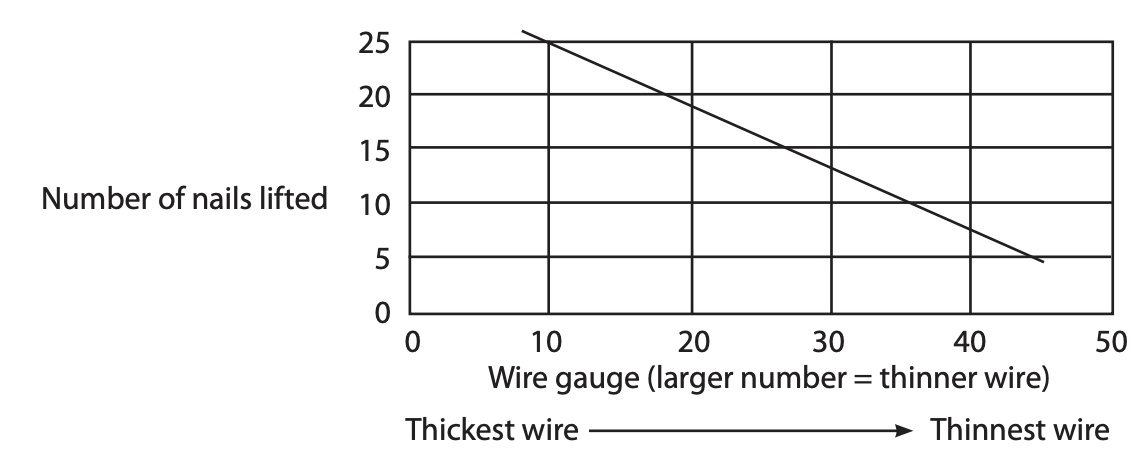
This Graph shows the results of an investigation with an electromagnet.
The thinner the wire, the more nails lifted.
The gauge (Thickness) of the wire does not affect how many nails can be picked up.
The thicker the wire, the fewer (less) nails lifted.
The thinner the wire, the fewer (less) nails lifted.