The following data about a metal was collected in the lab. What is its density?
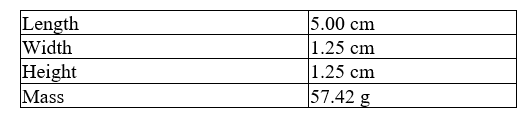
The following data about a metal was collected in the lab. What is its density?
If the temperature of a sample of gas is increased while maintaining constant pressure what happens to the volume?
If the temperature of a gas is kept constant, the pressure and volume of the gas are
Which of the following defines standard temperature?
Which of the following defines standard pressure?
Raising the temperature of a gas in a fixed volume container will most likely change the
The particles in a solid are
When the temperature decreases during a chemical reaction this described as a(n)________ reaction.
According to the kinetic-molecular theory, particles of matter are in constant motion in
Which set of characteristics correctly describes an ionic compound?
The origin of the word acid relates to how acids tend to taste, which is best described as
A smooth, slippery feel is associated with
What is the correct name of the acid HNO3?
The correct name of the acid HBr is
The pH of a basic solution is
Which of the following substances will NOT dissolve in water?
How does a covalent bond differ from an ionic bond?
Write out and balance the following chemical equation:
zinc reacts with iron (III) chloride yielding zinc chloride and iron
What is the name of the compound whose formula is (NH4)3PO4?
What is the name of the compound whose formula is FeSO4?
What is the name of the molecular substance PCl5?
In a reaction in which hydrogen reacts with oxygen to produce water, which substances are the reactants?
What is the molar mass of water?
How many total atoms are there in this expression 3Al2(SO4)3?
Which of the following is an empirical formula?
What is the formula (molar) mass of Ca(NO3)2?
The symbol (s) written after a formula in a chemical equation stands for
Two white powders are mixed in a flask. The bottom of the flask feels warmer. This is an example of what kind of reaction?
What number is represented by “∆” to balance the equation: ∆Na + MgCl2 → NaCl + Mg ?
What will happen if a lead metal strip is placed into a solution of zinc nitrate? (hint: write out the equation first; what kind of reaction is it?)
Which of the following normally exists as a diatomic molecule?
What mass of phosphorous would be needed to produce 3.25 mol of P4O10 in the following reaction?
4 P (s) + 5 O2 (g) → P4O10 (s)
How many grams of oxygen are required to react completely with 0.38 grams of hydrogen to form water? __O2 + __H2 -> __H2O (hint: make sure it’s balanced!)
How many valence electrons does an element with an electron configuration of 1s22s22p63s23p5 have?
An atom will bond with another atom if both atoms have
In the reaction N2 + 3H2 → 2NH3, what is the mole ratio of nitrogen to ammonia?
The Haber process for producing ammonia commercially is represented by the equation:
N2 (g) + 3H2 (g) → 2NH3 (g)
To completely convert 9.0 mol hydrogen gas to NH3 gas, how many moles of nitrogen gas are required?
For the reaction 2Na + 2H2O → 2NaOH + H2, how many grams of sodium hydroxide are produced from 3.0 mol of water?
Valence electrons are those
The number of valence electrons that Group 15 elements have is
How many electrons does an atom of Magnesium that has a +2 charge have?
Name the compound N2O4.
How many neutrons does an average atom of Uranium have?
Which subatomic particle determines the identity of the atom?
What element has this noble gas electron configuration [Xe]6s2?
Elements in a group in the periodic table can be expected to have similar
What is the common charge for Nitrogen?
How many valence electrons does Chlorine have?
The molar mass of NH3 is 17.04 g/mol. How many moles of NH3 are present in 107.1 g?
What are the products of a combustion reaction?
Approved eye protection devices (such as goggles) are worn in the laboratory
Which of the following elements is a metalloid?
A sample of hydrogen gas had a volume of 455 L at 20°C and 755 mmHg. What would be its volume at 100°C and 565 mmHg?
Formula: P1V1 = P2V2
T1 T2
The pressure of a 250 mL sample of gas is 105 kPa. What would be the pressure if the volume was increased to 375 mL?
Formula: P1V1 = P2V2
T1 T2
What family does Bromine belong to?
What type of compound requires a roman numeral in its name?
A compound contains 32.38% sodium, 22.65% sulfur, and 44.99% oxygen. What is the empirical formula of the compound?
The molar mass of a carbon, hydrogen, and oxygen compound is 180 g/mol. If the empirical formula is CH2O, what is its molecular formula?
What is the percentage of calcium in calcium phosphide?
Which element is the only nonmetal located on the “metal side” of the periodic table?
The following data about a metal was collected in the lab. What is its density?
What type of reaction is this?
Ba(OH)2 → BaO + H2O
What type of reaction is this?
2Mg (s) + O2 (g) → 2MgO(s)
What type of reaction is this?
C3H8 + 5O2 → 3CO2 + 4H2O
What type of reaction is this?
Cl2 (g) + 2 KBr (aq) → 2KCl (aq) + Br2 (l)
What type of reaction is this?
Na2O + 2AgNO3 → 2NaNO3 + Ag2O