Log in
Sign up for FREE
arrow_back
Library
3J Bearington's Mistakes
By Jill Hand - VUSD Browns Valley
star
star
star
star
star
Share
share
Last updated about 1 month ago
8 questions
Add this activity
Look at Bearington's mistakes. Help him find out what he did wrong and fix his mistakes.
zoom_in
1
6.NS.1
1
Question 2
2.
6.NS.1
zoom_in
1
Question 3
3.
Bearington is trying to find his mistake. Mark all that apply.
Bearington forgot to flip the second fraction before multiplying.
Bearington should have used partial products.
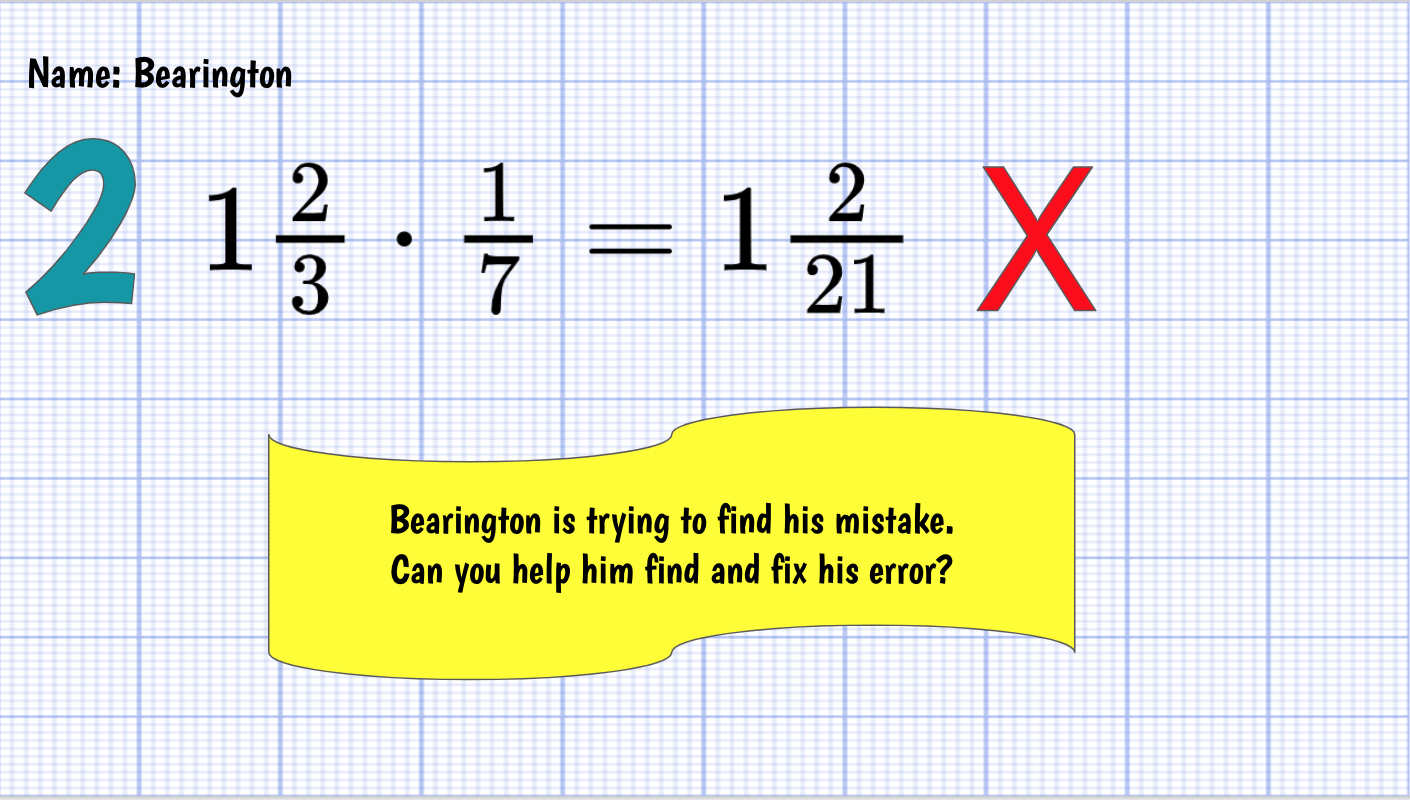
Bearington should have multipled 1/7 by both parts of the mixed number.
1
Question 4
4.
zoom_in
1
1
Question 6
6.
zoom_in
1
Question 7
7.
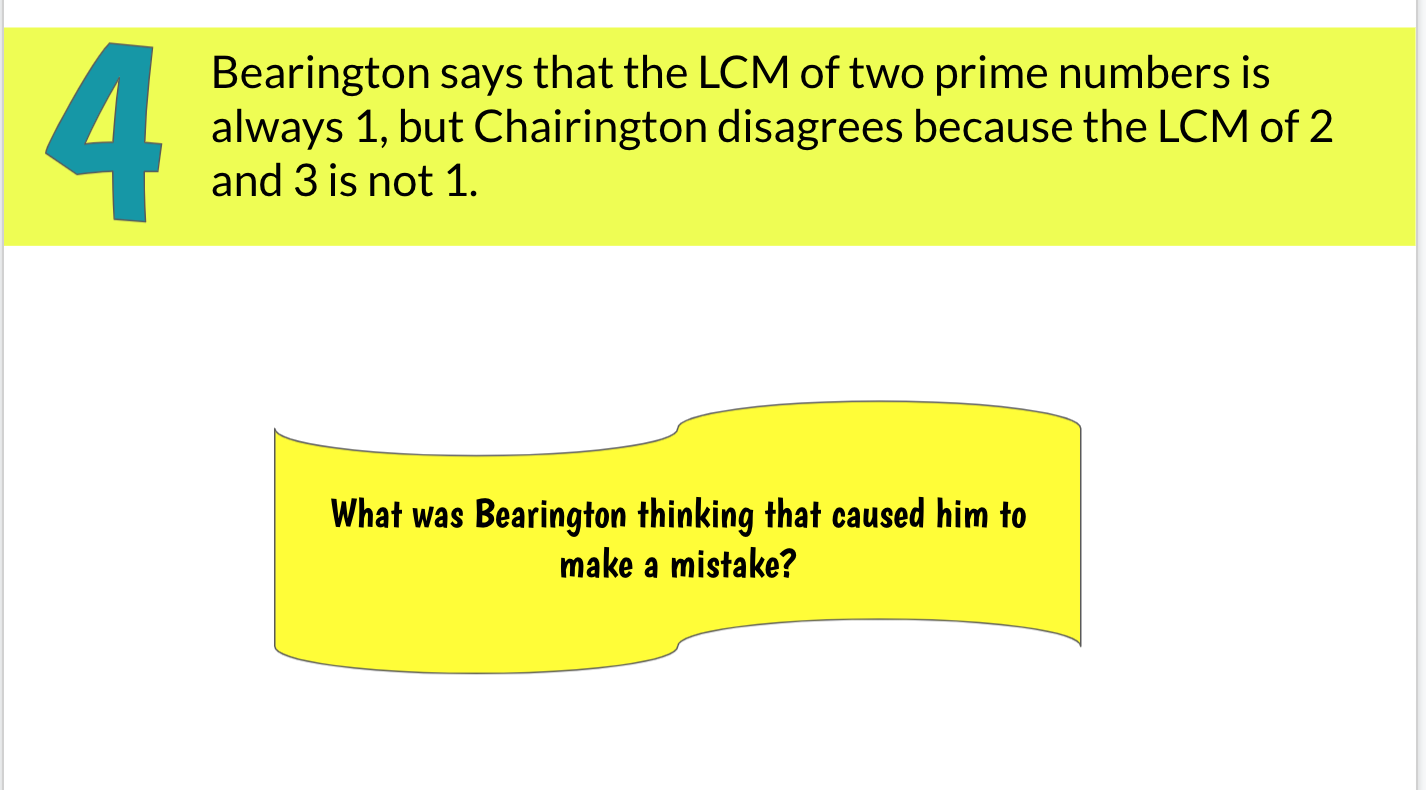
Analyze Bearington's mistake. Mark all that apply.
Bearington is mixing up prime numbers with factors.
Bearington meant to say that the GCF of two prime numbers is always 1.
Bearington forgot that multiples go up and factors go down.
Bearington thought that you find LCM by listing the multiples of each number.
zoom_in
1
Question 8
8.
What mistakes did Bearington make? Mark all that apply.
Bearington used 3 as the GCF. Since 3x20 =60 and 3x30=90, we should take 3 and multiply it by the sum of 20 + 30.
Bearington should have used 30 as the GCF. If he had, he would have multiplied 30(2 +3)
Bearington should have used 10 as the GCF. If he had, he would have multiplied 10(6+9)
Bearington did not make a mistake.
Question 1
1.
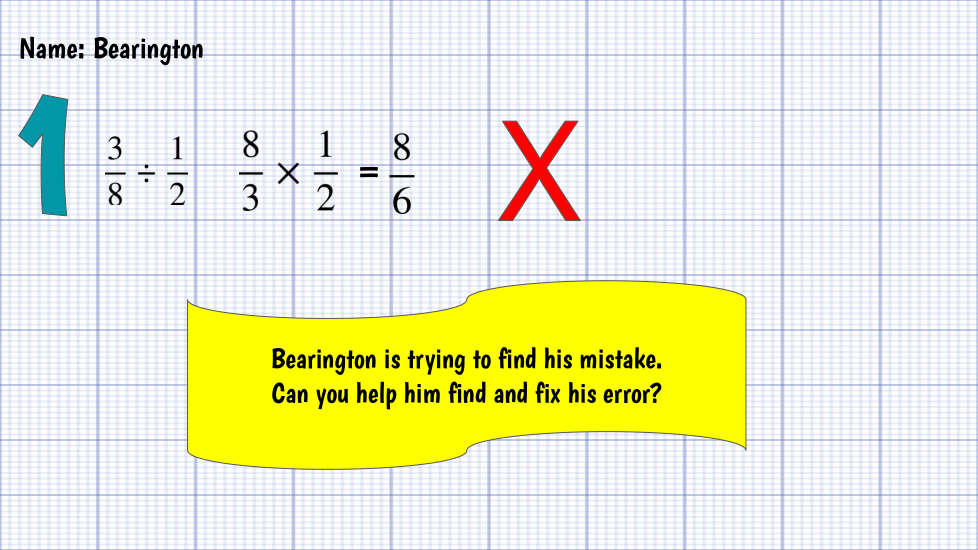
Bearington is trying to find his mistake. Mark all that apply.
Bearington used the inverse operation of division and changed it to multiplication when he used the reciprical method.
Bearington flipped the first fraction and multiplied straight across.
Bearington skipped the second fraction before he multiplied straight across.
Bearington did not make a mistake.
Question 5
5.
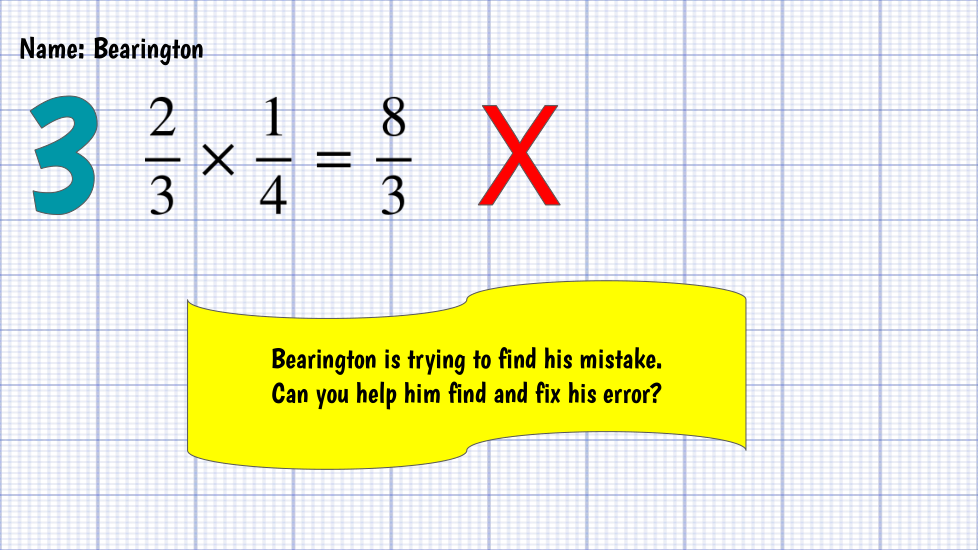
Bearington is trying to find his mistake. Mark all that apply.
Bearington multiplied straight across to get
Bearington multiplied the numerator of the first fraction with the denominator of the second fraction. He multiplied the denominator of the first fraction with the numerator of the second fraction.
Bearington should have simplified to get
Bearington should have multiplied straight across.
Bearington did not make any mistake.