This Week 3: Thermal Energy lesson has a couple short videos and about 16 questions. There is an optional experiment at the end you can do with an adult's permission and supervision.
Be sure to attempt all the questions and submit when you are finished. Please contact me through the comment feature or send an email to rshaw@fergflor if you have any questions.
Question 1
1.
Question 2
2.
Question 3
3.
What is thermal equilibrium?
Question 4
4.
Question 5
5.
When an object gains heat energy, do the particles inside the object move faster or slower?
Question 6
6.
Question 7
7.
Question 8
8.
Question 9
9.
Question 10
10.
Question 11
11.
Question 12
12.
Question 13
13.
Question 14
02:54
keyboard_arrow_down
Required
1
Question 15
01:45
keyboard_arrow_down
1
Question 15
15.
What is happening to the atoms inside the balloon when the balloon is placed in the freezer?
Question 17
17.
Question 18
18.
How long did this lesson take you to complete today?
What is the total energy of all the particles in an object called?
chemical energy
thermal energy
potential energy
nuclear energy
When the kinetic energy of the particles in an object increases, the temperature-
increases
remains the same
is fixed at 90 degrees Celsius.
decreases
What is styrofoam?
Styrofoam cups pictured here.
conductor
insulator
Rank the following by Thermal Energy
1. Highest Thermal Energy
6. Lowest Thermal Energy
mouse (real living creature)
popscile
hot engine of a motorbike
hot coffee
ice water
Human
Define : transfer
tiny organisms that are made of a single cell
when something becomes different over time
a “balanced state” in which a system is stable, such as when two or more samples are at the same temperature
water that is underground
to make something safe to eat or drink by heating it
a small part that is meant to show what the whole is like
when something stays mostly the same over time
measure of the average speed of the particles in an item
the total kinetic energy of all the particles that make up a sample
to move from one object to another or one place to another
a heating unit that stores and warms water
Define : thermal energy
tiny organisms that are made of a single cell
when something becomes different over time
a “balanced state” in which a system is stable, such as when two or more samples are at the same temperature
water that is underground
to make something safe to eat or drink by heating it
a small part that is meant to show what the whole is like
when something stays mostly the same over time
measure of the average speed of the particles in an item
the total kinetic energy of all the particles that make up a sample
to move from one object to another or one place to another
a heating unit that stores and warms water
Define : temperature
tiny organisms that are made of a single cell
when something becomes different over time
a “balanced state” in which a system is stable, such as when two or more samples are at the same temperature
water that is underground
to make something safe to eat or drink by heating it
a small part that is meant to show what the whole is like
when something stays mostly the same over time
measure of the average speed of the particles in an item
the total kinetic energy of all the particles that make up a sample
to move from one object to another or one place to another
a heating unit that stores and warms water
Define : equilibrium
tiny organisms that are made of a single cell
when something becomes different over time
a “balanced state” in which a system is stable, such as when two or more samples are at the same temperature
water that is underground
to make something safe to eat or drink by heating it
a small part that is meant to show what the whole is like
when something stays mostly the same over time
measure of the average speed of the particles in an item
the total kinetic energy of all the particles that make up a sample
to move from one object to another or one place to another
a heating unit that stores and warms water
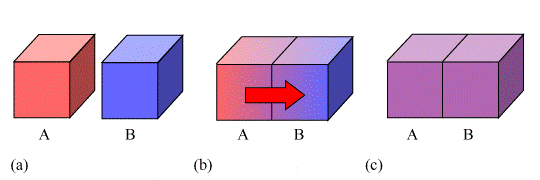
In part (a), describe the process of heat flow.
Both objects have a difference in thermal mass.
Both objects have a difference in kinetic energy.
Both objects have a difference in temperature.
In part (b), describe the process of heat flow.
Heat is being transferred from the cold object to the hot object.
Thermal energy is being transferred from the cold object to the warm object.
Thermal energy is being transferred from the hot object to the warm object.
Thermal energy is being transferred from the hot object to the cold object.
In part (c) above, describe the process of heat flow.
Heat flows slowly from one object to the other. Equilibrium has been reached.
Heat flows from the warm object to the hot object. Equilibrium has been reached.
Heat is quickly flowing from one object to the other. Equilibrium has been reached.
Heat has stopped flowing between the objects. Equilibrium has been reached.
Question 14
14.
What kind of device do you use to complete the review lessons? Select all that apply
Phone
Computer/Laptop
Tablet
Other
What is happening to the atoms of air as they heat up?
The atoms move around faster and move farther apart
The atoms move around slower and move closer together