Ɛhia
1
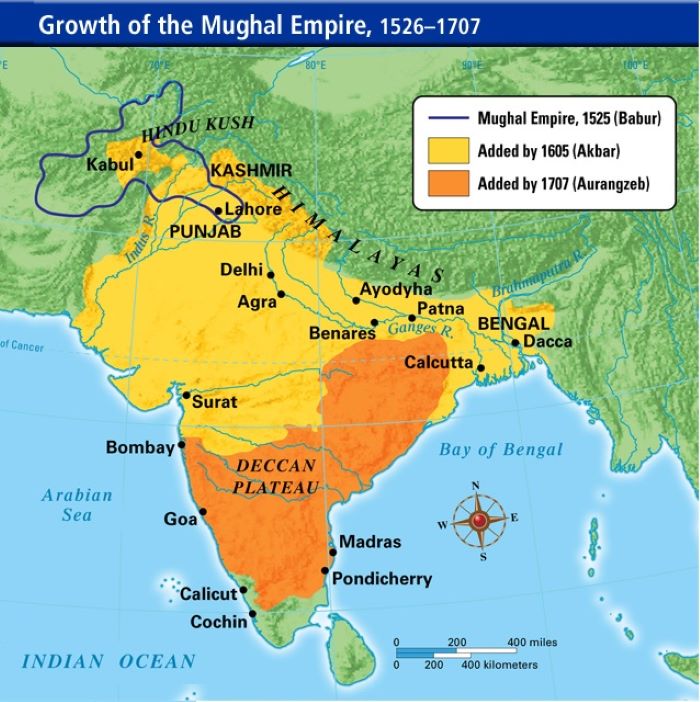
Which city was part of the original Mughal Empire established by Babur?
Which city was part of the original Mughal Empire established by Babur?
1
Read about The Mughal Empire, just ONE EXAMPLE of a historical empire, and answer the questions that follow.
Source: https://www.khanacademy.org/humanities/whp-1750/xcabef9ed3fc7da7b:unit-1-the-world-in-1750/xcabef9ed3fc7da7b:1-3-expanding-to-a-global-scale/a/read-mughal-empire-beta
By the fifteenth century, Indians had taken advantage of growing global markets to expand textile production and distribution. And trade was really spiced up by the nutmeg, mace, cloves, cardamom and cinnamon coming out of Indonesia's "spice islands". Other than black pepper, India didn't grow many spices of its own, but it was the world's trans-shipment center for spices. Columbus had sailed on behalf of the King and Queen of Spain in 1492 to get easier access to that flavorful wealth. By 1750, almost every household in London and Lisbon had a pepper pot!
Which city was part of the original Mughal Empire established by Babur?
The Mughals were a Muslim dynasty who ruled over a majority Hindu population. By 1750, they had dominated much of South Asia for several centuries. Muslims were already living in India when the Mughals first arrived. During Mughal rule, Muslims averaged only about 15 percent of the population. For most of their era of dominance, however, Mughal rule was generally tolerant of all of the religions of the region. That policy created enough social stability to ensure healthy business, investment, and trade.
The Mughal Empire was a
For most of its history, the Mughal Empire was generally toward the other religions in their empire.
The Mughals had built their empire by making good use of India's resources, developing its production capacity, and supporting a very rich Muslim-dominated trade system in the Indian Ocean. India was at the center of a global market for goods in which Muslims, from many backgrounds and regions, were the principal dealers. Muslims across the Indian Ocean benefitted by having a common language (Arabic), a common set of ethical codes, and a shared tradition of commercial practices.
The Mughals grew powerful by making good use of India's
The Mughals became extremely wealthy because they were the center of the global market for goods.
South Asia had an important place in this system. While most of the population farmed foods such as rice, Mughal India had a thriving manufacturing industry, producing a massive quantity of hand-loom textiles for the Indian Ocean economy. The trade in cotton and silk fabrics had brought great wealth to India as early as the fifth century BCE (during the Roman Empire). High demand for these items had attracted traders from as far as China in the East and Persia in the West. Yet this wealth made the region a target for competitive rivals.
Which industry helped the Mughals become very rich?
One of the main reasons why Columbus sailed in 1492 was to get access to
The Mughal state was established by the Sultan Babur in the sixteenth century, with his legendary victory over the Lodhi Sultan in 1526. Babur used 20 cannons to defeat an army twice the size of his own. But he died two years later, so it wasn't really Babur's leadership that sustained his dynasty. That success belonged to his grandson, who managed to expand Mughal territories and establish a highly efficient governance structure. Extensive commercial activity, both in trade and textile production, created great wealth. By the early seventeenth century, Mughals governed one of the world's most populous and affluent empires in world history.
How did Babur establish the Mughal Empire?
This wealth was ensured by a wide-spread, efficient government. The Mughal rulers established a complex bureaucracy. Both Hindu rajas and Muslim sultans could become officers of the state, called mansabdars, when the emperors awarded them land grants. These military and civil leaders maintained cavalry (armed horsemen) ready for battle, and they collected taxes on behalf of the empire. In return, they got land rights, payment, and status.
Because the Mughals were Muslim, they only allowed other Muslims to become mansabdars (government officials).
The northern part of India was added to the Mughal Empire before the southern part of India.
On what continent could you find the Mughal Empire?
The Mughals were the Muslim leaders of the empire. What percentage of the empire's population was also Muslim?
Why did other Muslims (outside the Mughal Empire) benefit from the Mughal Empire?
The Mughals' wealth made it a target for other empires and nations that wanted to become more rich and powerful.
What were the two main jobs of the mansabdars (government officials)?