☀️ D3 (MUST-DO): Historical Dilemma - Is Cultural Imperialism Bad?
star
star
star
star
star
Last updated almost 4 years ago
13 Nsɛmmisa
Ɛhia
1
Before you read, check off all of the following that are normally considered elements of "culture."
Cultural imperialism was around long before the United States became a world power. In its broadest strokes, imperialism describes the ways that one nation asserts its power over another. Just as imperial Britain economically ruled the American colonists, so did Britain strongly influence the culture of the colonies.
Cultural imperialism occurs when one nation asserts its power over the
Today, cultural imperialism tends to describe the United States’ role as a cultural superpower throughout the world. American movie studios are generally much more successful than their foreign counterparts not only because of their business models but also because the concept of Hollywood has become one of the modern worldwide movie business’s defining traits.
Multinational, nongovernmental corporations can now drive global culture. This is neither entirely good nor entirely bad. On one hand, foreign cultural institutions can adopt successful American business models, and corporations are largely willing to do whatever makes them the most money in a particular market—whether that means giving local people a shot at making movies, or making multicultural films such as 2008’s Slumdog Millionaire. However, cultural imperialism has potential negative effects as well. From a spread of Western ideals of beauty to the possible decline of local cultures around the world, cultural imperialism can have a quick and devastating effect.
Today, the U.S. is often seen as the world's "cultural superpower."
Italian philosopher and critic Gramsci originated the idea of cultural hegemony to describe the power of one group over another...Gramsci argued that culture and the media exert such a powerful influence on society that they can actually influence workers to buy into a system that is not economically advantageous to them. This argument that media can influence culture and politics is typified in the notion of the American Dream. In this rags-to-riches tale, hard work and talent can lead to a successful life no matter where one starts. Of course, there is some truth to this, but it is by far the exception rather than the rule.
The term "cultural hegemony" is used when
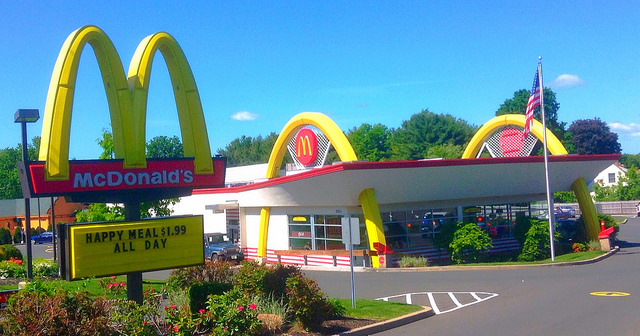
A key danger of cultural imperialism is the possibility that American tastes will crowd out local cultures around the globe. The McDonaldization of the globe applies not just to its namesake, McDonald’s, with its franchises in seemingly every country, but to any industry that applies the technique of McDonald’s on a large scale. Coined by George Ritzer in his book The McDonaldization of Society (1993), the concept is rooted in the process of rationalization. With McDonaldization, four aspects of the business are taken to the extreme: efficiency, calculability, predictability, and control. These four things are four of the main aspects of free markets. Applying the concepts of an optimized financial market to cultural and human items such as food, McDonaldization enforces general standards and consistency throughout a global industry.
One problem with cultural imperialism is the idea that American culture may ruin local cultures around the world.
Unsurprisingly, McDonald’s is the prime example of this concept. Although the fast-food restaurant is somewhat different in every country—for example, Indian restaurants offer a pork-free, beef-free menu to accommodate regional religious practices—the same fundamental principles apply in a culturally specific way. The branding of the company is the same wherever it is; the “I’m lovin’ it” slogan is inescapable, and the Golden Arches are, according to Eric Schlosser in Fast Food Nation, “more widely recognized than the Christian cross (Schlosser, 2001).” Yet, more importantly, the business model of McDonald’s stays relatively the same from country to country. Although culturally specific variations exist, any McDonald’s in a particular area has basically the same menu as any other. In other words, wherever a consumer is likely to travel within a reasonable range, the menu options and the resulting product remain consistent.
The McDonald's menu is the exact same in every country.
Some local cultures around the world have taken to Western-style business models so greatly that they have created their own hybrid cultures. One well-known example of this is India’s Bollywood film industry. Combining traditional Indian music and dance with American-style filmmaking, Bollywood studios release around 700 major films each year, three times the rate of the major Hollywood studios. India’s largest film industry mixes melodrama with musical interludes, lip-synced by actors but sung by pop stars. These pop songs are disseminated well before a movie’s release, both to build up hype and to enter multiple media markets. Although similar marketing tactics have been employed in the United States, Bollywood seems to have mastered the art of cross-media integration. The music and dance numbers are essentially cinematic forms of music videos, both promoting the soundtrack and adding variety to the film.
Explain how Bollywood is a muxture of both American and local culture.
What evidence does the author use to support the idea that the U.S. is a cultural superpower.
Cultural imperialism is always bad.
Cultural imperialism is always good.
According to this philosopher, both
Do you agree that culture and the media can get people to act in a certain way? Give one example to support your response.
After reading about "McDonaldization" of society, why do you think some people think it is a bad thing for the world?