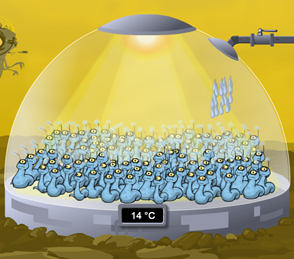
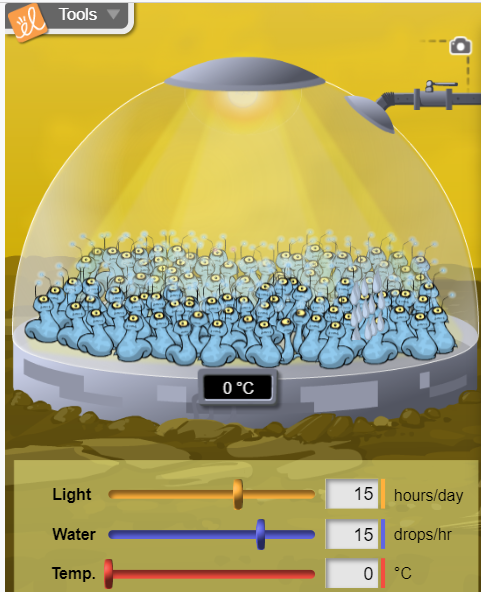
Imagine a new alien life form that has just been discovered on a nearby planet. Your job is to study this new life form. The Effect of Environment on New Life Form Gizmo shows 100 individuals that have been transported from the planet to your laboratory.
It is your job to discover how three environmental factors affect the aliens: light, water, and temperature.
Look at the data in the Gizmos Status box as soon as you open the Gizmos. How many of each body shape are present?
Number of thin:
Number of medium:
Number of thick:
DO NOT CHANGE ANY SETTINGS. (If you change the settings, you must close and reopen the Gizmos.)
Change the way information is presented on the alien life forms from DESCRIPTION to BAR CHART. Click the box SHOW NUMERICAL VALUES to see the exact number of each body shape. The number of each body shape is the number on the top of the bar. You can use either the bar chart tab or the description tab to collect data on the number of alien life forms.
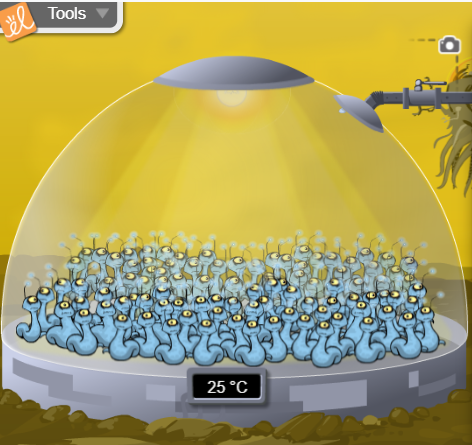
1. Look at the sliders under the picture of the alien habitat. What are the settings for the environmental conditions?
Light:
Water:
Temperature:
2. To change environmental conditions, move the sliders. Let's see what happens when setting the environmental conditions to the following:
Light = 15 hours/day.
Water = 13 drops/hour
Temperature = 19 °C
Click the PLAY button and watch the bar chart to see what happens to the number of each body type.
How do the number of each type of alien form change? What are the new numbers for each type?
Number of Thin -
Number of Medium -
Number of Thick -

A variable is something that can be changed in an experiment. Look at the SIMULATION pane. What are the three variables you can change in your laboratory?
Observations - the beginning of curiosity.
Before a scientist designs an experiment, they need to make a LOT of observations. First, you will change the environmental conditions of the aliens living environment and then observe the impact on the aliens.
Change the conditions to:
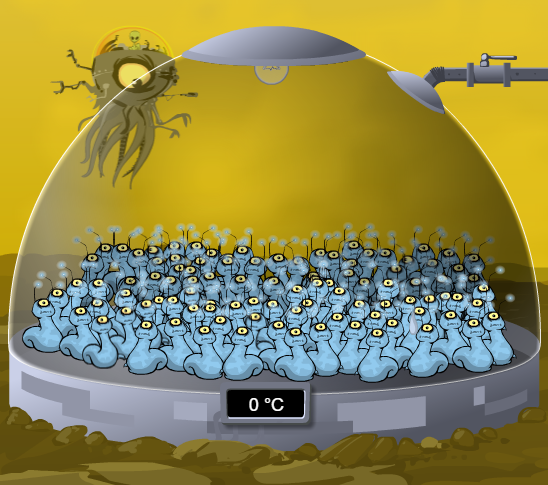
Light = 0 hours/day
Water = 1 drop/hr
Temp. = 0 °C
Click Play, and observe the aliens until the numbers are stable
Click Pause
How many of each type of alien body shape are there now?
Thin =
Medium =
Thick =
Click RESET
Change the conditions again and watch what happens.
Change the conditions to:
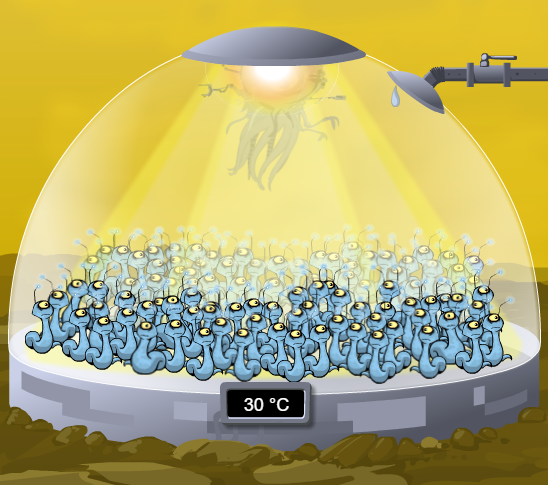
Light = 24 hours/day
Water = 20 drop/hr
Temp. = 30 °C
Click Play, and observe the aliens until the numbers are stable
Click Pause
How many of each type of alien body shape are there now?
Thin =
Medium =
Thick =
When all the sliders are set to the lowest numbers, which body type has the smallest number?
When all the sliders are set to the lowest numbers, which body type has the highest number?
When all the sliders are set to the highest numbers, which body type has the highest number?
When all the sliders are set to the highest numbers, which body type has the lowest number?
You changed all the variables at the same time. Which environmental variable caused the change in life form type?
Form a hypothesis: A hypothesis is a proposed explanation for an observation. Hypotheses must be testable. You decide to test the effect of temperature on the shape of the alien life forms.
Which statement below is a hypothesis that tests the effect of temperature on the shape of the alien life form?
Design an experiment: A controlled experiment is one in which only one variable is changed at a time. What would your experiment's set-up look like if you tested the effect of temperature on the shape of the light forms?
NOTE: Look at your notes if you need help.
The controlled variables in my experiment are and .
I am testing the effect of on the alien body shape.
The variable I am testing is my variable.
The variable I am measuring is the .
I am counting the of each type of life form as I change the .
Go to Google Classroom and open the spreadsheet. Record your observations in the spreadsheet. We will start by setting the controlled variables of light and water. Set the amount of light to 15 hours/day and the amount of water to 15 drops/hour.
Our independent variable is temperature.
Our dependent variable is the number of each life form shape at various temperatures.
Record the amount of each alien body type at 5-degree intervals in the data table.
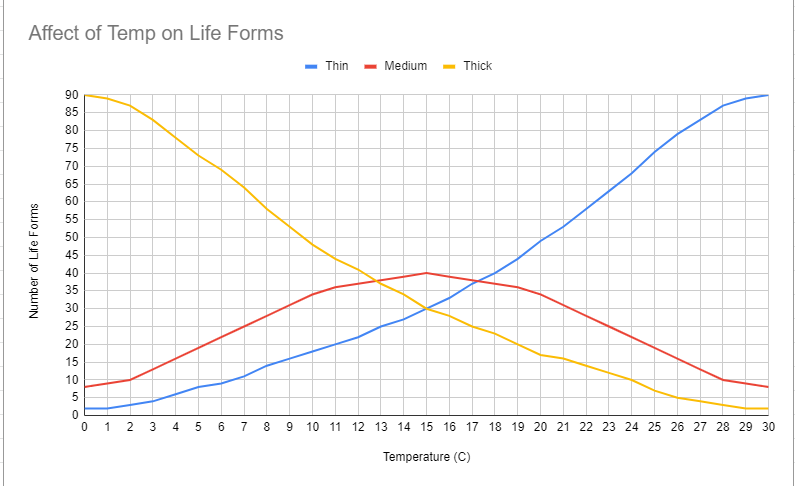
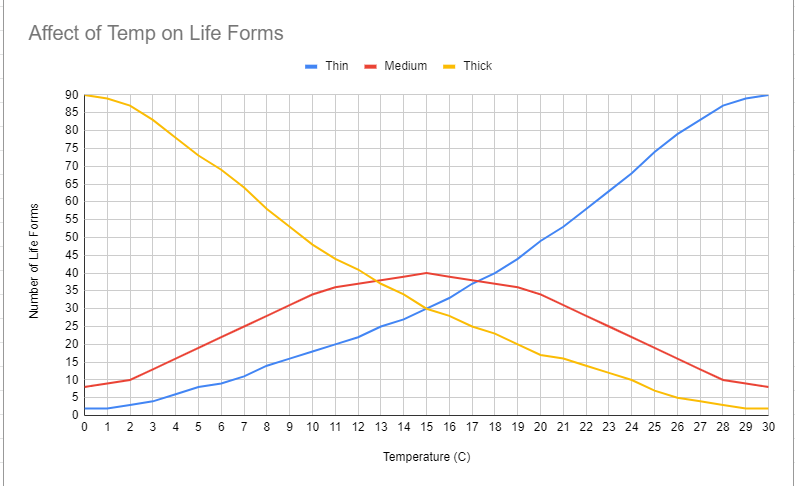
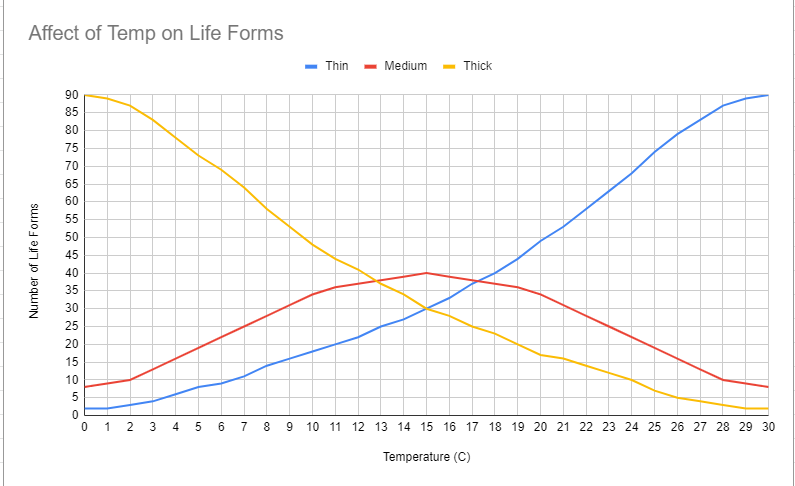
Make a line graph to represent the data in the table. Watch the video on how to make a line graph from your completed data table.
Download a copy of your line graph as a .png to your Google Drive, then upload it into the workspace. NOTE: Copy/Paste directly from Google Sheets won't work.
You can also use Snip & Sketch - copy/paste works with Snip & Sketch.
How does changing the temperature affect the alien body shape? Select all statements that are supported by your data.
The temperature at which the number of thick and thin aliens is the same is
The temperature at which the number of medium-sized aliens begins to shift from increasing to decreasing is
Match the variable in the experiment with its academic term.
The independent variable(s) in this experiment is/are
Match the variable in the experiment with its academic term.
The controlled variable(s) in this experiment is/are
Now, let's test a new hypothesis. If the amount of light changes, then the number of each alien life form will change.
Set the amount of water to 15 drops/hour and the temperature to 15 C.
Run a new experiment.
Light at 0 hours/day:
Number of thin -
Number of medium -
Number of thick -
Light at 12 hours/day:
Number of thin -
Number of medium -
Number of thick -
Light at 24 hours/day:
Number of thin -
Number of medium -
Number of thick -
The independent variable(s) in this experiment is/are
The dependent variable(s) in this experiment is/are
The controlled variable(s) in this experiment is/are
How does changing the amount of water affect the aliens?
Now, let's test a new hypothesis. If the amount of water changes, then the number of each alien life form will change.
Set the light to 12 hours/day and the temperature to 15 C.
Run a new experiment.
Water at 0 drops/hour:
Number of thin -
Number of medium -
Number of thick -
Water at 10 drops/hour:
Number of thin -
Number of medium -
Number of thick -
Water at 20 drops/hour:
Number of thin -
Number of medium -
Number of thick -
Which variable was the independent variable in this experiment?
The controlled variable(s) in this experiment:
The dependent variable(s) in this experiment is/are