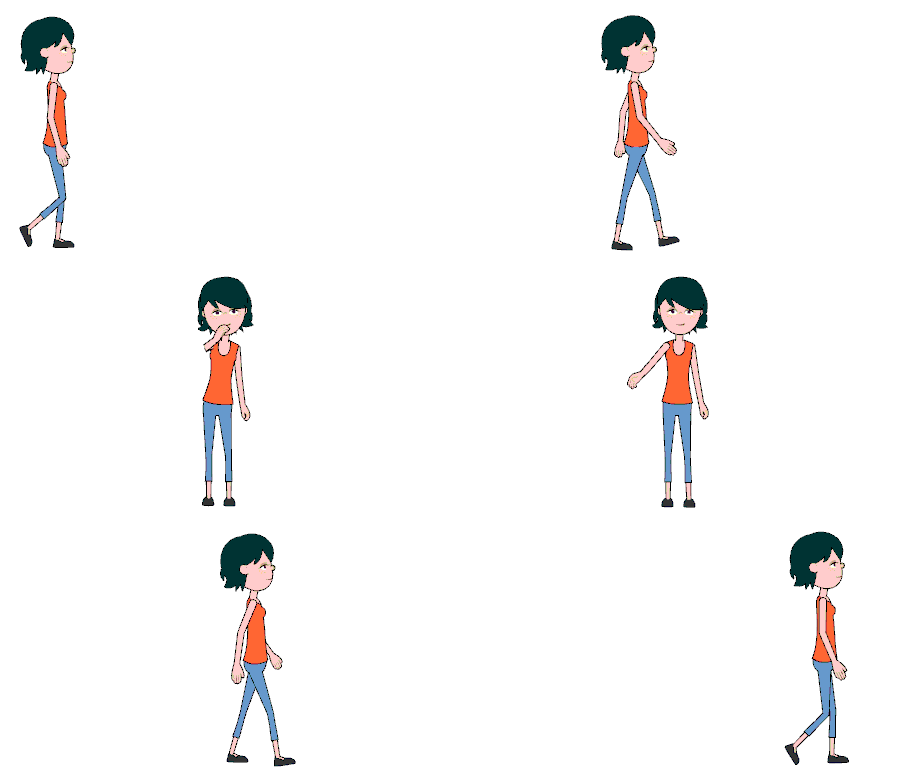
Motion: The change in an object’s position with respect to a change in time and in comparison to the position of other objects used as reference points.
1 point
1
1 point
1
Question 3
3.
Create a short bullet point list of what is needed for motion.
*
*
*
*
1 point
1
Question 4
4.
The world you see is full of motion caused by forces that push or pull.
Force: A push or pull that can change the motion of an object.
What forces are acting in the video of the biker (you do not need to watch the whole video)?
Hint: To start, look where objects are in contact (touching).
Sentence Starter: One force that I see in the video of the biker is... To explain further... Another force that I see in the video is...
Some of the forces that you may have seen in the video and have mentioned in your answer are contanct forces. Examples of these pairs of contact forces are the interactions between the road and tires (the force of the road acts on the tires, and the force of the tires acts on the road), the biker and the air, and the seat and the biker. Any pair could be analyzed as a system of interacting forces. Other force pairs can act at a distance, such as the force of gravity between Earth and the rider.
1 point
1
1 point
1
Laws of Motion Sir Isaac Newton, a 17th century Englishman, was the first to correctly explain the relationship between force
and motion. He developed three laws of motion. The first two laws explain the motion of a single object in which forces are absent or present.
1 point
1
1 point
1
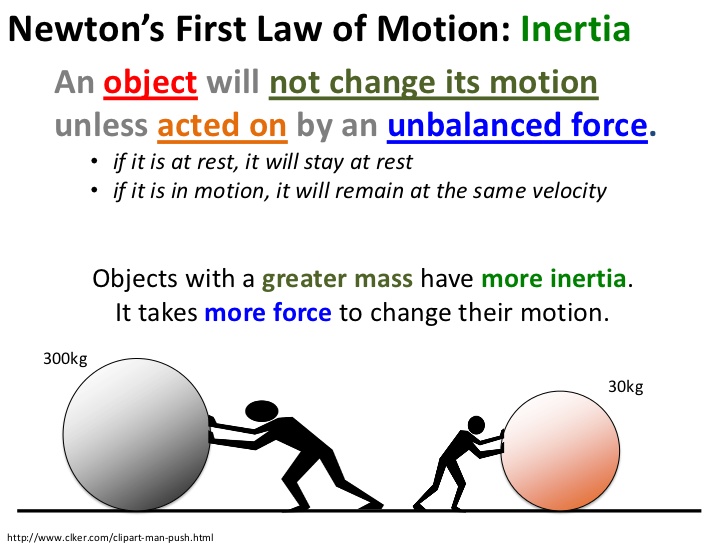
Newton’s first law of motion: An object (body) at rest remains at rest, and an object (body) in motion continues to move at a constant velocity unless acted upon by an external (outside) force. (law of Inertia).
1 point
1
1 point
1
Question 10
10.
Draw two examples:
A) an object at reast
B) an object moving at a constant velocity (speed).
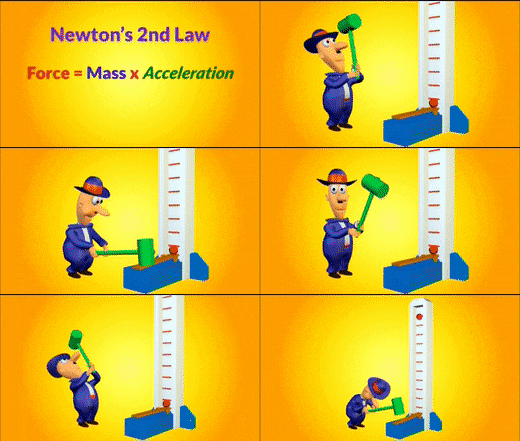
Newton’s second law of motion: Acceleration (increasing or decreasing speed) is directly proportional (equal in size) to force and inversely (in an opposite manner) proportional to mass. (F=ma or a= F/m).
This law is important because through it we can calculate the force, accleration, and even determine the mass applied to different objects.
1 point
1
2 points
2
Question 12
12.
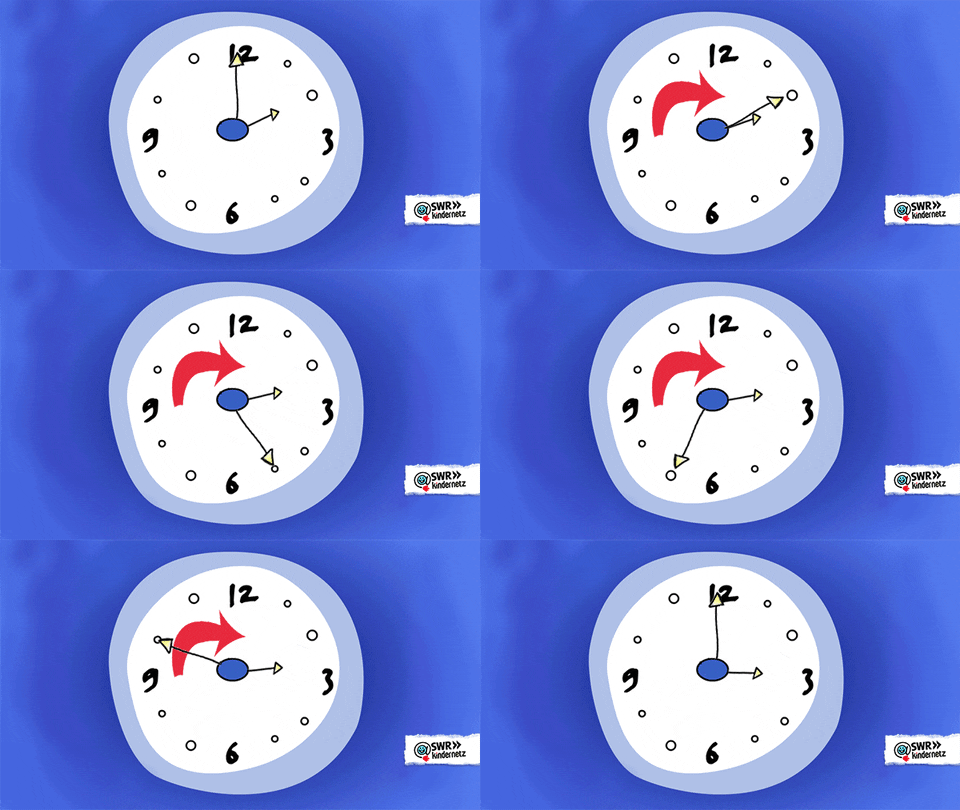
Based on what you just read. A) What does acceleration mean?
B) Create a graphic to display your understanding of the word acceleration.
Sentence Starter: Acceleration means...
1 point
1
Question 13
13.
Based on what you just read, what does acceleration mean?
Sentence Starter: Acceleration means...
Newton’s third law of motion: This law involves pairs of forces that act on two interacting objects like those in the biker video.
Newton's third law says "for every action force, there is an equal and opposite reaction force." Where objects contact, they interact with pairs of forces (action-reaction) equal in strength but in the opposite direction.
When one object exerts a force on a second object, the second object also exerts a force on the first object at the same time.
1 point
1
1 point
1
Question 15
15.
Netwon's Third Law is that for every ___________ there is an equal and opposite _____________ .
Other Answer Choices:
action
reaction
1 point
1
1 point
1
Question 17
17.
Considering the phrase "equal and opposite", if a person pushes a baby in swing with a force of 500 N the baby moves, but how much force was put on the person by the baby in the equal and opposite direction?
1 point
1
Question 18
18.
Considering the phrase equal and opposite, " what would be the best example of that from below?
The three laws of motion can be summarized more simply as
Newton's First Law (Inertia): An object will remain in its current state (moving or stopped) unless an outside force is applied.
Newton's Second Law (F=ma): Force = mass x acceleration
Newton's Third Law (Action and Reaction): For every action there is an equal and opposite reaction
1 point
1
6 points
6
Question 20
20.
Create an inforgraphic with all three laws displayed.