Ten students compare their high school grade–point–average (GPA) with their college GPA. Their data are presented in the table below.
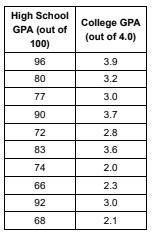
Ten students compare their high school grade–point–average (GPA) with their college GPA. Their data are presented in the table below.
Determine the correlation coefficient between these two variables.
Explain what this value indicates about the relationship between high school GPA and college GPA for these students.
A car manufacturer collects data on the number of gallons of gasoline left in the gas tank after driving for different numbers of miles. The manufacturer creates a scatter plot of the data and determines that the correlation coefficient is –0.92.
Select each true statement based on this correlation coefficient.
A high school principal collects data on the English and math scores of students in grades 9 through 12. The principal plots the scores for each grade on a separate scatter plot and draws a line of best fit for each scatter plot. The results are described below.
In Grade 9, there was no correlation between the English and math scores of each student.
In Grade 10, there was a strong correlation between the English and math scores of each student.
In Grade 11, as the English scores increase, the math scores generally increase, but there is only a moderate correlation between the two variables.
In Grade 12, as the English scores increase, the math scores generally decrease, but the data points are not close to the line of best fit.
Determine whether each correlation coefficient below corresponds to grade 9, 10, 11, or 12. Select a
grade for each correlation coefficient.
| Draggable item | arrow_right_alt | Corresponding Item |
|---|---|---|
Grade 10 | arrow_right_alt | r = 0.014 |
Grade 11 | arrow_right_alt | r = 0.986 |
Grade 12 | arrow_right_alt | r = 0.637 |
Grade 9 | arrow_right_alt | r = -0.431 |
The table below shows the cost of gasoline, per gallon, at various gas stations, and the distance each gas station is from the nearest port.
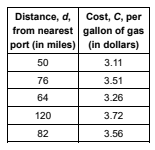
Use Desmos to write a linear function that models these data.
Use the equation from Part A to estimate the cost per gallon of gas at a station that is 150 miles from the nearest port.
What does the correlation coefficient say about the data? Check all that apply.