Create your own model of the digestive system.
Here are two examples to help you:
Example 1:
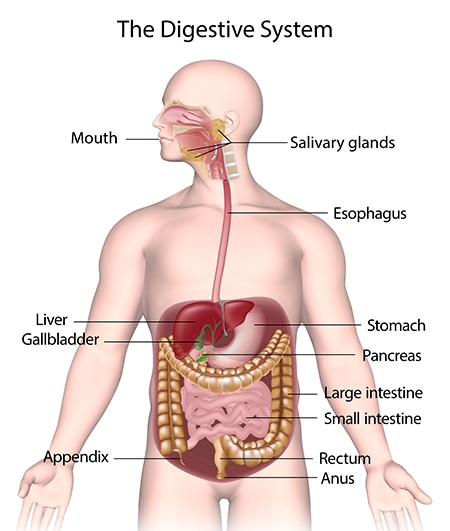
Example 2:
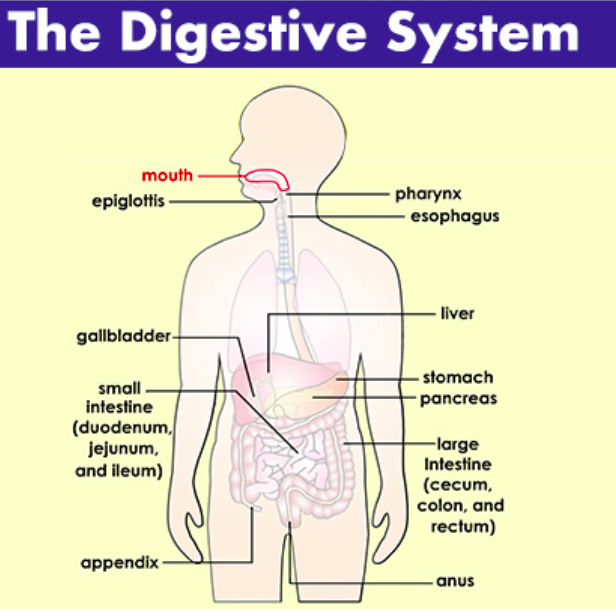
Create your own model of the digestive system.
Here are two examples to help you:
Example 1:
Example 2:
Your digestive (say: dye-JES-tiv) system started working even before you took the first bite of your pizza. And the digestive system will be busy at work on your chewed-up lunch for the next few hours — or sometimes days, depending upon what you've eaten. This process, called digestion, allows your body to get the nutrients and energy it needs from the food you eat. So let's find out what's happening to that pizza, orange, and milk.
Even before you eat, when you smell a tasty food, see it, or think about it, digestion begins. Saliva (say: suh-LYE-vuh), or spit, begins to form in your mouth.
When you do eat, the saliva breaks down the chemicals in the food a bit, which helps make the food mushy and easy to swallow. Your tongue helps out, pushing the food around while you chew with your teeth. When you're ready to swallow, the tongue pushes a tiny bit of mushed-up food called a bolus (say: BO-luss) toward the back of your throat and into the opening of your esophagus, the second part of the digestive tract.
Make a bullet point list of the main ideas of the paragraphs you read.
*
*
*
*
The esophagus (say: ih-SOF-eh-guss) is like a stretchy pipe that's about 10 inches (25 centimeters) long. It moves food from the back of your throat to your stomach. But also at the back of your throat is your windpipe, which allows air to come in and out of your body. When you swallow a small ball of mushed-up food or liquids, a special flap called the epiglottis (say: ep-ih-GLOT-iss) flops down over the opening of your windpipe to make sure the food enters the esophagus and not the windpipe.
If you've ever drunk something too fast, started to cough, and heard someone say that your drink "went down the wrong way," the person meant that it went down your windpipe by mistake. This happens when the epiglottis doesn't have enough time to flop down, and you cough involuntarily (without thinking about it) to clear your windpipe.
Once food has entered the esophagus, it doesn't just drop right into your stomach. Instead, muscles in the walls of the esophagus move in a wavy way to slowly squeeze the food through the esophagus. This takes about 2 or 3 seconds.
Make a bullet point list of the main ideas of the paragraphs you read.
*
*
*
*
Your stomach, which is attached to the end of the esophagus, is a stretchy sack shaped like the letter J. It has three important jobs:
to store the food you've eaten
to break down the food into a liquidy mixture
to slowly empty that liquidy mixture into the small intestine
The stomach is like a mixer, churning and mashing together all the small balls of food that came down the esophagus into smaller and smaller pieces. It does this with help from the strong muscles in the walls of the stomach and gastric (say: GAS-trik) juices that also come from the stomach's walls. In addition to breaking down food, gastric juices also help kill bacteria that might be in the eaten food.
Onward to the small intestine!
Make a bullet point list of the main ideas of the paragraphs you read.
*
*
*
*
Select all the true statements
The small intestine (say: in-TESS-tin) is a long tube that's about 1½ inches to 2 inches (about 3.5 to 5 centimeters) around, and it's packed inside you beneath your stomach. If you stretched out an adult's small intestine, it would be about 22 feet long (6.7 meters) — that's like 22 notebooks lined up end to end, all in a row!
The small intestine breaks down the food mixture even more so your body can absorb all the vitamins, minerals, proteins, carbohydrates, and fats. The grilled chicken on your pizza is full of proteins — and a little fat — and the small intestine can help extract them with a little help from three friends: the pancreas (say: PAN-kree-uss), liver, and gallbladder.
Those organs send different juices to the first part of the small intestine. These juices help to digest food and allow the body to absorb nutrients. The pancreas makes juices that help the body digest fats and protein. A juice from the liver called bile helps to absorb fats into the bloodstream. And the gallbladder serves as a warehouse for bile, storing it until the body needs it.
Your food may spend as long as 4 hours in the small intestine and will become a very thin, watery mixture. It's time well spent because, at the end of the journey, the nutrients from your pizza, orange, and milk can pass from the intestine into the blood. Once in the blood, your body is closer to benefiting from the complex carbohydrates in the pizza crust, the vitamin C in your orange, the protein in the chicken, and the calcium in your milk.
Next stop for these nutrients: the liver! And the leftover waste — parts of the food that your body can't use — goes on to the large intestine.
Make a bullet point list of the main ideas of the paragraphs you read.
*
*
*
*
The nutrient-rich blood comes directly to the liver for processing. The liver filters out harmful substances or wastes, turning some of the waste into more bile. The liver even helps figure out how many nutrients will go to the rest of the body, and how many will stay behind in storage. For example, the liver stores certain vitamins and a type of sugar your body uses for energy.
Make a bullet point list of the main ideas of the paragraphs you read.
*
*
*
*
At 3 or 4 inches around (about 7 to 10 centimeters), the large intestine is fatter than the small intestine and it's almost the last stop on the digestive tract. Like the small intestine, it is packed into the body, and would measure 5 feet (about 1.5 meters) long if you spread it out.
The large intestine has a tiny tube with a closed end coming off it called the appendix (say: uh-PEN-dix). It's part of the digestive tract, but it doesn't seem to do anything, though it can cause big problems because it sometimes gets infected and needs to be removed.
Like we mentioned, after most of the nutrients are removed from the food mixture there is waste left over — stuff your body can't use. This stuff needs to be passed out of the body.
Can you guess where it ends up? Well, here's a hint: It goes out with a flush.
Before it goes, it passes through the part of the large intestine called the colon (say: CO-lun), which is where the body gets its last chance to absorb the water and some minerals into the blood. As the water leaves the waste product, what's left gets harder and harder as it keeps moving along, until it becomes a solid. Yep, it's poop (also called stool or a bowel movement).
The large intestine pushes the poop into the rectum (say: REK-tum), the very last stop on the digestive tract. The solid waste stays here until you are ready to go to the bathroom. When you go to the bathroom, you are getting rid of this solid waste by pushing it through the anus (say: AY-nus). There's the flush we were talking about!
Make a bullet point list of the main ideas of the paragraphs you read.
*
*
*
*
You can help your digestive system by drinking water and eating a healthy diet that includes foods rich in fiber. High-fiber foods, like fruits, vegetables, and whole grains, make it easier for poop to pass through your system.
The digestive system is a pretty important part of your body. Without it, you couldn't get the nutrients you need to grow properly and stay healthy. And next time you sit down to lunch, you'll know where your food goes — from start to finish!
Make a bullet point list of the main ideas of the paragraphs you read.
*
*
*
*
The large intestine is the last chance for the body to..
Food needs to be broken down into smaller pieces, which is called "
Word bank:
absorbed
digestion
Word bank:
alimentary
small intestine
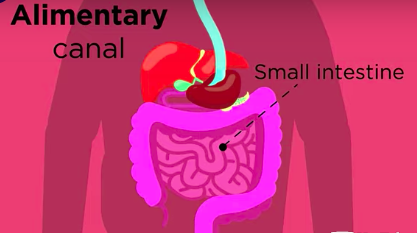
Digestion occures in the
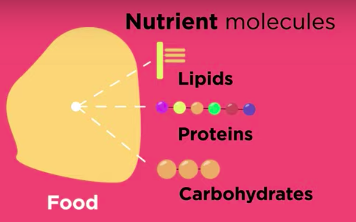
Large foods are made up of lipids, proteins and carbohydrates. These large foods are...
Different types of enzymes digest different types of food.
Lipases
Proteases
Carbohydrases
break down carbohydrates
break down proteins
break down lipids
The simplest carbohydrates are
Word Bank:
starch
sugar
An enzyme that breaks down starch, a big carbohydrate is
Carbohydrates are first brokwn down chemically...
Word Bank:
enzymes
fish
amino acids
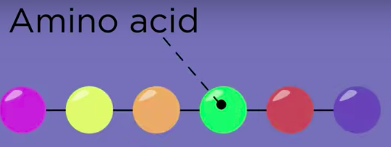
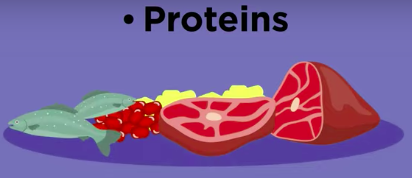
Proteins are found in meat,
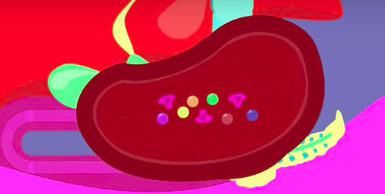
Breaking down proteins does not work once the food has entered the...
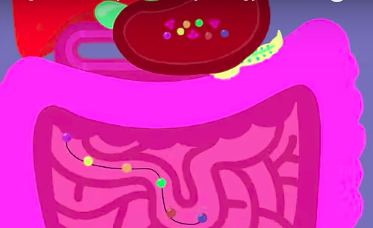
Proteins are broken down by the enzyme protease in the...
Word Bank:
trypsin
small intestine
protease
The pancrease releases a different
The pepsin enzyme works well in the stomach but not in the small intestine, why is that? Use information from the video to answer.
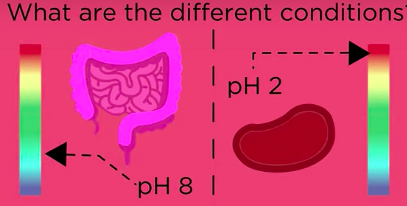
Word Bank: protease pepsin acidic pH low high 2 8 enzyme
Sentence Starter: The reason why pepsin works better in the stomach as opposed to the small intestine is...
Lipids are digested by lipases and are broken down into...
<Select all that apply>