Open Up Resources
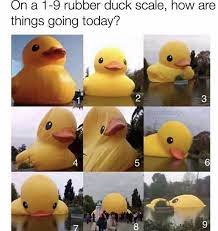
¿Qué pato de goma muestra cómo van tus cosas hoy?
Ni ubuhe bwoko bwa rubber bwerekana uko ibintu byawe bigenda uyu munsi?
Ni bata yupi anayeonyesha jinsi mambo yako yanavyokwenda leo?
What is today's date?
¿Cuál es la fecha de hoy?
Itariki yuyu munsi niyihe?
Tarehe ya leo ni nini?
What is the title of the lesson you will be working on today?
Ni kichwa gani cha somo litakalofanyia kazi leo?
Nuwuhe mutwe w'isomo uzakora uyu munsi?
¿Cuál es el título de la lección en la que trabajará hoy?
Any other information I need to know to help you be successful today?
¿Alguna otra información que necesite saber para ayudarlo a tener éxito hoy?
Andi makuru yose nkeneye kumenya kugirango agufashe gutsinda uyu munsi?
Taarifa nyingine yoyote ninayohitaji kujua ili kukusaidia kufanikiwa leo?
I can make a valid conclusion in any geometric context.
Puedo llegar a una conclusión válida en cualquier contexto geométrico.
Nshobora gufata umwanzuro wemewe murwego urwo arirwo rwose.


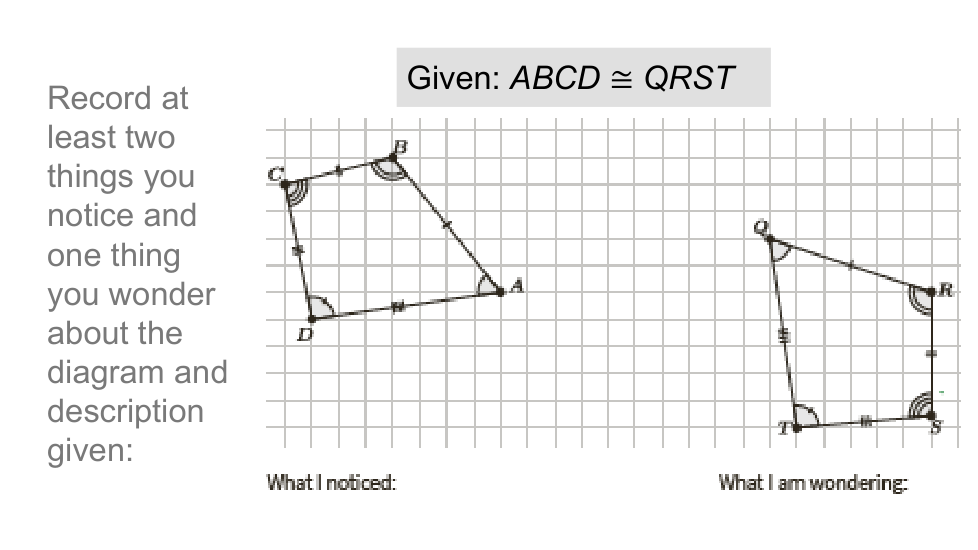
What I noticed:
Lo que noté:
What I am wondering:
Lo que me pregunto:


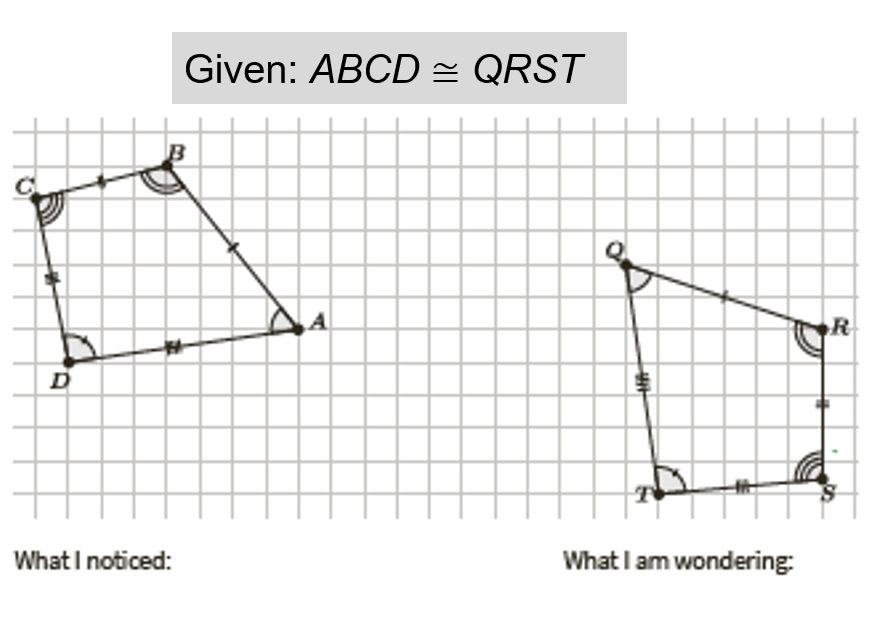
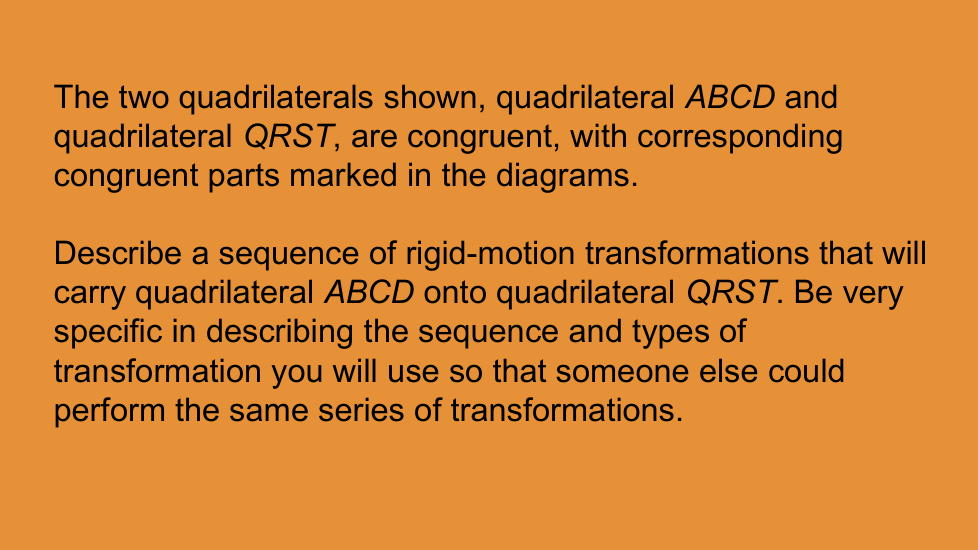
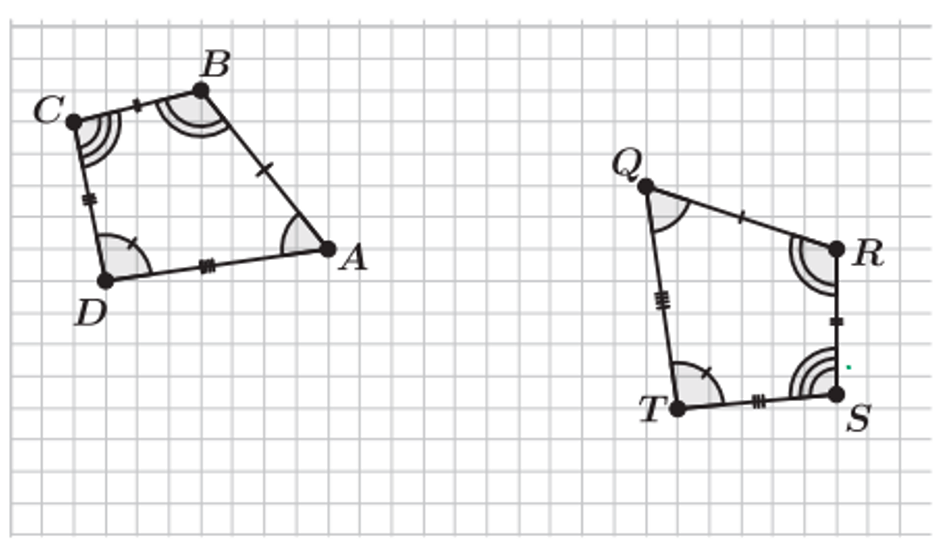
Describe a sequence of rigid-motion transformations that will carry quadrilateral ABCD onto quadrilateral QRST. Be very specific in describing the sequence and types of transformation you will use so that someone else could perform the same series of transformations.
Describa una secuencia de transformaciones de movimiento rígido que lleven el cuadrilátero ABCD al cuadrilátero QRST. Sea muy específico al describir la secuencia y los tipos de transformación que usará para que otra persona pueda realizar la misma serie de transformaciones.

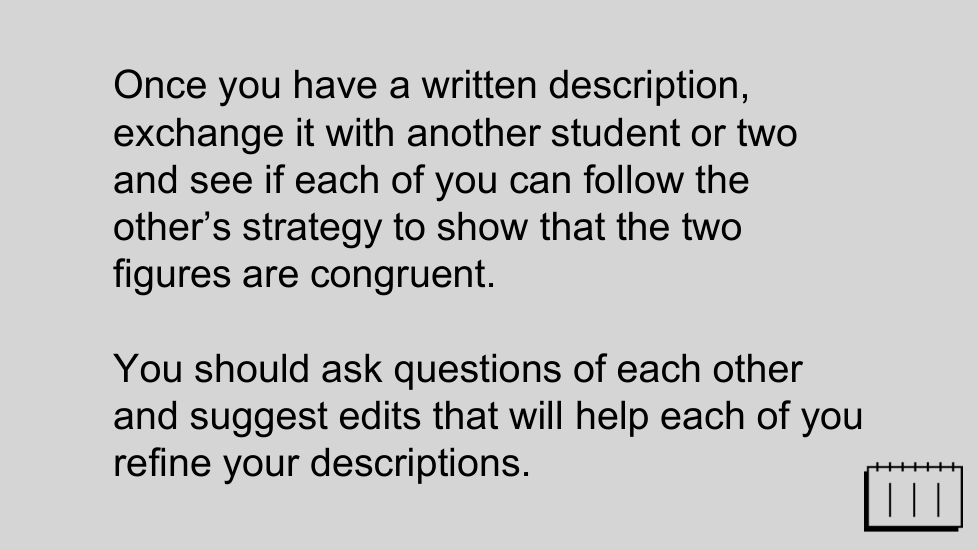
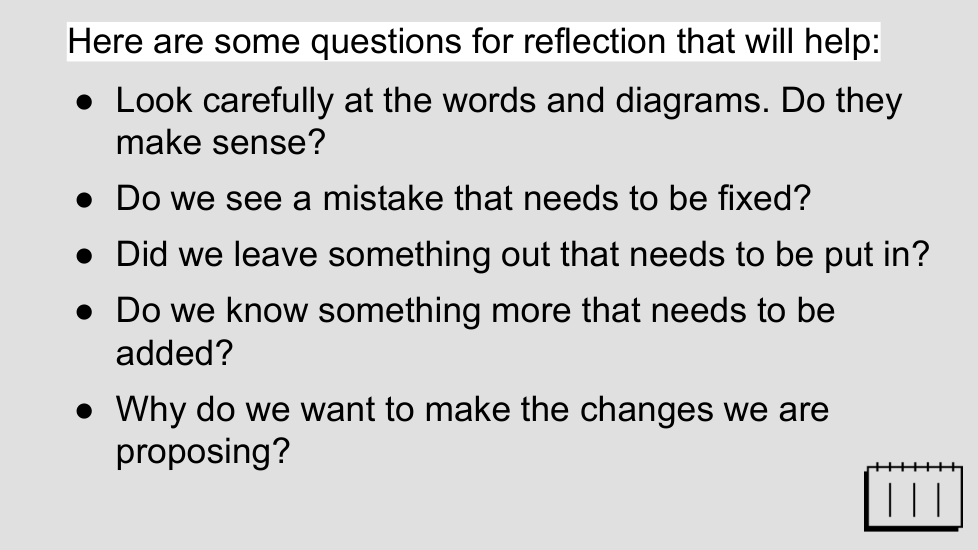
Use the whiteboard to follow the description from your partner. Also write down any questions or edits.
Utilice la pizarra para seguir la descripción de su compañero. También escriba cualquier pregunta o edición.


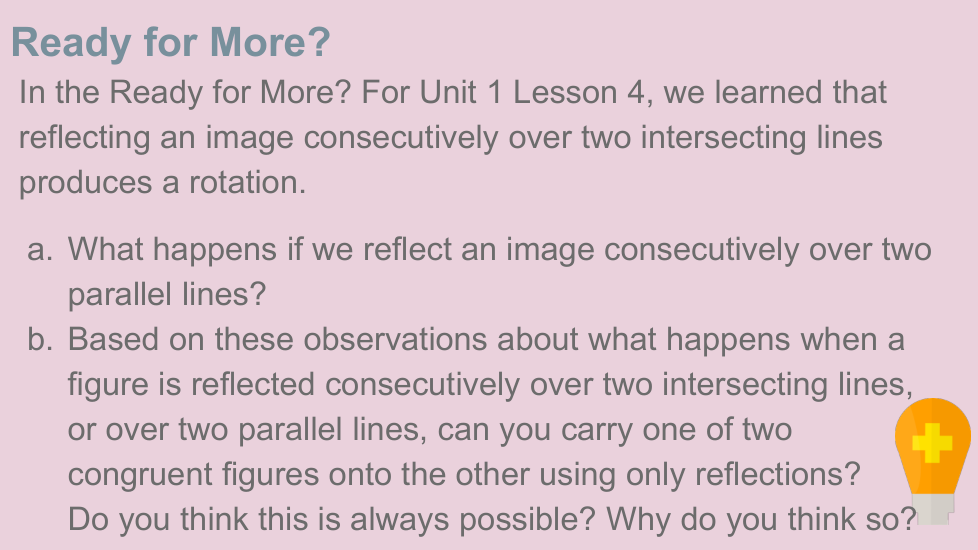
a.What happens if we reflect an image consecutively over two parallel lines?
¿Qué sucede si reflejamos una imagen consecutivamente sobre dos líneas paralelas?
Based on these observations about what happens when a figure is reflected consecutively over two intersecting lines, or over two parallel lines, can you carry one of two congruent figures onto the other using only reflections? Do you think this is always possible? Why do you think so?
Con base en estas observaciones sobre lo que sucede cuando una figura se refleja consecutivamente sobre dos líneas que se cruzan o sobre dos líneas paralelas, ¿puedes llevar una de dos figuras congruentes a la otra usando solo reflejos? ¿Crees que esto siempre es posible? ¿Por qué piensas eso?

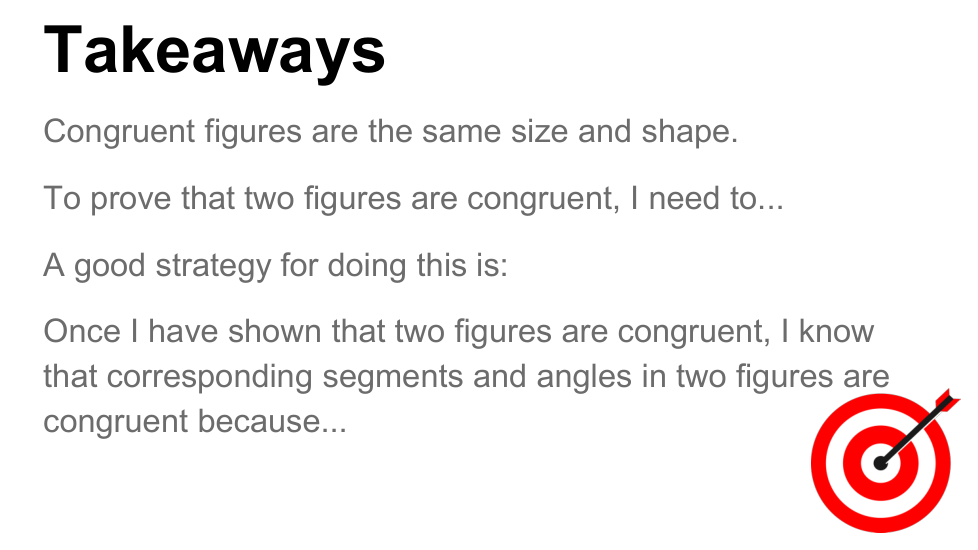
To prove that two figures are congruent, I need to
Para probar que dos figuras son congruentes, necesito
A good strategy for doing this is:
Una buena estrategia para hacer esto es:
Once I have shown that two figures are congruent, I know that corresponding segments and angles in the two figures are congruent because
Una vez que he demostrado que dos figuras son congruentes, sé que los segmentos y ángulos correspondientes en las dos figuras son congruentes porque
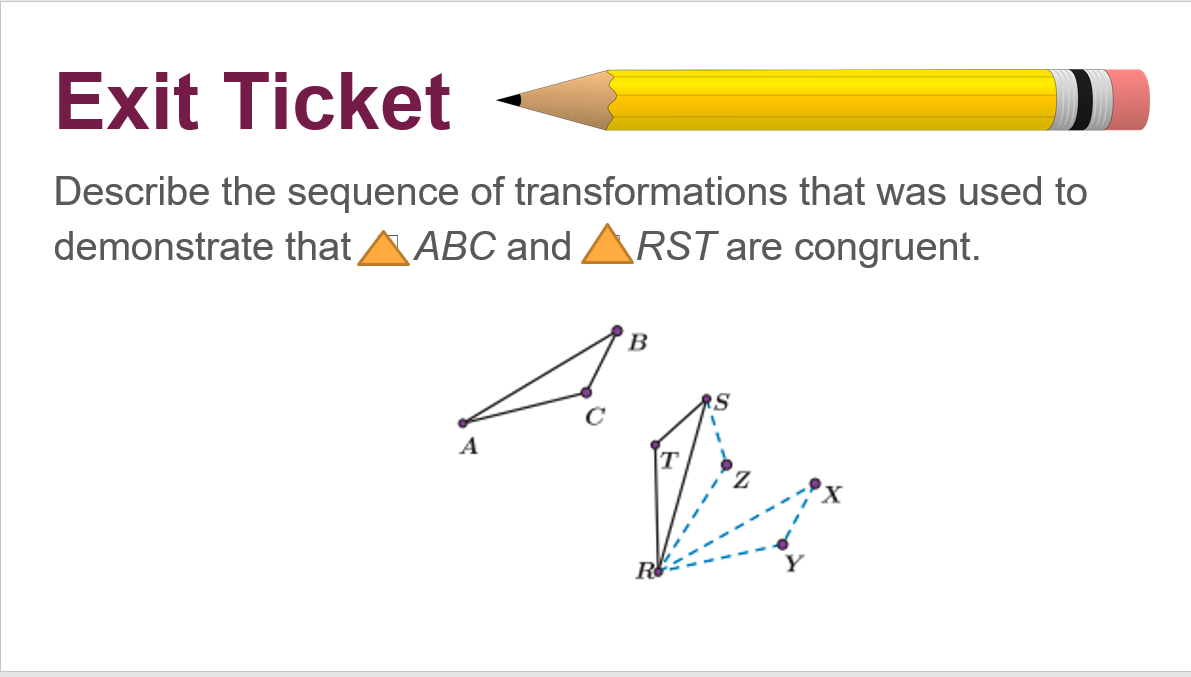
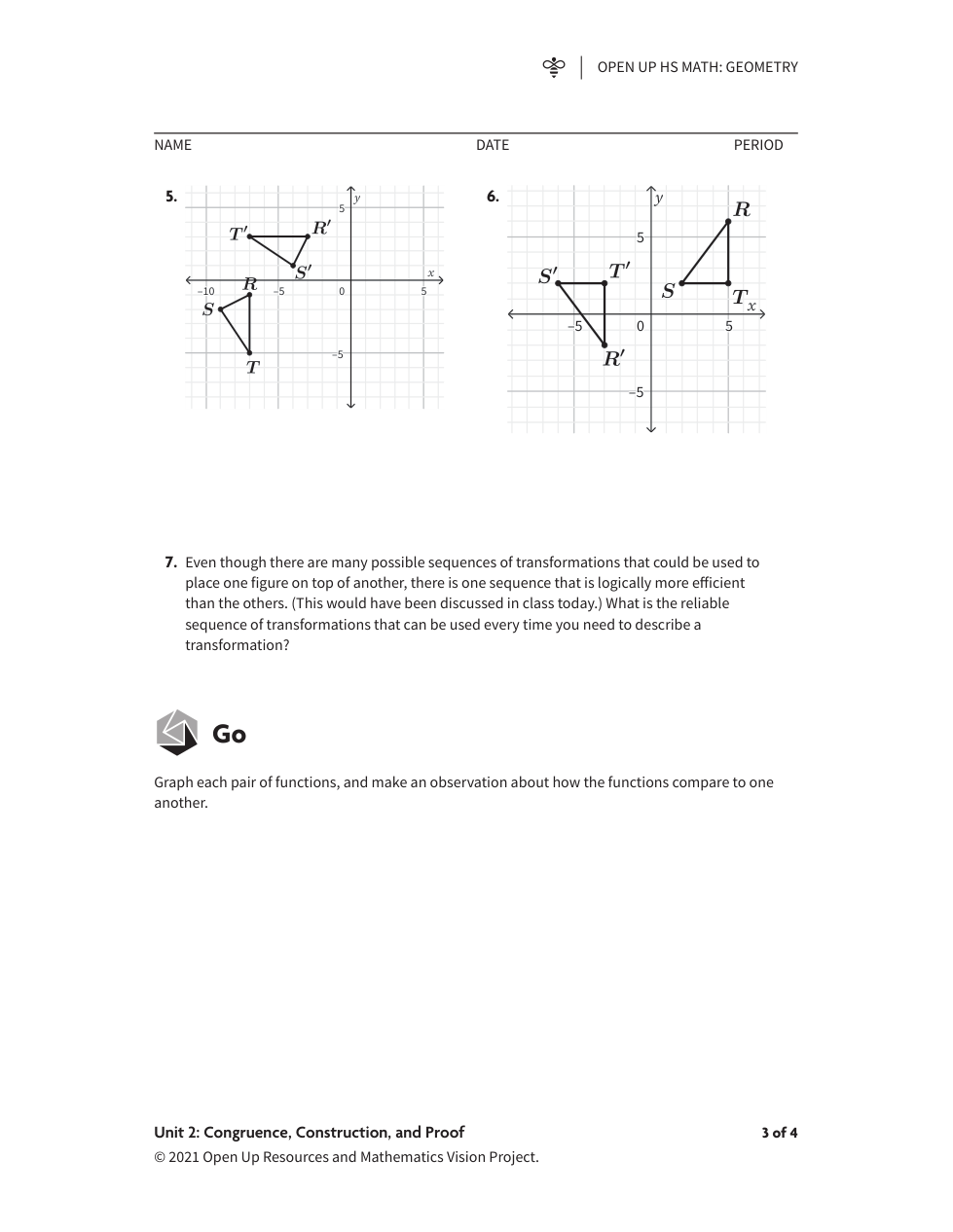
Describe la secuencia de transformaciones que se usó para demostrar que
y
son congruentes.

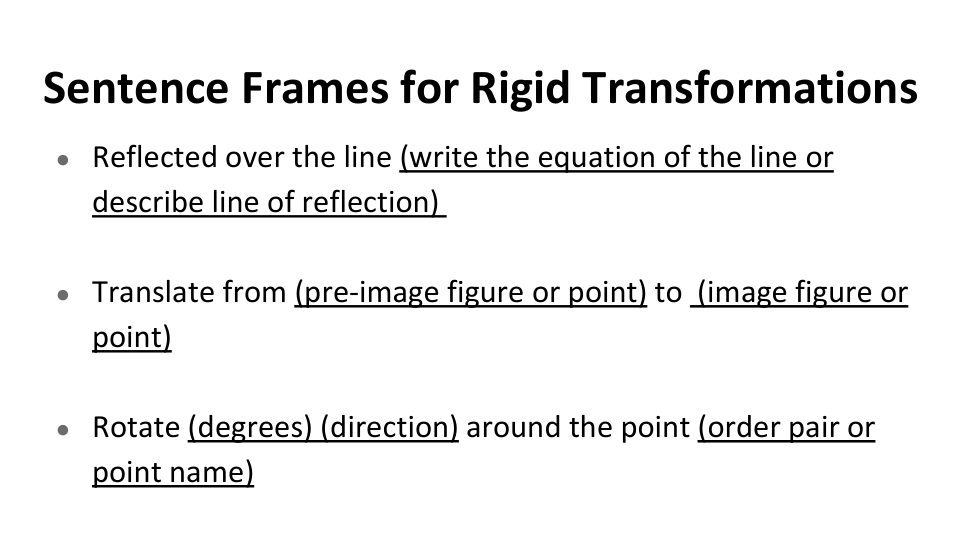
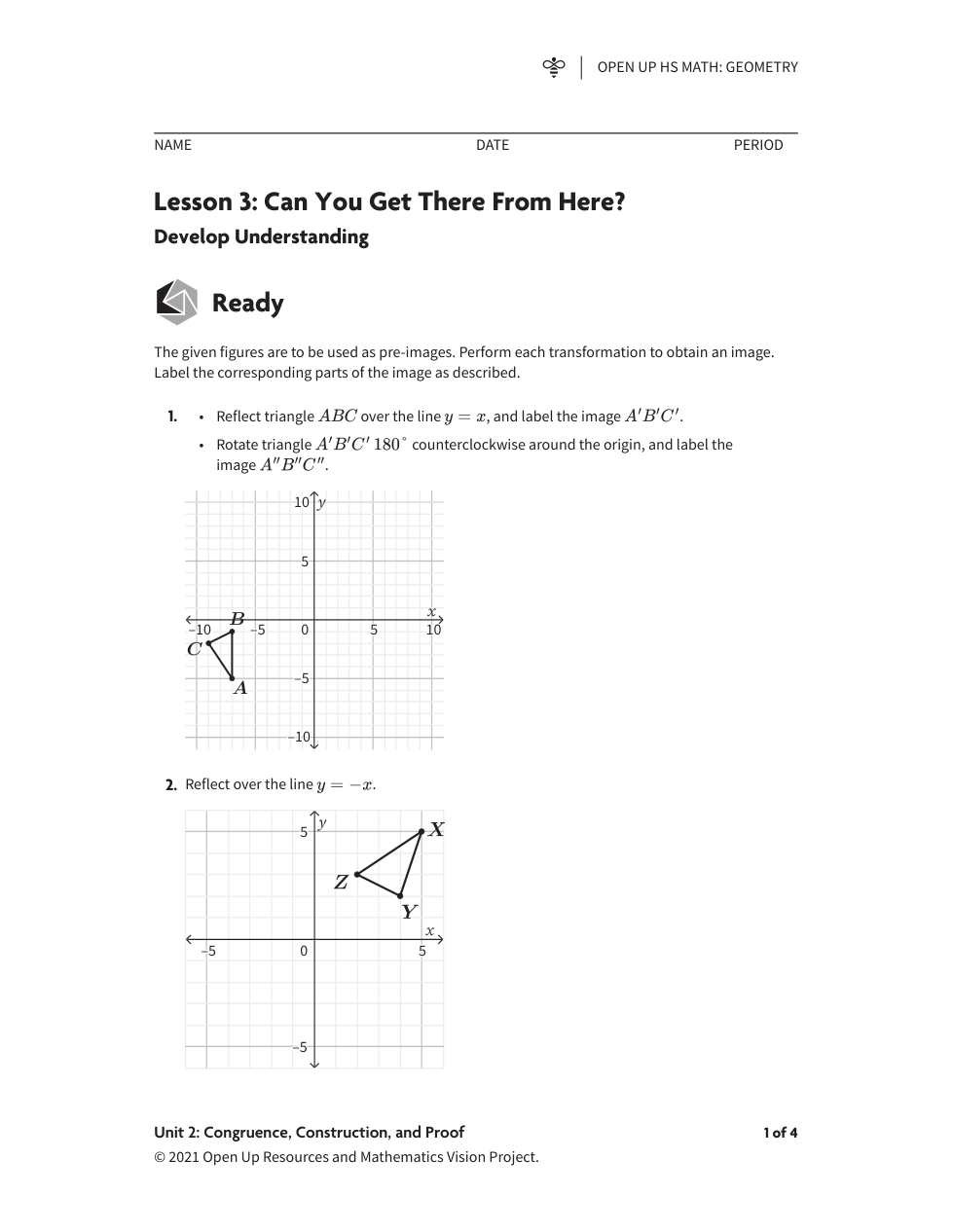
Reflect triangle ABC over the line y = x, and label the image A'B'C;.
Rotate triangle A'B'C' 180 degrees counterclockwise around the origin, and label the image A''B''C''.
Refleja el triángulo ABC sobre la línea y = x, y rotula la imagen A'B'C;.
Gira el triángulo A'B'C' 180 grados en sentido antihorario alrededor del origen y rotula la imagen A''B''C''.
Reflect over the line y = -x.
Reflexiona sobre la recta y = -x.

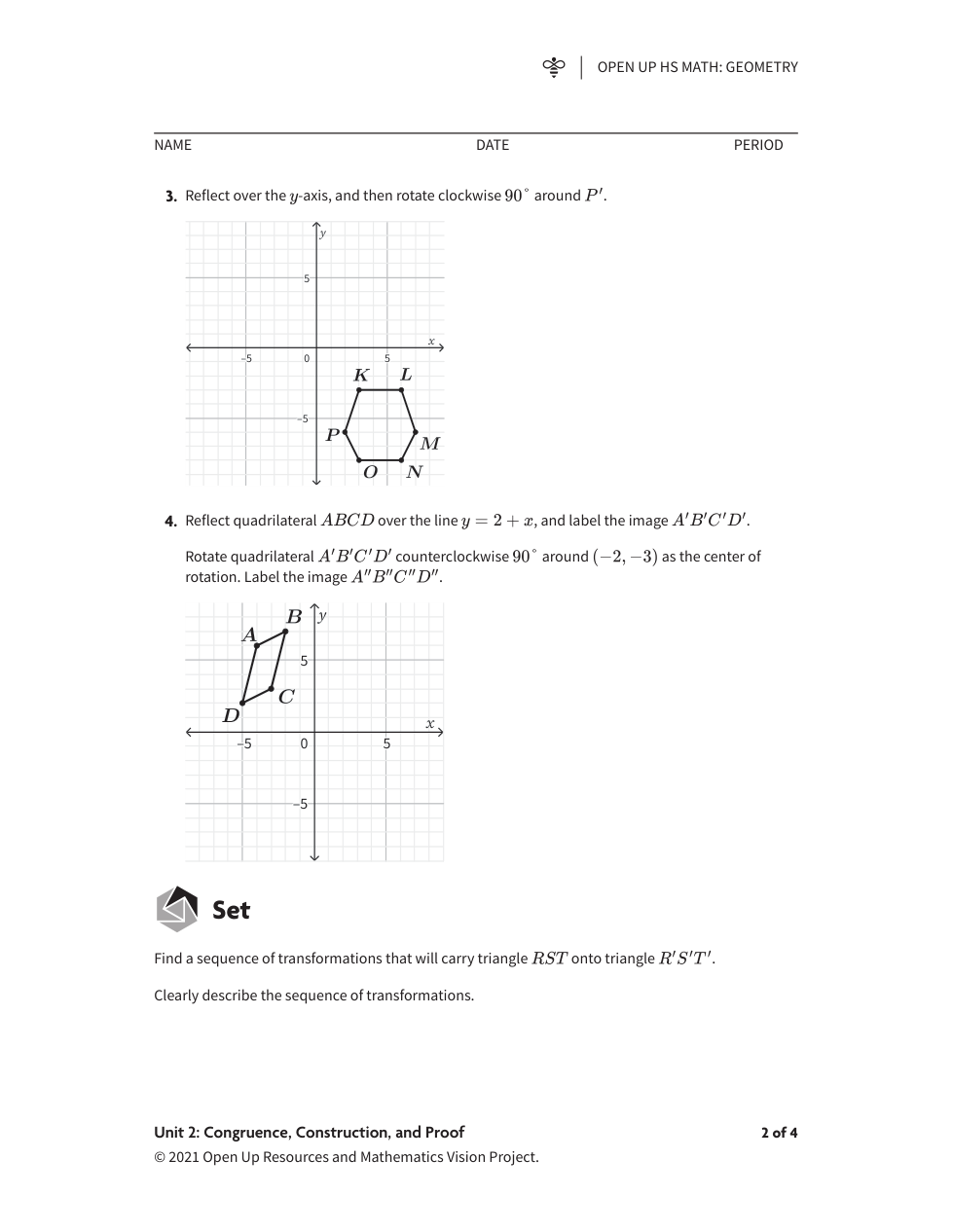
Reflect over the y-axis, and then rotate clockwise 90 degrees around P'.
Refleje sobre el eje y y luego gire en el sentido de las agujas del reloj 90 grados alrededor de P'.
Reflect quadrilateral ABCD over the line y = 2 + x, and label the image A'B'C'D'.
Rotate quadrilateral A'B'C'D' counterclockwise 90 degrees around (-2, -3) as the center of rotation. Label the image A''B''C''D''.
Refleja el cuadrilátero ABCD sobre la línea y = 2 + x, y rotula la imagen A'B'C'D'.
Gira el cuadrilátero A'B'C'D' en sentido antihorario 90 grados alrededor de (-2, -3) como centro de rotación. Etiquete la imagen A''B''C''D''.

Clearly describe the sequence of transformations.
Describe claramente la secuencia de transformaciones.
Clearly describe the sequence of transformations.
Describe claramente la secuencia de transformaciones.

I can make a valid conclusion in any geometric context.
Puedo llegar a una conclusión válida en cualquier contexto geométrico.
Nshobora gufata umwanzuro wemewe murwego urwo arirwo rwose.
What score do you give yourself?
Ni ayahe manota wiha wenyine?
Dhibco noocee ah ayaad naftaada siisaa?
Unajipa alama gani?
¿Qué puntuación te das a ti mismo?
Cite your evidence from the assignment and explain how it supports your score, based on the success criteria.
Cite su evidencia de la tarea y explique cómo respalda su puntaje, según los criterios de éxito.
Tanga ibimenyetso byawe uhereye kumikoro hanyuma usobanure uburyo ishyigikira amanota yawe, ukurikije ibipimo byatsinze.
Taja ushahidi wako kutoka kwa kazi na ueleze jinsi inavyoauni alama yako, kwa kuzingatia vigezo vya mafanikio.
Even though there are many possible sequences of transformations that could be used to place one figure on top of another, there is one sequence that is logically more efficient than the others. (This would have been discussed in class today.) What is the reliable sequence of transformations that can be used every time you need to describe a transformation?
Aunque hay muchas secuencias posibles de transformaciones que podrían usarse para colocar una figura encima de otra, hay una secuencia que es lógicamente más eficiente que las demás. (Esto se habría discutido en clase hoy.) ¿Cuál es la secuencia confiable de transformaciones que se puede usar cada vez que necesite describir una transformación?