7th Math 5.9
star
star
star
star
star
Last updated about 3 years ago
7 Nsɛmmisa
IP

1
1
1
1
1
1


4

Objective and Summary:
SWBAT compare estimated probabilities to those predicted by a probability model
Setup--Mr. Kovalik made a spinner with 3 colors out of paper and a needle. He says it is a fair spinner with all colors having an equal probability, but he does not show you the spinner.
He spins it many times and records each outcome. It lands on yellow 40 times, cyan 9 times, and blue 11 times.
a) What is the theoretical probability of the spinner landing on yellow if all three colors have an equal probability? (give a fraction or percent)
CFS:
#1: Accurately calculates theoretical probability
Continued from question 1.
The spinner landed on yellow 40 times, cyan 9 times, and blue 11 times.
b) What is the experimental probability of landing on yellow? Do you think Mr. Hwung was using a fair spinner with an equal probability for all three colors? Explain why or why not using evidence.
"I think Mr. Kovalik (was / was not) using a fair spinner because..."
CFS:
#2: Accurately calculates total number of trials to find experimental probability
#3: Accurately compares experimental and theoretical probabilities using math evidence
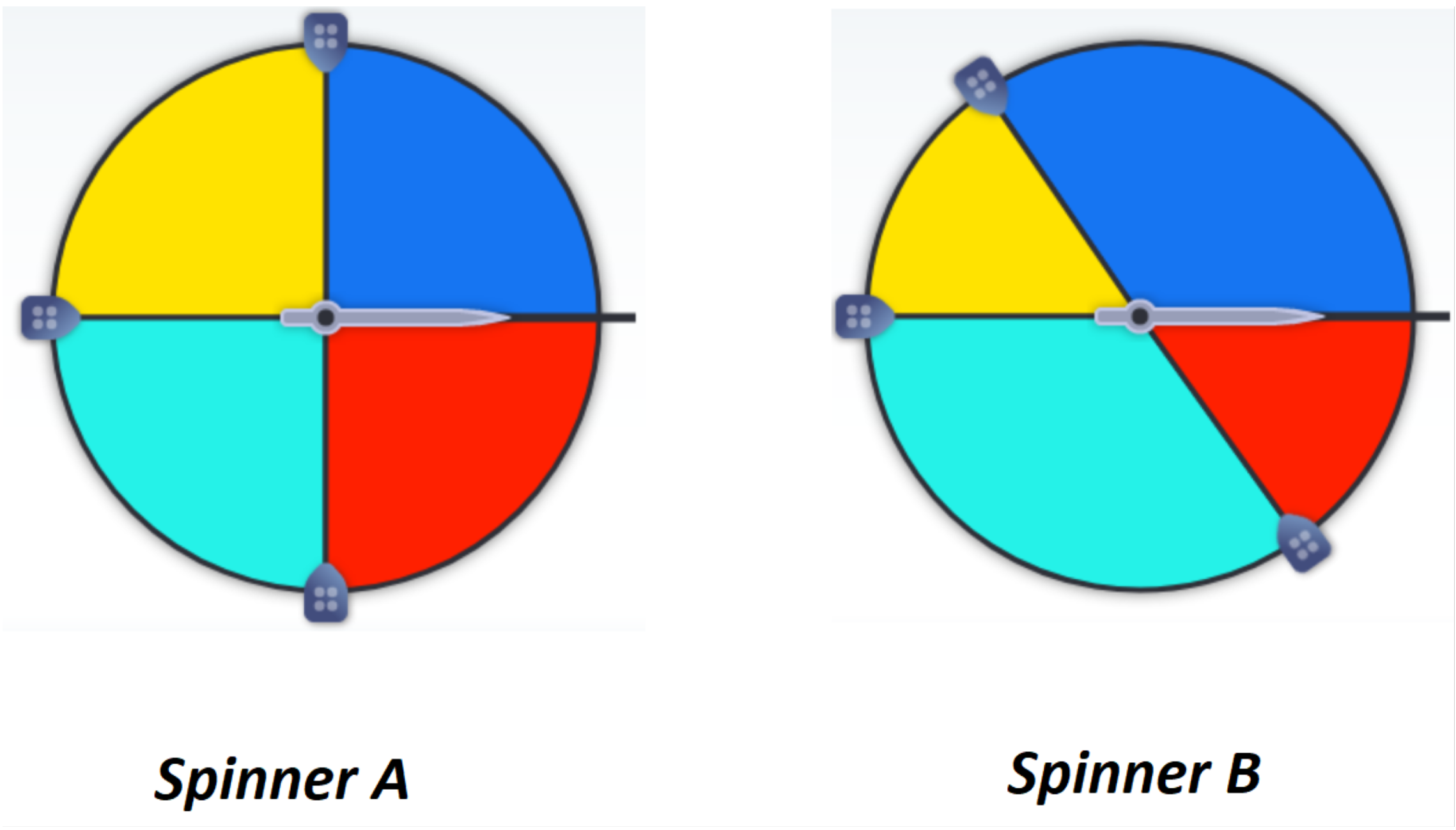
A/B--Ms. Santoyo creates two spinners that both have 4 colors each.
She spins one of the spinners and gets 8 reds, 10 yellows, 15 cyans, and 17 blues. Which spinner do you think Ms. Santoyo used? Explain with math evidence.
"I think Ms. Santoyo..."
CFS:
#1: Accurately calculates theoretical probability
#2: Accurately calculates total number of trials to find experimental probability
#3: Accurately compares experimental and theoretical probabilities using math evidence
Grades--Mr. Kovalik decided to reward students who understand probability. There are two bags which have pieces of paper with either an “A” or a “C” on them. Students will receive whatever grade they pick out of the bag. Use the table from the SYW section.
Which bag is the best choice for you to pick from? Explain why using evidence.
"The best bag to pick from..."
CFS:
#1: Accurately calculates total number of trials to find experimental probability
Try if you have time...
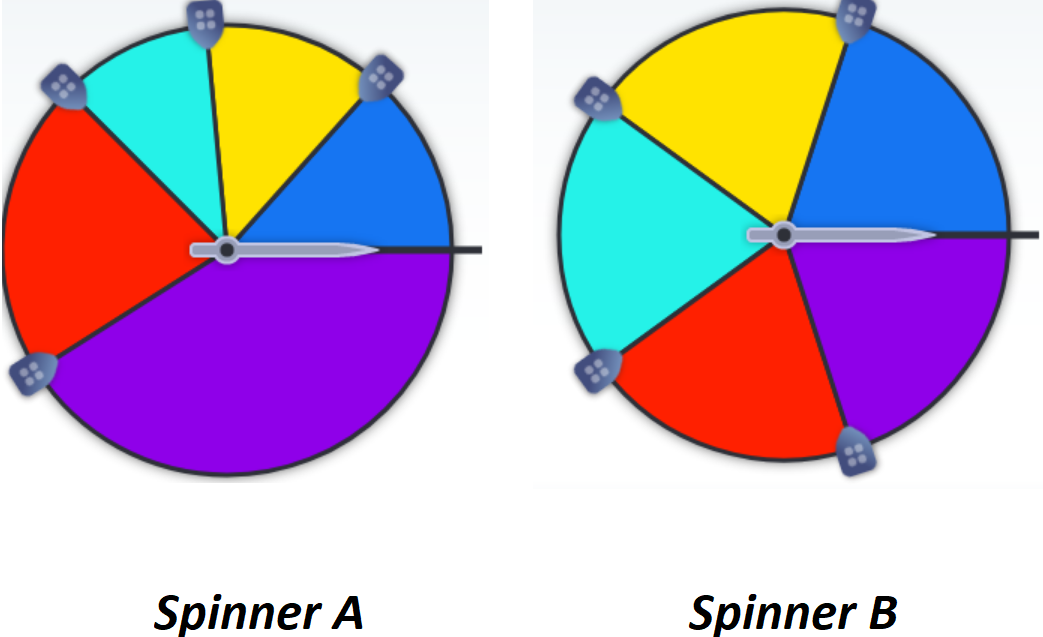
8th Spins Too!--Mr. Vasquez also created a pair of spinners to test the 8th grade students.
He spins one of the spinners many times and gets the results in the table in the SYW section. Which spinner do you think Mr. Vasquez used? Explain with math evidence.
"I think Mr. Vasquez used... because..."
CFS:
#2: Accurately calculates total number of trials to find experimental probability
#3: Accurately compares experimental and theoretical probabilities using math evidence
Try if you have time...
Show Integrity!--Mr. Kovalik recorded dice results made by students while playing Monopoly. They only used one die with 6 sides (1, 2, 3, 4, 5, 6)
Using the results from the table, do you think this was a fair (normal) die? Explain why or why not with math evidence.
CFS:
#2: Accurately calculates total number of trials to find experimental probability
#3: Accurately compares experimental and theoretical probabilities using math evidence
Blues Brothers--Anthony and his brother Banthony are competing on a show to pick out the most blue chips, just like we did at the beginning of class today.
They each carried out their own research that is organized in tables in the SYW section.
Answer ALL parts of this task.
CFS:
#1: Accurately calculates theoretical probability
#2: Accurately calculates total number of trials to find experimental probability
#3: Accurately compares experimental and theoretical probabilities using math evidence