Click on the graph background to add a point. Add two points to create a graph. Drag a point or type in x and y coordinates to edit its position. Click on a point to delete it.
Ready for More?
Witeguye byinshi?
Uko Tayari kwa Zaidi?
¿Listo para más?
1 point
1
Question 12
12.
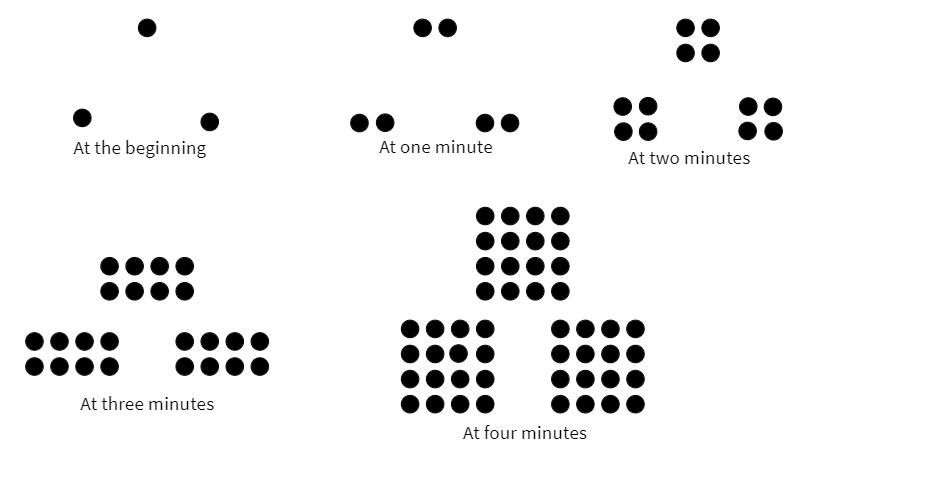
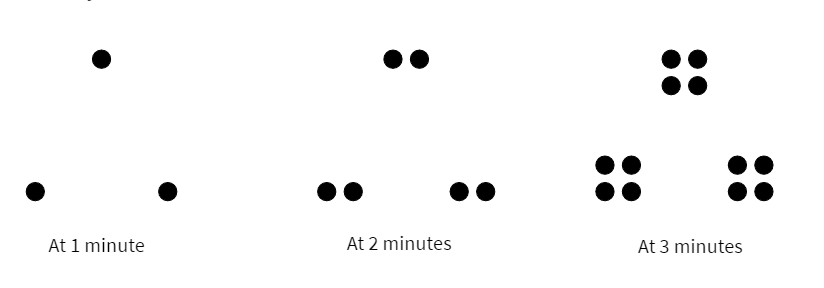
Write the recursive equation to model the pattern if the diagram were relabeled.
Escribe la ecuación recursiva para modelar el patrón si el diagrama fuera reetiquetado.
In this lesson, we modeled a growing pattern using tables, graphs, and equations. We learned about a new type of function, a geometric sequence that has a common ratio between terms.
Katika somo hili, tuliiga mfano unaokua kwa kutumia meza, grafu, na hesabu. Tulijifunza juu ya aina mpya ya kazi, mlolongo wa kijiometri ambao una uwiano wa kawaida kati ya maneno.
En esta lección, modelamos un patrón de crecimiento usando tablas, gráficos y ecuaciones. Aprendimos sobre un nuevo tipo de función, una secuencia geométrica que tiene una razón común entre términos.
Check for Understanding:
Angalia Uelewa:
Hubi Fahamka:
Reba kugirango ubyumve:
Verificar comprensión:
1 point
1
Question 26
26.
How are the outputs in the table in an arithmetic sequence like we saw in Growing Dots different from the outputs in the table of a geometric sequence like we worked with in this task?
¿En qué se diferencian los resultados de la tabla en una secuencia aritmética como la que vimos en Puntos crecientes de los resultados de la tabla de una secuencia geométrica como la que trabajamos en esta tarea?
Tutoring Help:
Msaada wa Tutoring:
Ubufasha bw'abatoza:
Caawinta Tababarka:
Tutoría Ayuda:
Extra Practice
Practica extra
Imyitozo y'inyongera
Mazoezi ya Ziada
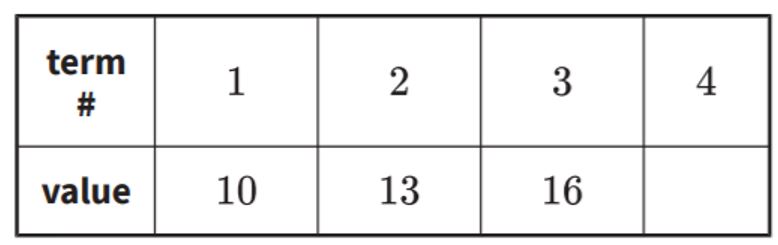
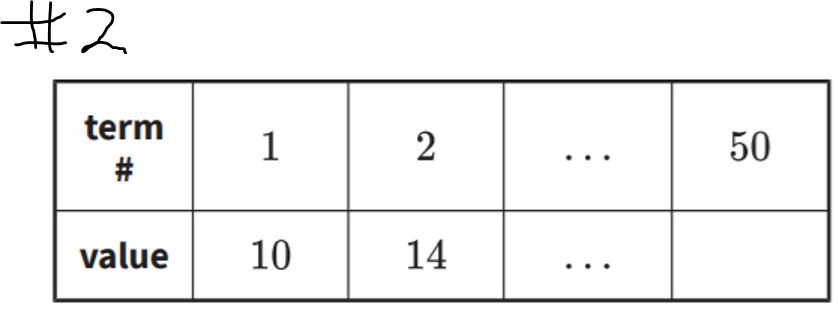
For problems 1-4, create the missing equation for the sequence based on the table, the description, or the given equation. Then decide which equation will help to find the missing term of the sequence most efficiently. Find the term and explain your choice.
Kwa shida 1-4, tengeneza equation iliyokosekana kwa mlolongo kulingana na meza, maelezo, au equation iliyopewa. Kisha amua ni mlingano gani utasaidia kupata muda uliopotea wa mlolongo kwa ufanisi zaidi. Pata neno na ueleze chaguo lako.
Para los problemas 1-4, cree la ecuación que falta para la secuencia según la tabla, la descripción o la ecuación dada. Luego, decida qué ecuación ayudará a encontrar el término faltante de la secuencia de manera más eficiente. Encuentra el término y explica tu elección.
Urukurikirane rurimo gukuba kabiri kuri buri ntambwe.
Explicit equation: f(n) = 6(2^n)
Ikigereranyo cyumvikana: f (n) = 6 (2^n)
Mlingano wazi: f (n) = 6 (2^n)
Ecuación explícita: f (n) = 6 (2^n)
1 point
1
Question 33
33.
Recursive equation:
Ecuación recursiva:
Ikigereranyo gisubiramo:
Mlinganyo wa kurudia:
1 point
1
Question 34
34.
Find the value of the 3rd
term:
Pata thamani ya muda wa 3:
Encuentra el valor del tercer término:
Shakisha agaciro ka manda ya 3:
1 point
1
Question 35
35.
Explanation:
Ibisobanuro:
Ufafanuzi:
Explicación:
#4. The value of the 3rd term is 12.
The sequence is being doubled at each step.
# 4. El valor del tercer término es 12.
La secuencia se duplica en cada paso.
# 4. Agaciro ka manda ya 3 ni 12.
Urukurikirane rurimo gukuba kabiri kuri buri ntambwe.
# 4. Thamani ya kipindi cha 3 ni 12.
Mlolongo unakuwa mara mbili kwa kila hatua.
Recursive: now = previous term x 2
Inajirudia: sasa = muda uliopita x 2
Recursivo: ahora = término anterior x 2
Isubiramo: ubu = ijambo ryabanje x 2
1 point
1
Question 36
36.
Explicit equation:
Ikigereranyo cyumvikana:
Mlingano dhahiri:
Ecuación explícita:
1 point
1
Question 37
37.
Find the value of the 10th term:
Encuentra el valor del décimo término:
Shakisha agaciro ka manda ya 10:
Pata thamani ya muda wa 10:
1 point
1
Question 38
38.
Explanation:
Ufafanuzi:
Explicación:
Ibisobanuro:
Evaluate the function to determine the output.
Suzuma imikorere kugirango umenye ibisohoka.
Tathmini kazi ili kubaini pato.
Evalúe la función para determinar la salida.
Example:
Recall that f(2) means to replace the value of n with 2 and work the problem to find f(n). The point (f, f(n) ) would be the location on a coordinate graph where n describes the location along the x-axis and f(n) is the height of the graph. So that if f(n) = 2n + 2, then f(5) = 2(5) + 2 = 10 + 2 = 12
Ejemplo:
Recuerde que f (2) significa reemplazar el valor de n con 2 y resolver el problema para encontrar f (n). El punto (f, f (n)) sería la ubicación en un gráfico de coordenadas donde n describe la ubicación a lo largo del eje xy f (n) es la altura del gráfico. De modo que si f (n) = 2n + 2, entonces f (5) = 2 (5) + 2 = 10 + 2 = 12
Urugero:
Ibuka ko f (2) bisobanura gusimbuza agaciro n n 2 hanyuma ugakora ikibazo kugirango ubone f (n). Ingingo (f, f (n)) yaba ikibanza kiri ku gishushanyo mbonera aho n isobanura ahantu hafi ya x-axis na f (n) ni uburebure bwishusho. Kugira ngo niba f (n) = 2n + 2, noneho f (5) = 2 (5) + 2 = 10 + 2 = 12
Mfano:
Kumbuka kwamba f (2) inamaanisha kuchukua nafasi ya thamani ya n na 2 na utumie shida kupata f (n). Hoja (f, f (n)) itakuwa mahali kwenye grafu ya kuratibu ambapo n inaelezea eneo kando ya mhimili wa x na f (n) ni urefu wa grafu. Ili kwamba ikiwa f (n) = 2n + 2, basi f (5) = 2 (5) + 2 = 10 + 2 = 12
Given that f(n) = 2(2)^n and g(n) = 8(5)^n, evaluate the following functions with the indicated values.
Kwa kuwa f (n) = 2 (2) ^ n na g (n) = 8 (5) ^ n, tathmini kazi zifuatazo na maadili yaliyoonyeshwa.
Dado que f (n) = 2 (2) ^ n y g (n) = 8 (5) ^ n, evalúe las siguientes funciones con los valores indicados.
Urebye ko f (n) = 2 (2) ^ n na g (n) = 8 (5) ^ n, suzuma imirimo ikurikira hamwe nagaciro kerekanwe.