Please complete the final unit assessment below. Good luck! 🍀
4
MS-PS3-1
2
Question 2
2.
Describe how you used the information about the falling pine cones to choose your answer.
MS-PS3-1
Question 3
3.
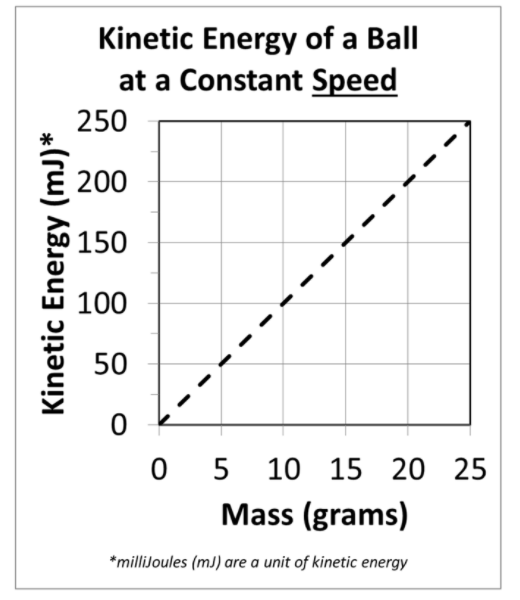
Refer to the graph below.
A student is investigating the kinetic energy of a ball that has been thrown.
In the first experiment, a ball is thrown at the same speed every time. On each throw the student increases the mass of the ball. The results are shown on the left.
4
Question 4
4.
When a ball with a mass of 10 grams is thrown, what is the kinetic energy of the ball?
MS-PS3-1
4
MS-PS3-1
3
MS-PS3-1
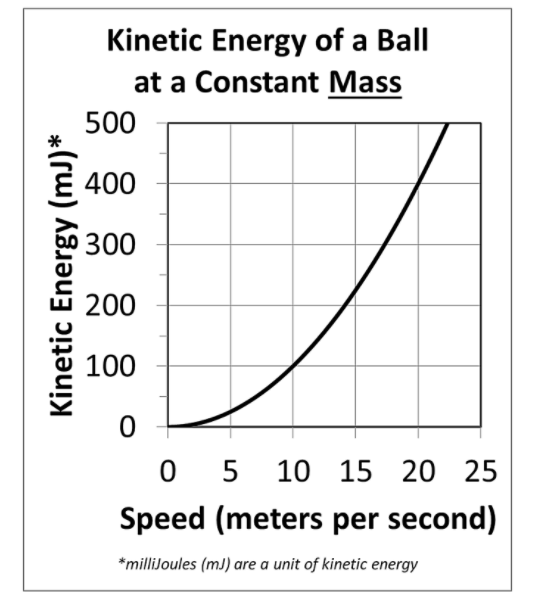
In the second experiment, a ball of the same mass is used every time. On each throw the student increases thespeed of the ball. The results are shown below.
4
Question 7
7.
When the ball is thrown at 10 meters per second, what is the kinetic energy of the ball?
MS-PS3-1
4
MS-PS3-1
3
MS-PS3-1
Question 10
10.
Question 11
11.
Question 12
12.
Question 13
13.
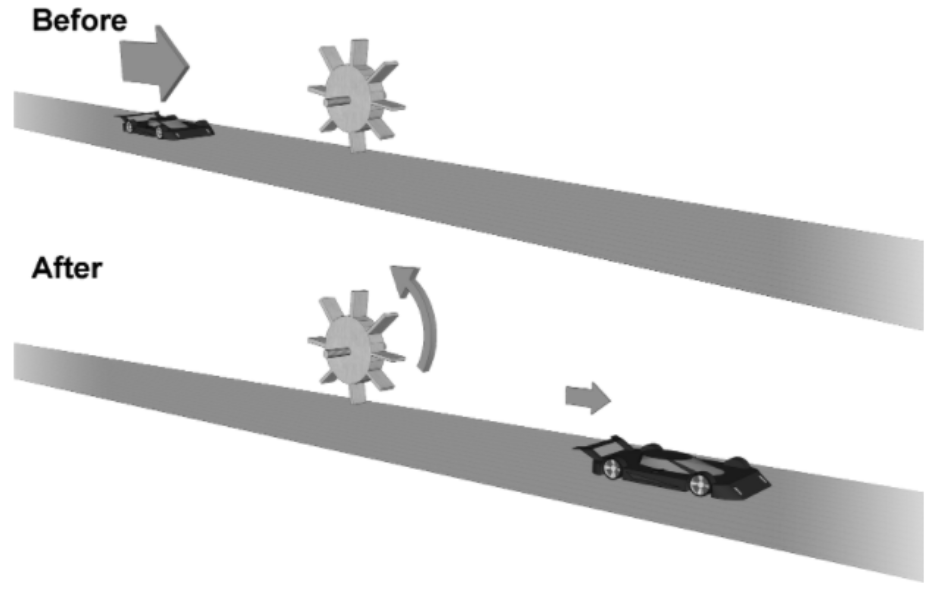
Examine the system model below, which shows a car moving along a track at two different points in time.
Assume there is no friction between the car and the track.
In the before image, a car is moving along a track at a constant speed towards a motionless wheel.
In the after image, the car has contacted the wheel, which begins to spin. The car continues to travel along the track at a slower speed.
Use your knowledge of the transfer of energy to complete the claim below to describe what causes the wheel to spin after contact with the car. Then, complete your scientific explanation by supporting your claim with evidence and reasoning.
Question 14
14.
Claim: The wheel begins to spin because...
Question 15
15.
Evidence: (Provide the data that can be used to support your claim.)
Question 16
16.
Reasoning: (Use scientific concepts to describe how the evidence supports your claim.)
Question 17
17.
Question 18
18.
Question 19
19.
Question 20
20.
Question 21
21.
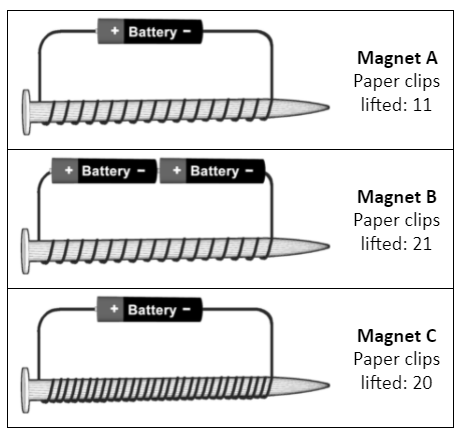
In an experiment to test the construction of electromagnets, the three electromagnets in the diagram were used to lift paperclips. The average number of paperclips each could lift is listed to the right of each diagram. The number of paperclips lifted indicates the strength of the electromagnet (more paper clips = stronger electromagnet).
Make a bar graph of the results of this experiment. The x-axis has been completed for you. Be sure to include a label and scale on the y-axis and provide a title for the graph.
Question 22
22.
Examine the diagram for differences between the electromagnets. Describe two differences you observe in the space below.
Question 23
23.
Fill in the blanks below to write a hypothesis about how the construction of an electromagnet will affect its strength. (Remember, "construction" means the way that it's built or designed."
My hypothesis is that if the construction of the electromagnet is changed by ____________________________,
it will increase the strength of the electromagnet.
⭐⭐⭐ This is the end of the assessment. PLEASE review your work - go back and see if you have missed any answers or explanations. When you have double-checked your work, please SUBMIT the Formative.
Question 1
1.
The kinetic energy of Object 1 is greater than the kinetic energy of Object 2. How does the speed of Object 1 compare to the speed of Object 2?
Object 1 is moving faster than Object 2.
Object 1 is moving slower than Object 2.
Object 1 is moving at the same speed as Object 2.
The only way to know which object is moving faster is to also know the mass of each object.
Question 5
5.
When a ball with a mass of 20 grams is thrown at the same speed, what is the kinetic energy of the ball?
Question 6
6.
Question 8
8.
When a ball of the same mass is thrown at 20 meters per second, what is the kinetic energy of the ball?
Question 9
9.
Use the data from the graphs above to complete the following sentence:
Doubling the mass of a moving object has ______________ effect on its kinetic energy than doubling the speed.
a larger
a smaller
the same
There is not enough information to tell.
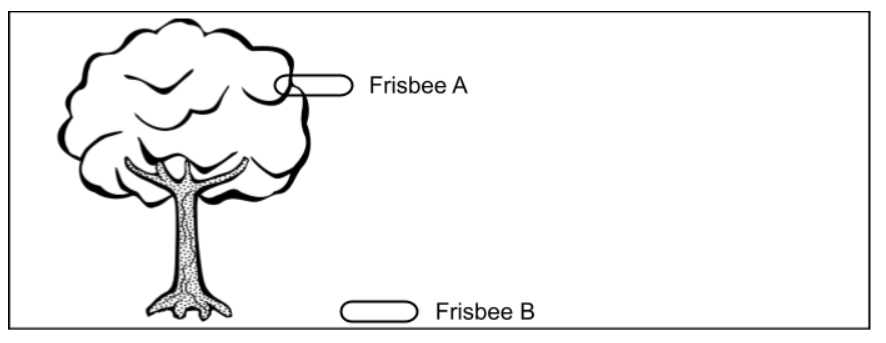
A system you are studying contains four parts:
The Earth’s surface (the ground)
A tree
A Frisbee stuck in the tree
A Frisbee resting on the Earth’s surface
Look at the model of the system below.
Which Frisbee has the greatest potential energy?
Frisbee A
Frisbee B
The Frisbee in the tree falls to the ground. As the Frisbee is falling:
Kinetic energy of the Frisbee is increasing, and potential energy is decreasing.
Kinetic energy of the Frisbee is decreasing, and potential energy is increasing.
Both kinetic energy and potential energy of the Frisbee are increasing.
Kinetic energy and potential energy of the Frisbee both stay the same.
You throw one of the Frisbees back up into the tree, where it comes to rest on a branch.
Compared to when both Frisbees were on the ground, which of the following is true about the effect this has on the potential energy of the Frisbee?
Potential energy increases.
Potential energy decreases.
Potential energy does not change.
Potential energy increases and then decreases.
A balloon with a static electric charge is placed near a student’s hair, causing the hair to stand up. Which of the following would increase the attractive force that the balloon exerts (puts on) on the student’s hair?
Changing the side of the balloon facing the hair.
Increasing the strength of the charge on the balloon.
Increasing the size of the balloon.
The force remains the same if the balloon is moved or the charge is changed.
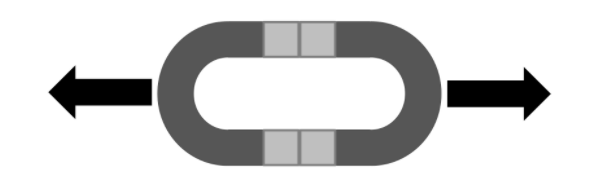
Two magnets are at rest on a table, as shown in the diagram below. In order to get the two ends of the magnets marked N to touch, which of the following is true?
A force must be applied, since the two ends marked N repel each other.
A force must be applied, since the two ends marked N attract each other.
The magnets will touch without any force being added.
Which of the following statements about electric and magnetic forces is TRUE?
Both electric and magnetic forces can be attractive.
Magnetic forces can be repulsive, but electric forces cannot.
Electric forces are not affected by distance, but magnetic forces are.
Magnetic and electric forces do not interact.
Two strong magnets are attracted to each other and are touching, as shown in the diagram below. You pull them apart. What will happen to the force the magnets exert on each other as they move apart?
As the magnets begin to move apart, they immediately stop exerting a force.
As the magnets begin to move apart, the force exerted increases.
As the magnets begin to move apart, the force exerted decreases.
As the magnets begin to move apart, no change in force occurs.
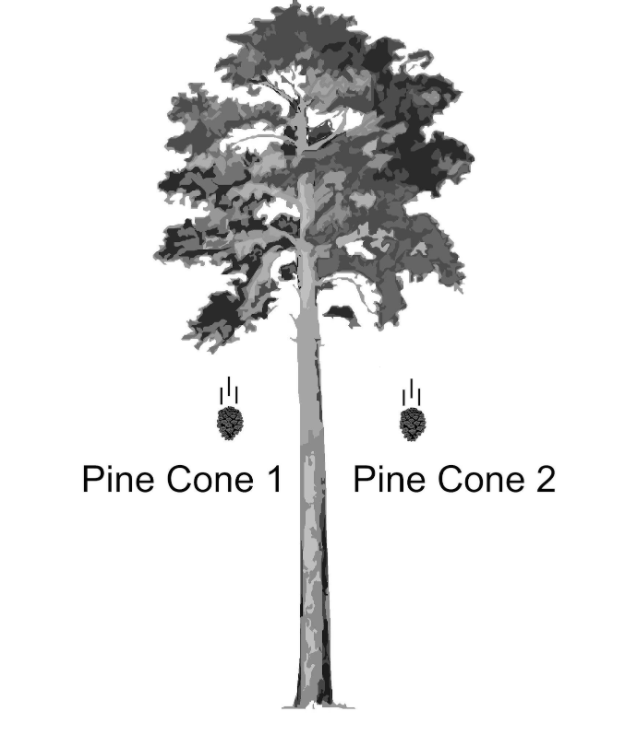
Two pine cones are falling from a pine tree. Both pine cones are falling at the same speed.
If Pine Cone 1 weighs less than Pine Cone 2, which pine cone has more kinetic energy?
Pine Cone 1 has more kinetic energy.
Pine Cone 2 has more kinetic energy.
Both pine cones have the same amount of kinetic energy.
Neither pine cone has any kinetic energy.
Choose the correct answer to complete the statement:
When two balls are thrown at the same speed, the kinetic energy of the 20 gram ball is _________ the kinetic energy of the 10 gram ball.
half (1/2x)
two times (2x)
the same as (=)
four times (4x)
Choose the correct answer to complete the statement:
When two balls of the same mass are thrown, the kinetic energy of a ball thrown at 10 meters per second is __________ the kinetic energy of a ball thrown at 20 meters per second.