Log in
Sign up for FREE
arrow_back
Library

Week 10: Science -Review

star
star
star
star
star
Last updated about 2 years ago
19 questions
Required
2
Required
1
Required
1
Required
1
1
Required
1
Required
1
Required
1
Required
1
Required
1
Required
1
Required
1
Required
1
Required
1
Required
1
Required
1
Required
1
1
1
Welcome Back! Week10: Review has 19 questions from earlier in the summer.

Be sure to attempt all the questions and submit when you are finished. Please contact me through the comment feature or send an email to rshaw@fergflor if you have any questions.
Question 1
1.

Question 2
2.

Question 3
3.

Question 4
4.

Question 5
5.

Question 6
6.

What is thermal equilibrium?


Question 7
7.

When an object gains heat energy, do the particles inside the object move faster or slower?

Question 8
8.

Question 9
9.

Question 10
10.

Question 11
11.

Question 12
12.

Question 13
13.

Question 14
14.

Question 15
15.

Question 16
16.

Draggable itemarrow_right_altCorresponding Item
arrow_right_alt
arrow_right_alt
arrow_right_alt
Question 17
17.

Question 18
18.

Question 19
19.

If you were to do this again next year, what would you suggest changing regarding the ten week review lessons?

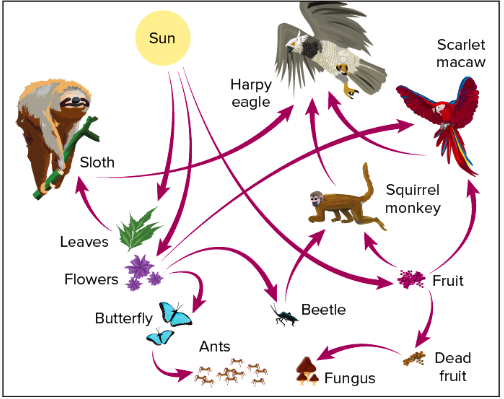
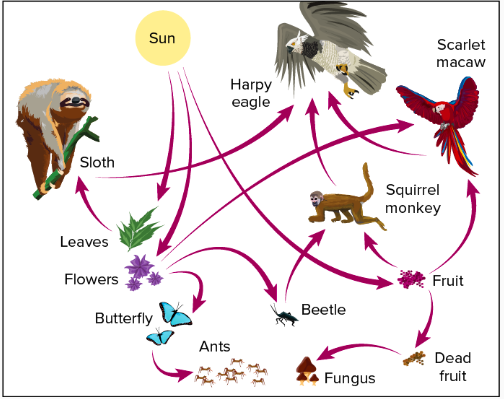
Analyze the food web above. Which of the following are producers? Select all that apply.
Butterfly
Leaves
Flowers
Sloth
Beetles
Fruit
Analyze the food web above. Which statement is true?
The harpy eagle eats more types of organisms in the food web than the scarlet macaw does.
The harpy eagle eats the same types of organisms in the food web than the scarlet macaw does.
The scarlet macaw eats the same types of organisms in the food web than the harpy eagle does.
The scarlet macaw is eaten by the same types of organisms in the food web than the harpy eagle is.
Mutualism (+/+)
Both organisms benefit
Parasitism(+/-)
1 organism benefits, the other is harmed
Commensalism(+/o)
1 organism benefits, the other is unaffected
Mutualism (+/+)
Both organisms benefit
Parasitism(+/-)
1 organism benefits, the other is harmed
Commensalism(+/o)
1 organism benefits, the other is unaffected
What is the total energy of all the particles in an object called?

chemical energy
thermal energy
potential energy
nuclear energy
Which kinds of materials do not conduct heat well?

conductors
radiators
insulators
metals
Heat energy transferred by direct touch is a process called what?

friction
radiation
convection
conduction
which of the following is an example of a vestigial structure?
the wings of a red-tailed hawk
the hind limbs of a house cat
the fins of sharks
the wings of an ostrich
What is an example of a vestigial structure of a HUMAN? Select all that apply.
Femur
Wisdom Teeth
Brain
Finger
Goosebumps
Appendix
Tailbone
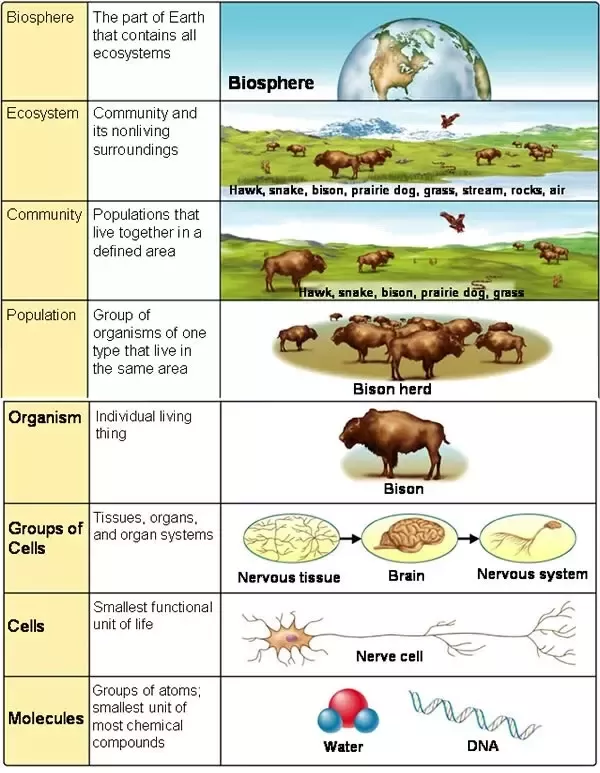
What is the best description of a population?
Population size compared to amount of space and resources available
The demand for resources such as food, water, and shelter
Parts of Earth and the atmosphere where life is found

What does it mean when animals "compete"
They have a demand for resources like food, water, and shelter
They have atmosphere and life around them
They live in the same area at the same time
Sort the variables based on whether they are independent or dependent
Time spent studying unit
Grade on unit test
Independent
Dependent
Sort the variables based on whether they are independent or dependent
Number of books someone has read
Number of words in their vocabulary
Independent
Dependent
Does heating a cup of water allow it to dissolve more sugar? Temperature of the water is measured in degrees Centigrade. Amount of sugar is measured in grams.
Temperature of water (Degrees C)
Dependent Variable
Water, amount of water, heating method
Independent Variable
Amount of sugar dissolved (g)
Constants
Fossil fuels negatively impact the environment, especially because of all of the carbon emissions
True
False
A renewable resource is …
A resource that is being (or can be) replenished as it is used
A resource that is being used up faster than it can be replenished
A resources that has no environmental impact