Log in
Sign up for FREE
arrow_back
Library

9/6 Diagnostic Exam_adv - ETM

star
star
star
star
star
Last updated over 3 years ago
34 questions
Required
0
Required
1
Required
1
Required
1
Required
1
Required
1
Required
1
Required
1
Required
1
Required
1
Required
1
Required
1
Required
1
Required
1
Required
1
Required
1
Required
1
Required
1
Required
1
Required
1
Required
1
Required
1
Required
1
Required
1
Required
1
Required
1
Required
1
Required
1
Required
1
Required
1
Required
1
Required
1
Required
1
Required
1
Question 1
1.

Question 2
2.

Question 3
3.

Question 4
4.

Question 5
5.

Question 6
6.

Question 7
7.

Question 8
8.

Question 9
9.

Question 10
10.

Question 11
11.

Question 12
12.

Question 13
13.

Question 14
14.

Question 15
15.

Question 16
16.

Question 17
17.

Question 18
18.

Question 19
19.

Question 20
20.

Question 21
21.

Question 22
22.

Question 23
23.

Question 24
24.

Question 25
25.

Question 26
26.

Question 27
27.

Question 28
28.

Question 29
29.

Question 30
30.

Question 31
31.

Question 32
32.

Question 33
33.

Question 34
34.

Tell me about the structures used in your 6, 7, or 8th grade science class. What structures did those teachers use that worked for you? (For example: name of a useful website or tech tool, a kind of activity, a type of game, etc. ) Try to explain using a few sentences or more.

What language version of this diagnostic would you prefer?
english version
spanish version
other language version
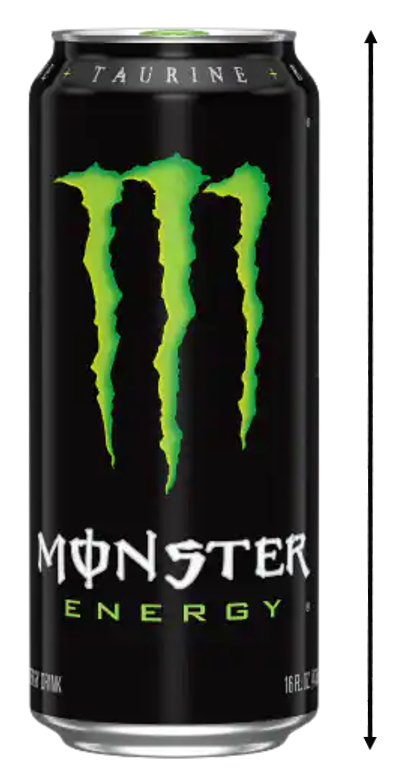
Estimate the shorter side of the object below without a ruler. (Don't click to enlarge picture)

between 0 and 1 inches
between 3 and 4 inches
between 4 and 5 inches
betwen 5 and 6 inches
Estimate the longer side of the object without a ruler. (Don't click to enlarge picture)

between 7 and 8 inches
between 3 and 4 inches
between 1 and 2 inches
between 0 and 1 inch
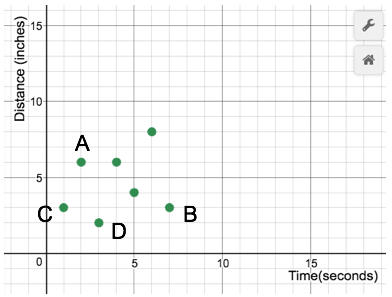
Which dot on the graph is most closely associated with time = 7 seconds and distance = 4 inches?

*associated can mean "connected to"

dot A
dot B
dot C
dot D
Which dot on the graph is most closely associated with time = 6 seconds and distance = 7 inches?

*associated can mean "connected to"


dot A
dot B
dot C
dot D
What values on the graph are most closely associated with Dot C?

*associated can mean "connected to"

time = 3 seconds, distance = 2 inches
time = 3 seconds, distance = 6 inches
time = 1 seconds, distance = 6 inches
time = 1 second, distance = 3 inches
What values on the graph are most closely associated with Dot B?

*associated can mean "connected to"

time = 1 seconds, distance = 3 inches
time = 7 seconds, distance = 3 inches
time = 3 seconds, distance = 7 inches
time = 5 second, distance = 4 inches
The data in the graph below is showing what kind of trend?

as time increases, distance decreases
as time decreases, distance increases
as time increases, distance increases
as time increases, distance remains constant
Which graph below only shows the trend “as stretch distance increases, force increases”?

graph A
graph B
graph C
graph D
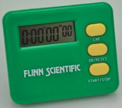
What time does the stopwatch below display?

two minutes and 37 seconds
two seconds and 37 hundredths of a second
thirty-seven minutes and two seconds
two hours and 37 minutes
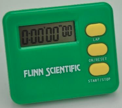
What time does the stopwatch below display?

1 day, 4 hours, and 59 minutes
59 hours, 4 minutes, and 1 second
1 hour, 4 minutes, and 59 seconds
1 minute, 4 seconds, and fifty-nine hundredths of a second
You are given the assignment to time your walk from home to school. As you stand outside your home holding a stopwatch, what step makes the most sense to begin with?

press the “START” button
press the “STOP” button
press the “RESET” button
press the “LAP” button
Continuing the previous question, some time later you arrive at Pritzker. As you arrive at the front door holding the stopwatch, what step makes the most sense to do now?

press the “START” button
press the “STOP” button
press the “RESET” button
press the “LAP” button
What units are shown on the graph?

Distance, Time
seconds, meters
distance, meters
Time, seconds
Which axis has the numbers "0, 10, 20, 30" on it?

horizontal axis
vertical axis
What is the title of the graph?

time (seconds)
Time versus Distance
Distance versus Time
Distance (meters)
What variables are shown on the graph?

Distance, Time
meters, seconds
distance, meters
Time, seconds
Physics students were directed to measure the width of their table. The results of their
measurements were 3 feet, 6 feet, and 6 feet. Determine the average of all the measurements made.
3 feet
5 feet
6 feet
15 feet
Physics students were directed to measure the length of their table. The results of their
measurements are in the data table below. Determine the average of all the measurements made.

6 feet
7 feet
4 feet
18 feet
If for every one minute there is 60 seconds then how many seconds are in 4 minutes?
15 seconds
240 seconds
604 seconds
64 seconds
If 20 pesos can be traded for 1 dollar than how many dollars can 180 pesos be traded for?
9 dollars
3600 dollars
360 dollars
200 dollars
If 1 dollar can be traded for 20 pesos and 1 peso can be traded for 4 Indian Rupees than how
many Indian Rupees can 5 dollars be traded for?
85 Indian Rupees
25 Rupees
80 Rupees
400 Rupees
Which unit name below can be used to measure how far you live from school (distance)?
minutes
pounds
miles
miles per minute
Which unit name below can be used to measure the time it takes you to get to school?
minutes
pounds
miles
miles per minute
Which of the two arguments below is a scientific argument?
We studied 14 people during a exercise test. Five people wore cloth masks, five wore surgical masks, and four did not wear a mask. After intense exercise, we measured no difference in blood oxygen or tissue oxygenation between any of the people tested. Therefore, wearing a mask has no effect on exercise performance or blood oxygen levels.
We studied 20 articles online and half of them said that wearing a mask prevents your brain from getting enough oxygen. We also found that most people we know don't like wearing masks when they exercise. Therefore, it is dangerous to wear a mask.
Substitute the given value for “x” into the equation and solve for “y”.

x = 5; y = 8x
y = 85
y = 8/5
y = 40
y = 13
Substitute the given values for “x” and “y” into the equation and solve for “z”.

x = 12; y = 3;
z = 4
z = 36
z = 40
z = 123
A friend walks from home to school the first day. They take 20 minutes to walk the 16 blocks. What was their rate of motion while walking?
0.8 blocks for every one minute
1.25 blocks for every one minute
36 blocks for every one one minute
4 blocks for every one minute
You decide to jog from home to a friend's house. You start by jogging at a rate of 1.5 blocks for every one minute for ten minutes. Then you jog 5 more blocks arriving at your friend's house. In total, how far did you jog?
15 blocks
16.5 blocks
20 blocks
75 blocks

The diagram below shows a race among five turtles: Tony, Ben, Tess, Geronimo and Proton.


Which turtle is immediately behind Tess in the race?

Ben
Geronimo
Tony
Proton
The formula for calculating Kinetic Energy is:

*mass is abbreviated as "m"
*velocity is abbreviated as "v"

If a person with mass 60 kilograms runs with a velocity of 3 meters per second then what is their kinetic energy?
180 units of energy
540 units of energy
270 units of energy
360 units of energy

A student notices some people run in the rain and some people walk. They wonder if the walking person always gets more rain. They decide to test this using a sponge. In one situation they walk in the rain with a sponge and measure the water squeezed out afterwards.

In a different situation they run in the rain and measure the water squeezed out. They compare the amounts of water and find that in both situations the sponge absorbed about 1 ounce of rain. Later that day they explain what they did and how it turned out to their parents.


Which sentence represents the "Analyze Data" step of the scientific method?

A student notices some people run in the rain and some people walk.
They wonder if the walking person always gets more rain.
They decide to test this using a sponge. In one situation they walk in the rain with a sponge and measure the water squeezed out afterwards.
In a different situation they run in the rain and measure the water squeezed out.
They compare the amounts of water and find that in both situations the sponge absorbed about 1 ounce of rain.
Later that day that explain what they did and how it turned out to their parents.
What is the question below asking for?

Jon and Marlene walk to school. They travel eight city blocks in 25 minutes. Determine how fast they walked to school.
eight city blocks and 25 minutes
how fast they walked to school
where did Jon and Marlene go
how far did they walk