Log in
Sign up for FREE
arrow_back
Library

EcoFootprint/Tragedy of the Commons REDemption

star
star
star
star
star
Last updated 12 months ago
8 questions
1
1
1
1
1
1
1
1
Question 1
1.

Question 2
2.

Question 3
3.

Question 4
4.

Question 5
5.

Question 6
6.

Question 7
7.

Question 8
8.

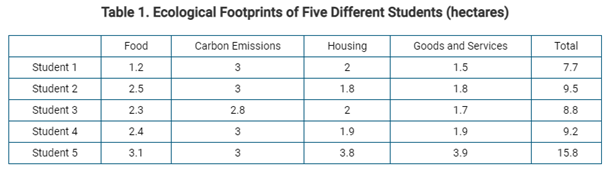
Which of the following is a limitation of using only the data in the table to complete an ecological footprint analysis of the different students?
The footprint is a static analysis and does not include all environmental impacts of an individual.
The footprint uses a top-down approach to provide a complete picture of resource use for comparison between individuals.
The footprint for each individual is based on simple calculations to determine approximate resource use.
The footprint uses global hectares, rather than hectares, to determine the approximate proportion of Earth’s surface needed to support the activities of an individual.
If Student 2 wanted to change his or her footprint to be more similar to that of Student 1, which of the following actions would he or she choose based on the data given in table 1?
Reducing the amount of meat in his or her diet
Moving into a smaller home or an apartment complex
Using mass transit options when available
Upgrading his or her electronic devices, such as laptops and cell phones, more often
After reviewing personal footprint data, Student 5 decides to take action to lower his or her overall footprint by reducing money spent on shoes and clothing. Land use in which of the following categories will be most affected by this change?
Goods and services
Carbon emissions
Food
Housing
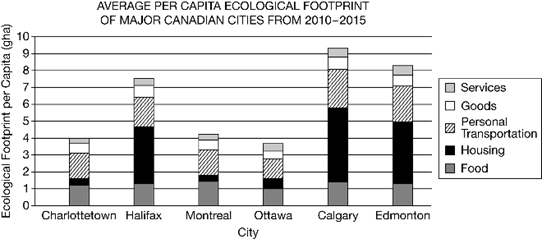
Based on the data in the graph, which of the following Canadian cities had the lowest average per capita ecological footprint?
Halifax
Montreal
Charlottetown
Ottawa
Which of the following is the best example of a tragedy of the commons?
Accumulation of plastics in the Great Pacific Garbage Patch
Requiring permits for grazing cattle on United States parklands
Depletion of crude oil on private lands
Eutrophication of a pond on a farmer’s land
Which of the following scenarios best explains the concept of the tragedy of the commons?
Fish are shared resources, and as the fishing industry competes for the fish, the resource extraction is no longer sustainable.
Fish farming, a type of aquaculture, produces fish through selective breeding to produce a cheap source of protein, reducing the fishing pressure on wild stock fish
A collapse of the fishing industry leads to a loss of fishing-related jobs, which will have negative consequences on the economy.
Declines in the fish population lead to a decline in the population of fish predators, affecting the entire food chain.
One example of the tragedy of the commons occurs when trees are harvested from tropical rain forests without any regulations. Which of the following best describes why this is an example of the tragedy of the commons?
Timber producers remove as much timber as possible as cheaply as possible.
Tropical rain forests have the highest number of species per unit area, and trees are important for stability in the ecosystem.
Trees are an important resource, but not all individuals can access the resource.
Tropical rain forests have a thin layer of decaying organic matter and relatively low nutrient levels slowing tree growth.
Which of the following characterizes Garrett Hardin's 'tragedy of the commons'?
It is in each farmer's interest to graze as many sheep as possible before the grass has become completely grazed, thereby over-exploiting the pasture.
No farmer can afford to reseed the pasture, in which case the grass is never replenished.
Even if each farmer agreed to limit the number of sheep they graze, they can't know how many sheep are too many, thereby over-exploiting the pasture.
The farmers are unable to agree on a set of rules that determine who is responsible for reseeding the pasture and how many sheep are allowed.