A2jlg

Last updated over 3 years ago
30 questions
1

A2 Many molecules (DNA, proteins, carbohydrates etc) are polymers. There are many reasons polymers are so important in biology.
Which is not a correct reason?

1

A2 What is the key difference between lipids (fats) and carbohydrates?

1

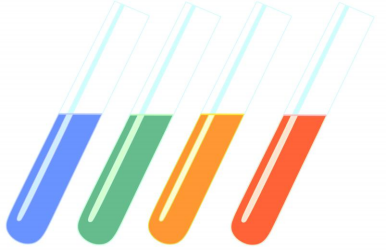
A2 In people with diabetes, blood sugar levels may become very high. The kidney usually reabsorbs all the sugar from blood plasma it fliters into urine. However, in diabetic people, the rate of glucose reabsorption in the kidney may become saturated. A Benedict's test used to be used to test the amount of sugar in samples from diabetic people.
Which is order of samples, from left to right, giving the results shown in the test-tubes?
1

A2 Plants use underground tubers to store carbohydrates densely over the winter. Plants pack fruits with sweet tasting carbohydrates to attract animals which will disperse their seeds. Other parts of the plant contain a mix of sugars being transported and metabolised or stored.
An iodine test was used on samples from a plant. Which is order of samples, from left to right, giving the results shown in the test-tubes?
1

A2 Albumins are soluble proteins present at extremely high concentrations in biological fluids (such as blood). When denatured, albumins loose certain properties, which is why fluids (such as egg whites) set when heated.
What key property do you suppose albumins have?

1

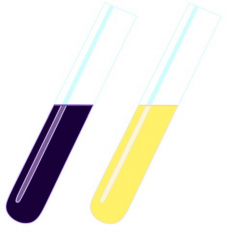
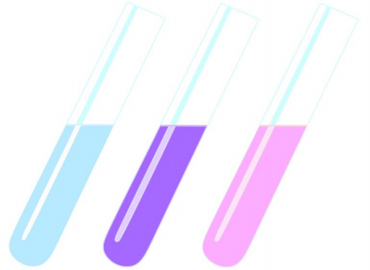
A2 A Biuret test was carried out on samples from these experiments.
Which is order of samples, from left to right, giving the results shown in the test-tubes?
1

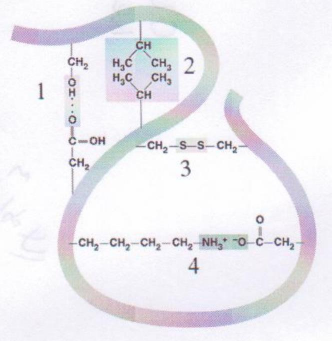
A2 Various forces are important in the interactions contributing to the tertiary structure of a protein.
The figure below is a diagram showing several possible interactions.
Which of the following letters represent the correct names for each type of interaction?

1

A2 In which of the following polymers would you find alpha glucose joined only by 1,4 glycosidic bonds?

1

A2 Four different concentrations of glucose solution were each tested using Benedict's solution. The same volume of glucose and Benedict's solution was used in each case. After 5 minutes the colour of the precipitate was noted:
Place the samples in increasing order of concentration.

  1. Sample 2: yellow
  2. Sample 4: brick-red
  3. Sample 3: green
  4. Sample 1: orange
1

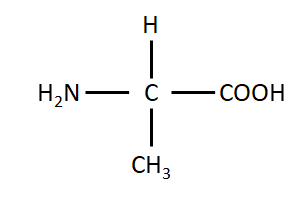
A2 The amino acid alanine is shown below.
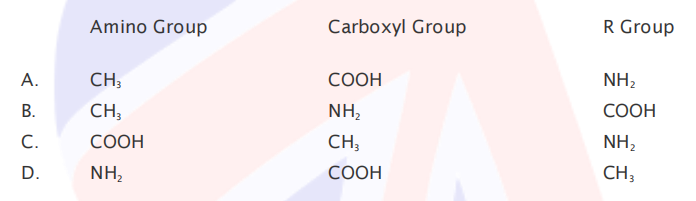
Which of the following parts of the molecule are the amino group, the carboxyl group and the R (variable) group?

1

A2 Titin is the largest known protein and is a component of muscle. In humans the protein is 34,350 amino acids long.
What is the minimum length of the human gene for titin?

1

A2 Which of the following is true of human metabolism?

1

A2 Plants use starch to store glucose, whilst animals store glycogen. Starch and glycogen stores have
different properties which reflect the different ways plants and animals function.
Which of the following is NOT a correct explanation of the difference between plant and animal stores?

1

A2 Which of the following elements is NOT present in haemoglobin?

1

A2 Humans have various stores of chemical energy. We store more of our energy reserves in some chemicals than others.
Put them in order from least energy stored to most energy stored.

  1. Phospho-creatine
  2. ATP
  3. Liver glucose
  4. Blood glucose
  5. Protein
  6. Fat
1

A2 Plants use starch to store glucose, whilst animals store glycogen. Starch and glycogen stores have different properties which reflect the different ways plants and animals function.
Which of the following is NOT a correct explanation of the difference between plant and animal stores?

1

A2 Many biological substances are polymers of simpler subunits. Condensation reactions join two molecules and water is produced as a product.
Which polymer is NOT produced in a condensation reaction?

1

A8 The main component of blood plasma is:

1

A2.2 Complete the answer table to indicate which of the following statements are true (+ ) and which are false (-).

1

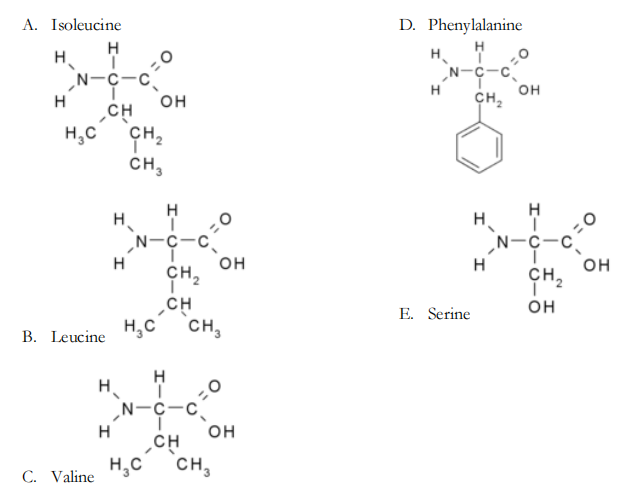
A2 The tiny hairs on a gecko's toes enable it to climb walls. The hairs are made of hydrophobic
keratin and adhere to surfaces via van der Waals interaction. At the tiny interface where the
gecko's toe hairs touch the surface it climbs, which amino acid are you LEAST likely to find?

1

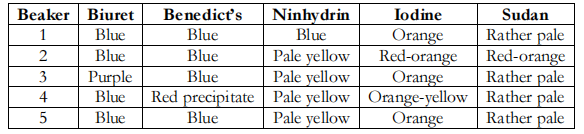
A2 While preparing to teach an organic chemistry class, Professor Dacb has managed to mix up
several beakers. He has taken samples from each beaker and enlisted your help in identifying them. Below are the results of a series of reagent tests.
Which of the following correctly matches each beaker to its possible contents?

1

A2 Which one of the statements relating to the isoelectric pH of a tetrapeptide is true?

1

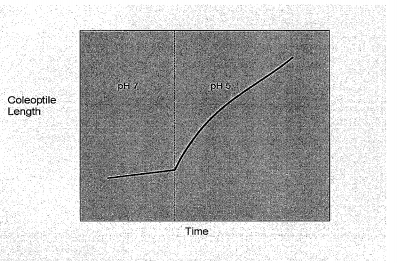
A2 A growing coleoptile was cut from a plant, frozen, thawed, hung on a position transducer and
subjected to constant force first at pH7 and then at pH5. The following plot was obtained (note that
the vertical line indicates the time at which pH was shifted from 7 to 5).
Which statement explains the increase in growth following transfer from pH7 to pHS?

1

A2 Which of the following is responsible for the summer and winter stratification of lakes?

1

A2 A sample of human blood is taken, and it is found that all of the cells are alive. The blood is then frozen at –20°C. One day later the blood is thawed and heated to 37°C and it is found that no cells in the blood are living. Why have the cells died?

1

A2 It is often commented that when the air is 30°C and has a relative humidity value of 95% that it "feels" much hotter than when the air is 30°C and has a relative humidity value of 50%. The reason for this is:

1

A2 Which property of water is most important to plants living below the surface of water in ponds?

1

A2.31 The structural level of a protein least affected by a disruption in hydrogen bonding is:

1

A2.22 The hydrolysis of a triglyceride leads to which of the following:
1. products which are less soluble in water than are triglycerides
2. an increase in pH
3. a decrease in pH

1

A2.31 A2.21 Which of the following statements are true of both cellulose and protein?
1. They may be used as an energy source by certain organisms
2. They are polymers of large molecular mass
3. They act as structural materials in the cell membrane
4. They are synthesized by a series of condensation reactions