Log in
Sign up for FREE
arrow_back
Library

The Photoelectric Effect Alternate E-day Project

star
star
star
star
star
Last updated about 1 year ago
28 questions
Note from the author:
You have one E-day session to complete this project.
Required
1
Required
1
Required
1
Required
1
Required
1
Required
1
3
Required
1
Required
1
Required
1
Required
1
Required
2
Required
1
Required
1
Required
1
Required
1
Required
1
Required
1
Required
1
Required
1
Required
6
5
5
4
4
Work your way through this project, reading the slides and answering the questions.

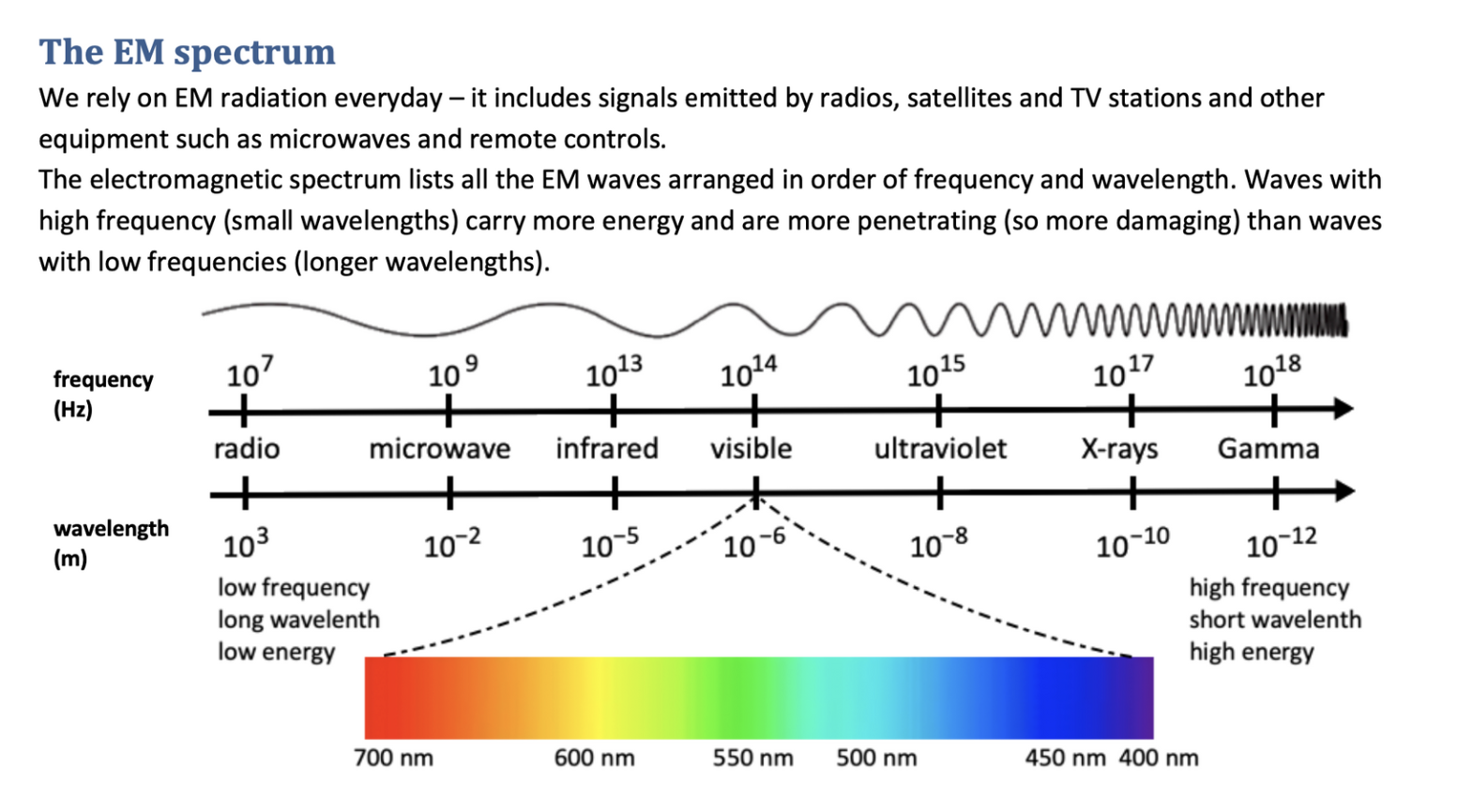
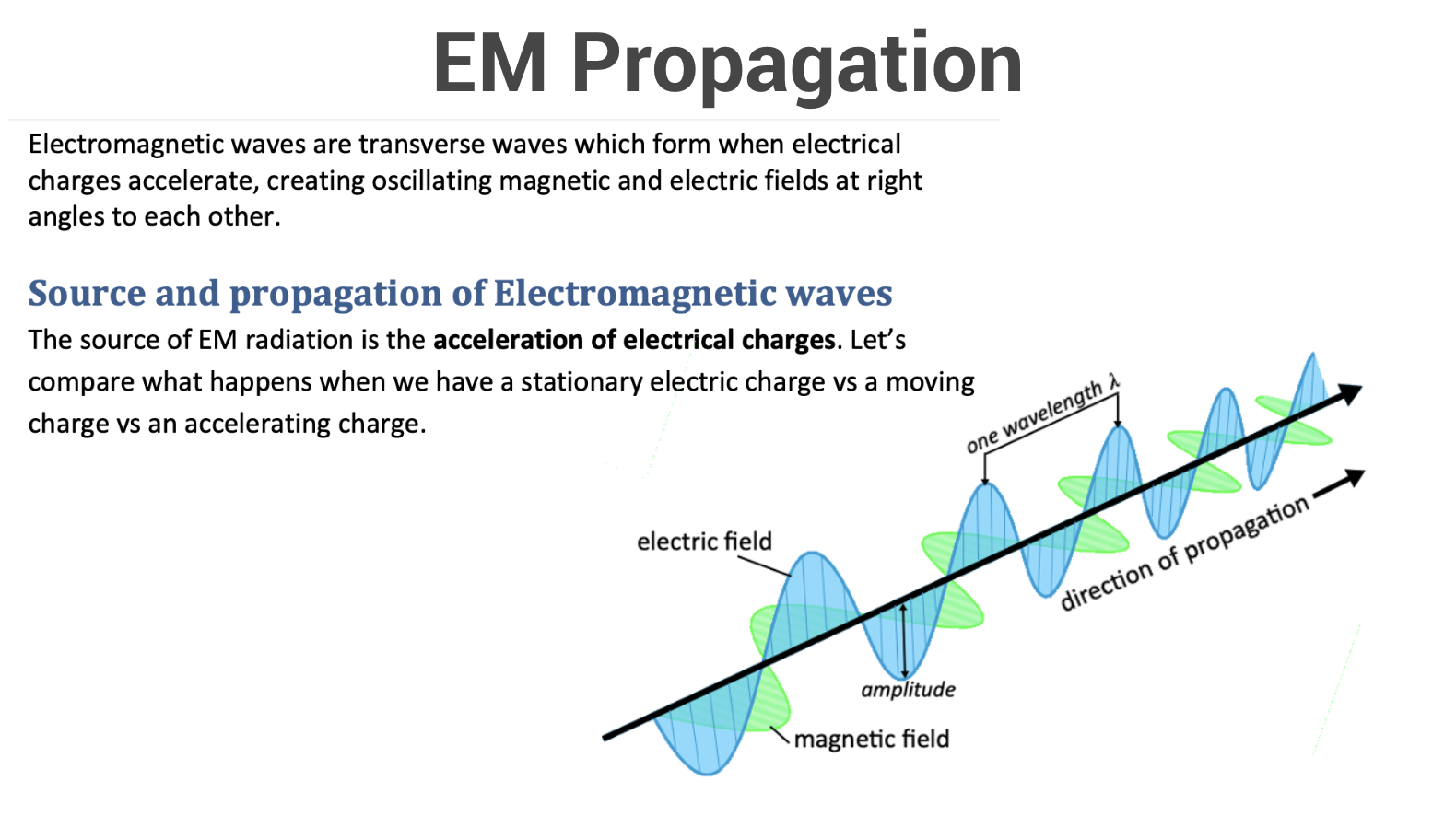
REVISION OF EM WAVES

Watch the embedded video below. If you have issues playing it within Formative, you can watch it on You Tube using this link
Question 1
1.

The electric and magnetic fields in electromagnetic waves are oriented

Question 2
2.

Which measures the number of waves that pass a certain point per second?

Question 3
3.

What happens to wavelength if the frequency of a wave doubles?

Question 4
4.

Which type of wave has the longest wavelength?

Question 5
5.

What is the relationship between the frequency and energy of a wave?

Question 6
6.

What defines the colour of light within the visible spectrum?

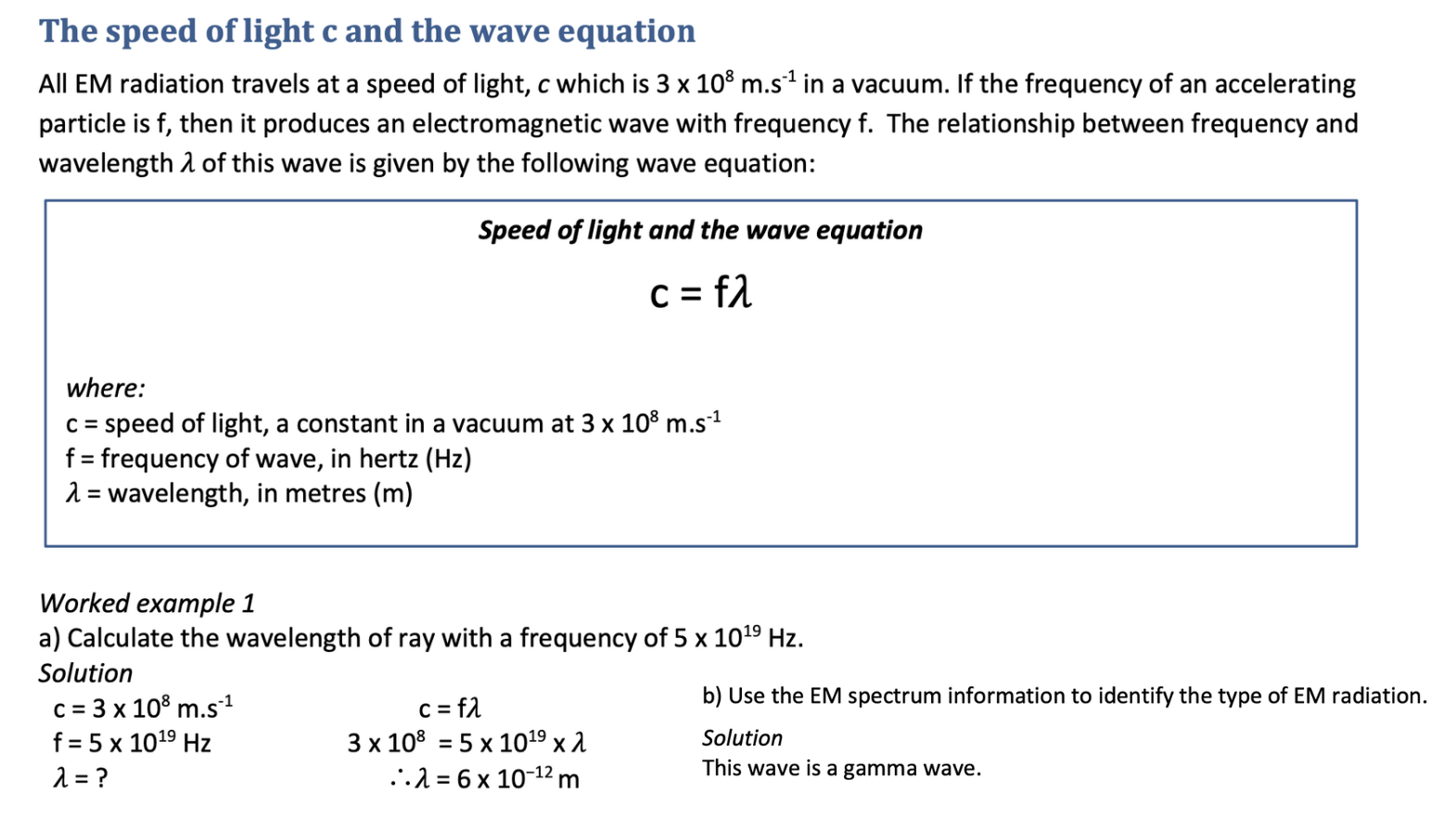
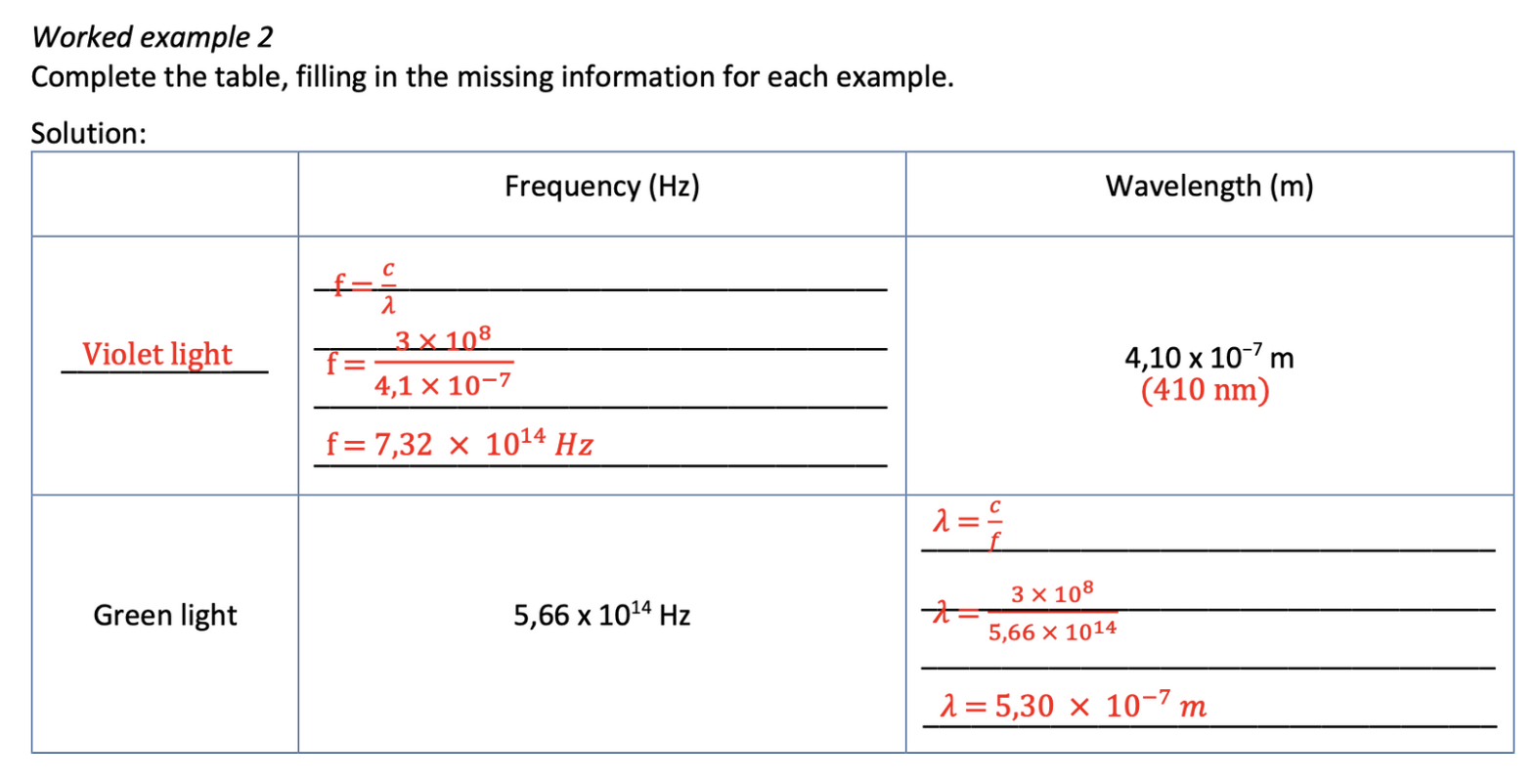
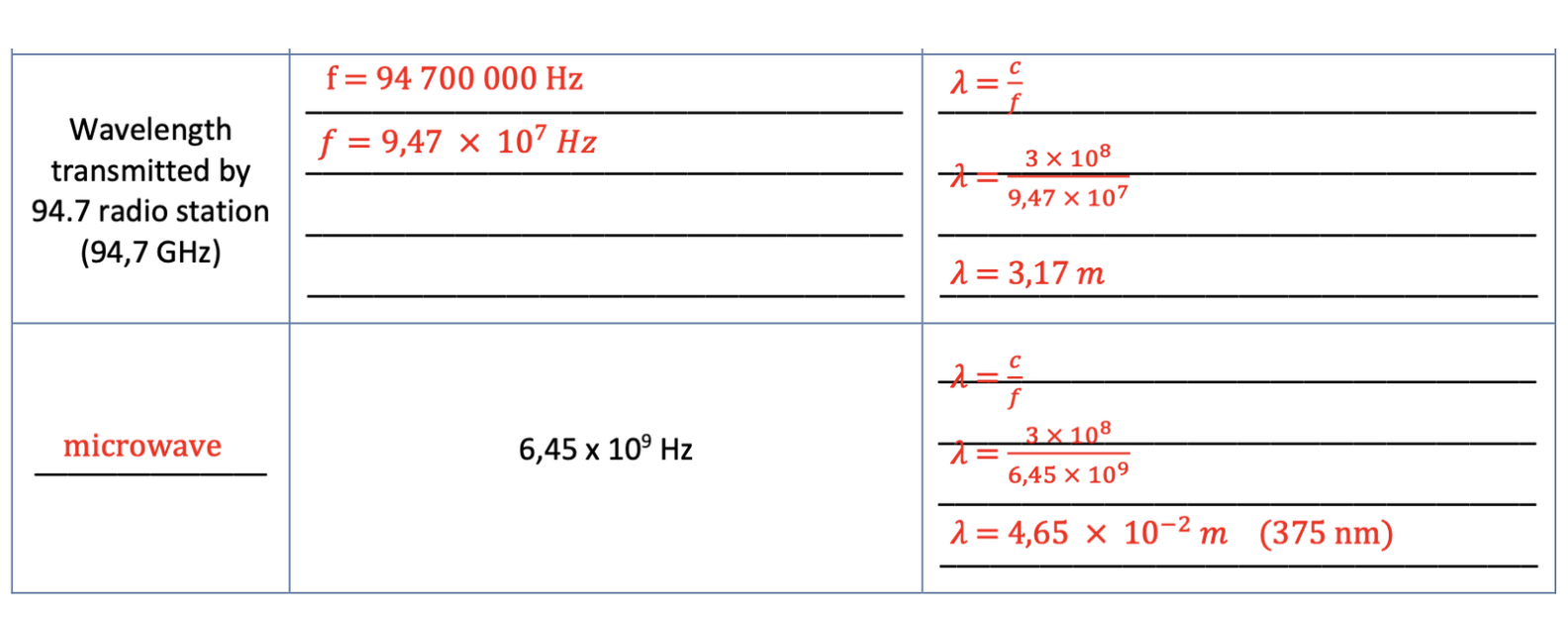
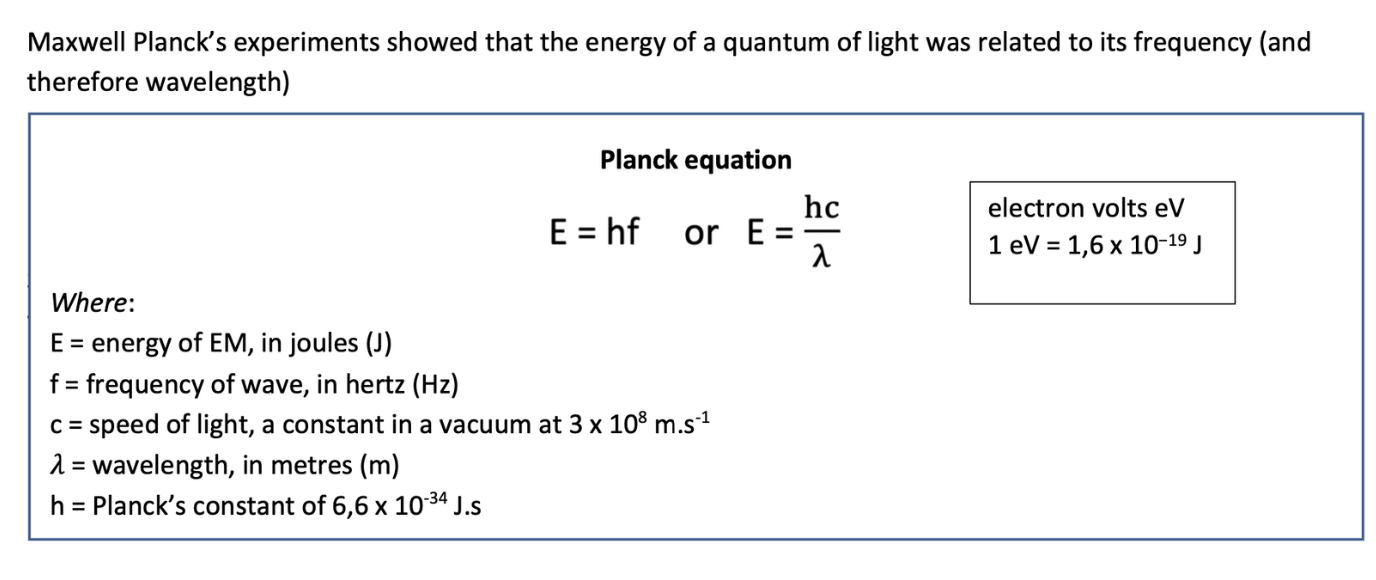
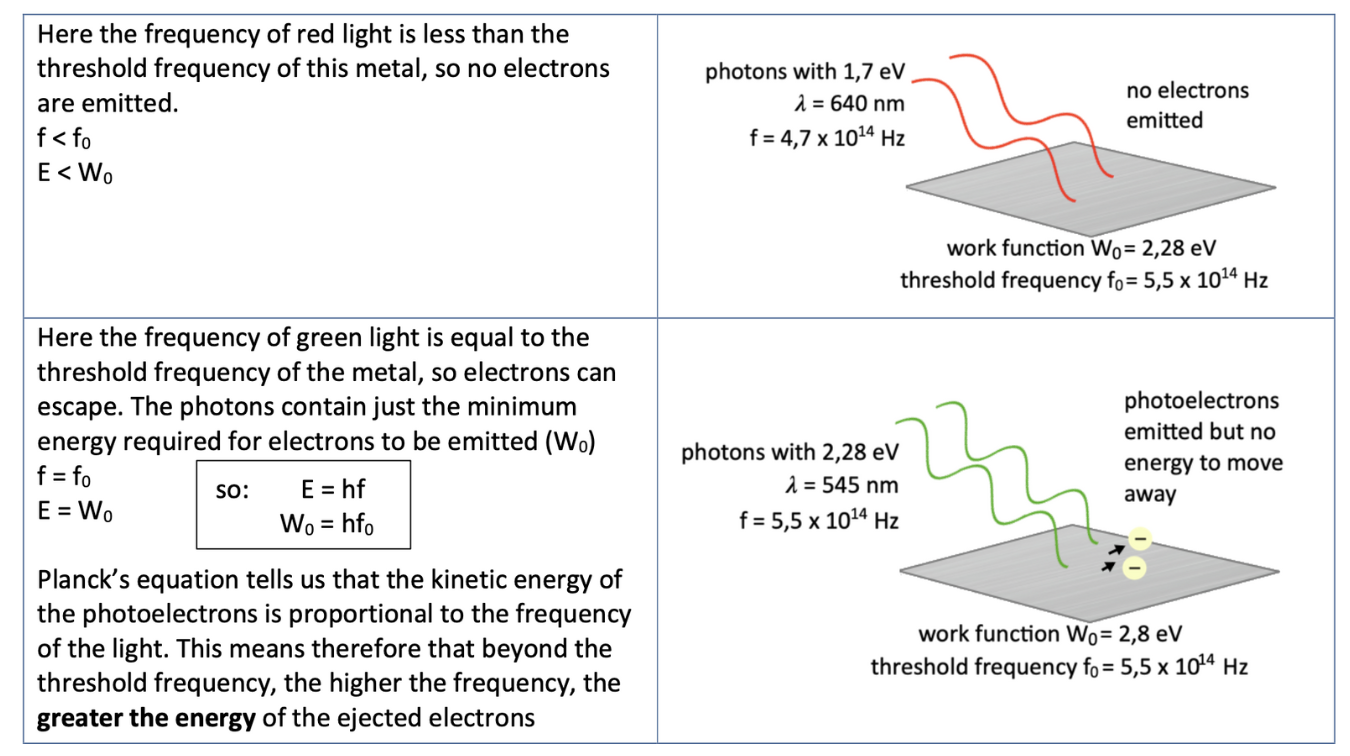
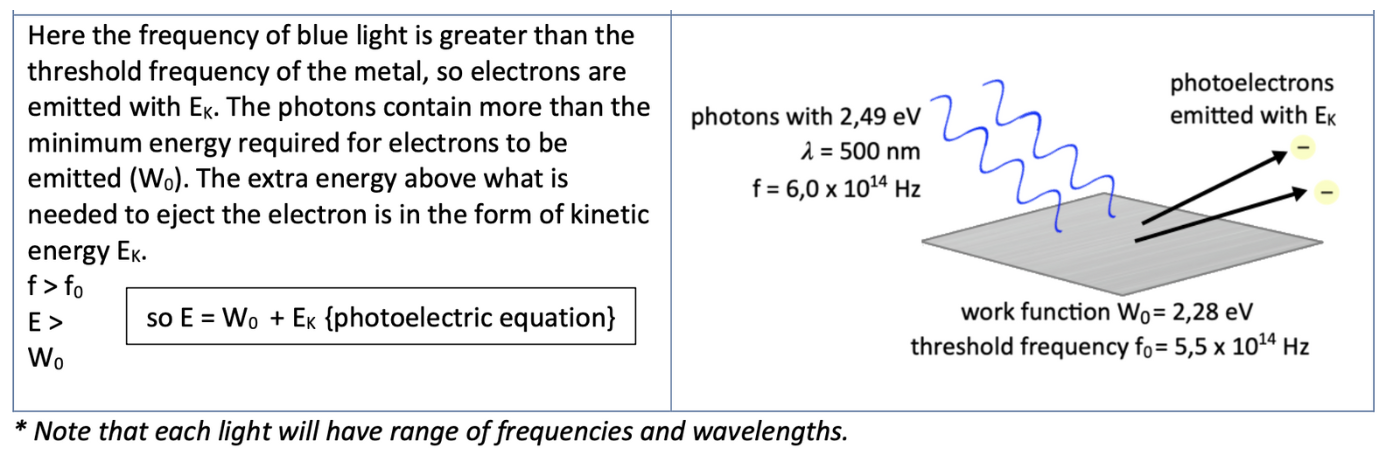
Copy this worked example into your workbook
Question 7
7.

Please upload a scanned copy of the Worked example table in your workbook, proving you have copied it into your book.

THE PHOTOELECTRIC EFFECT

Question 8
8.

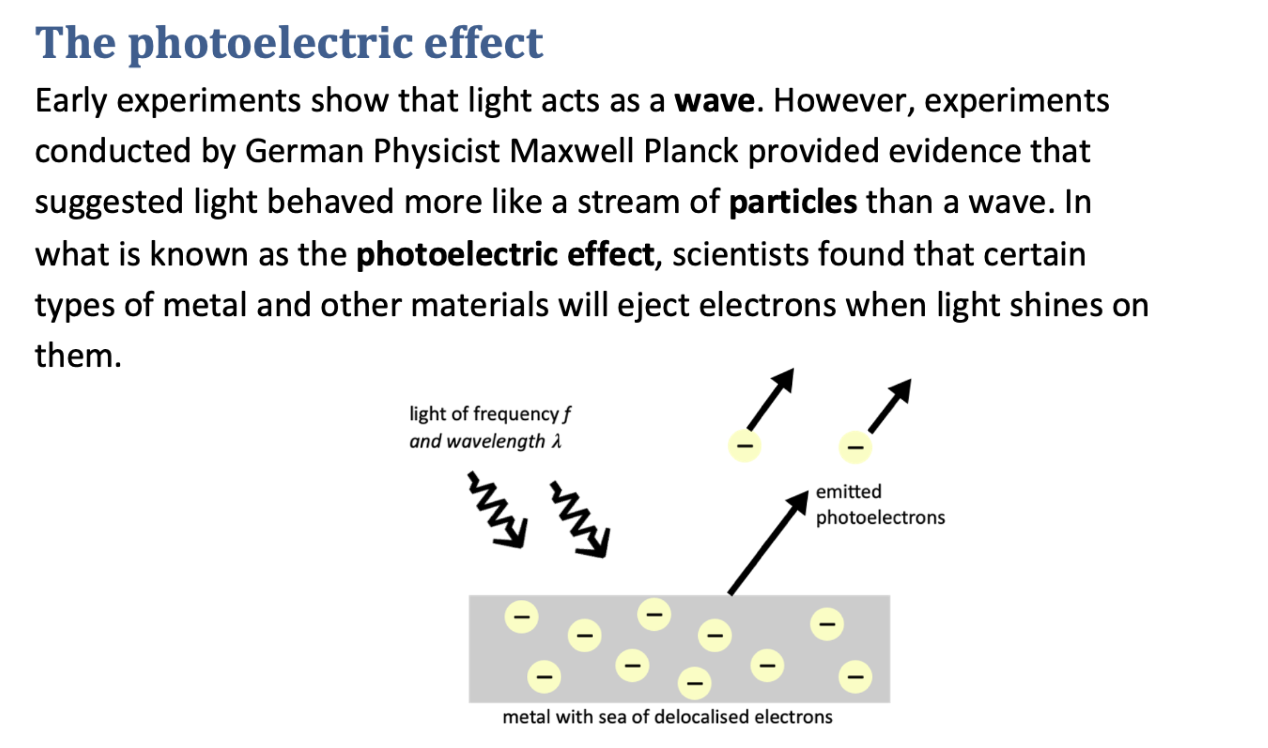
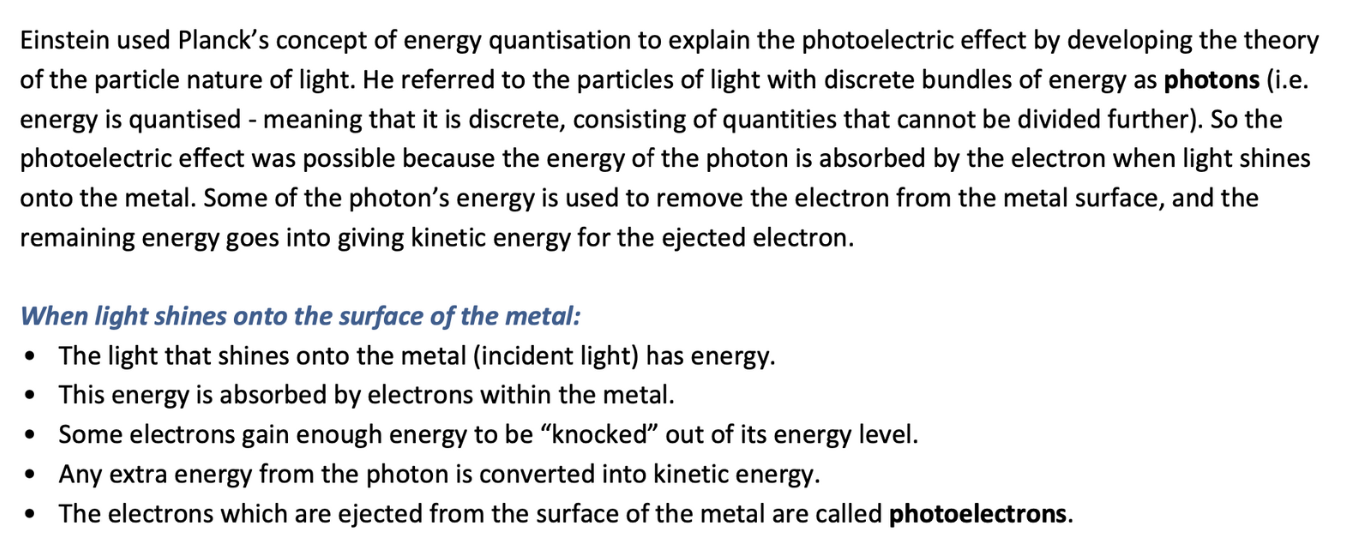
What is the photoelectric effect?

Question 9
9.

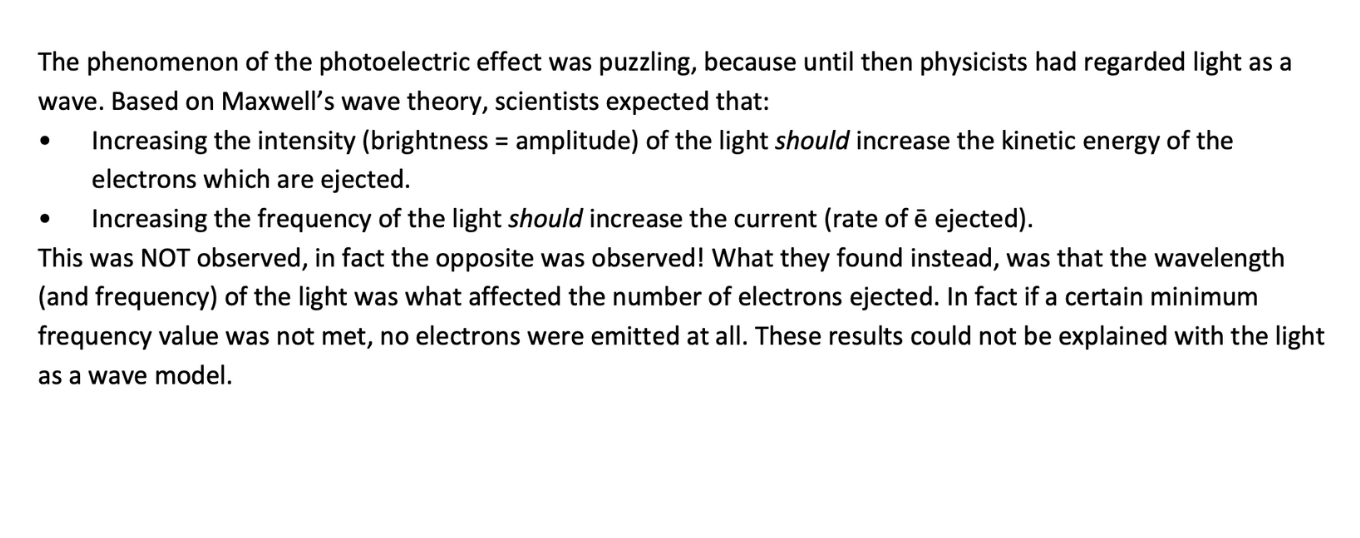
In the photoelectric effect ....

Question 10
10.

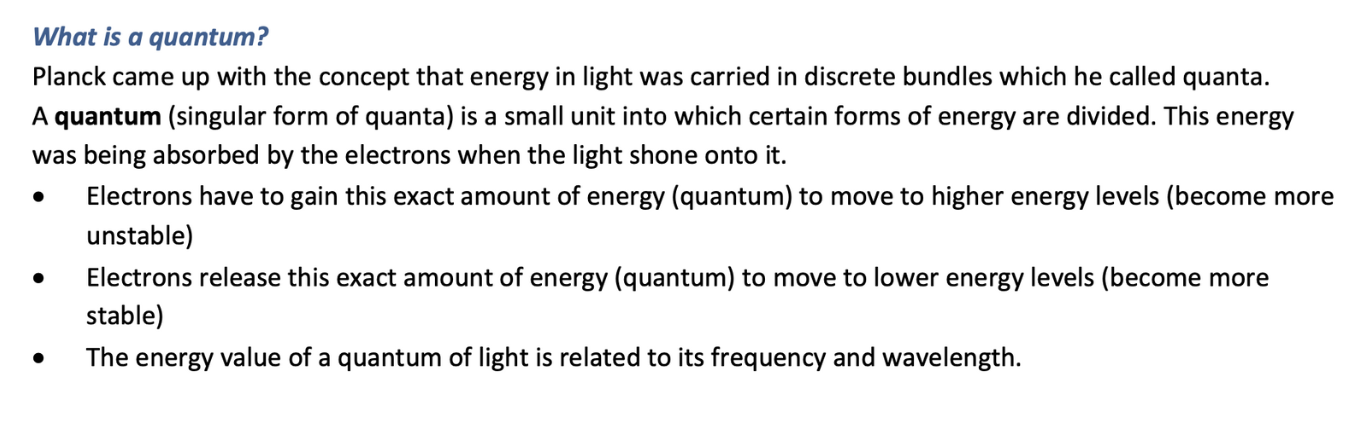
Who proposed the concept of 'quantum' in physics?

Question 11
11.

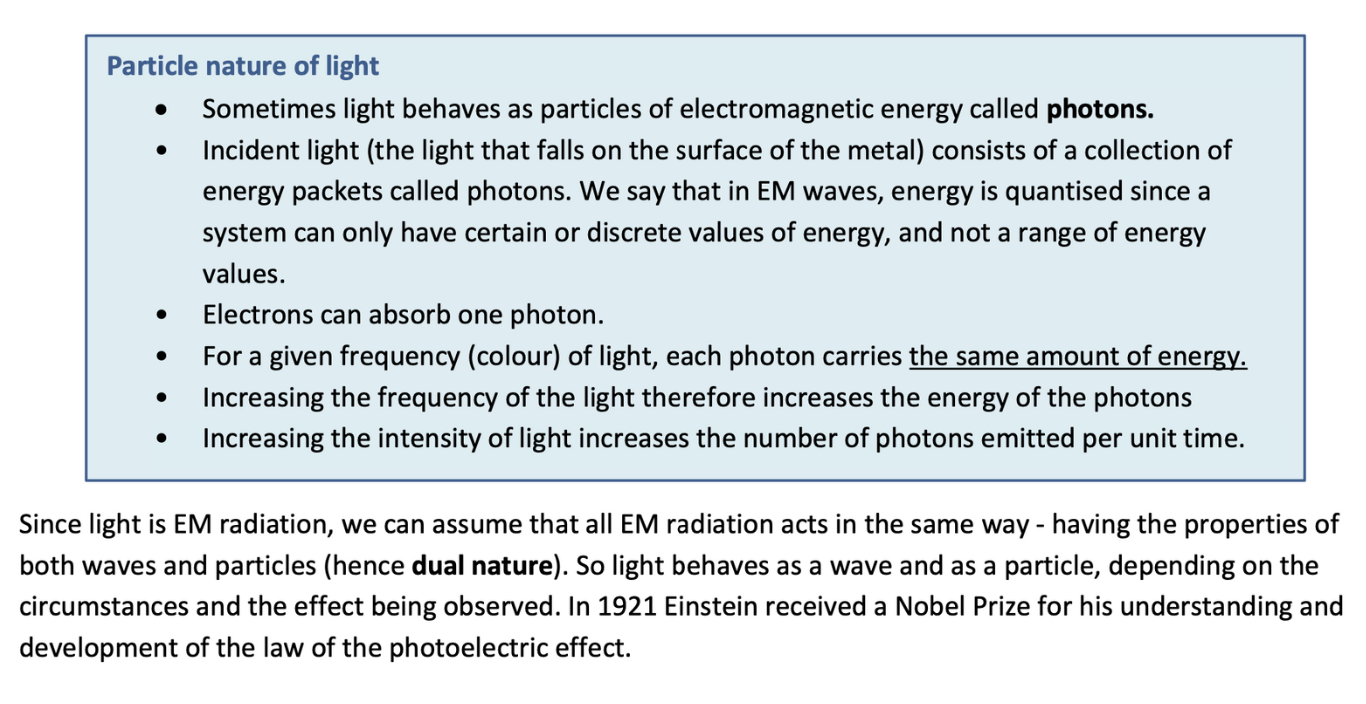
What is the term for the smallest discrete amount of any physical quantity?

Question 12
12.

What is the wavelength and frequency of UV light with energy of 3,74 x 10⁻¹⁸ J?

wavelength (m)
frequency (Hz)
3,62 × 10¹⁴
5,67 × 10¹⁵
5,29 × 10⁻⁸
1,10 × 10⁻²⁰
Question 13
13.

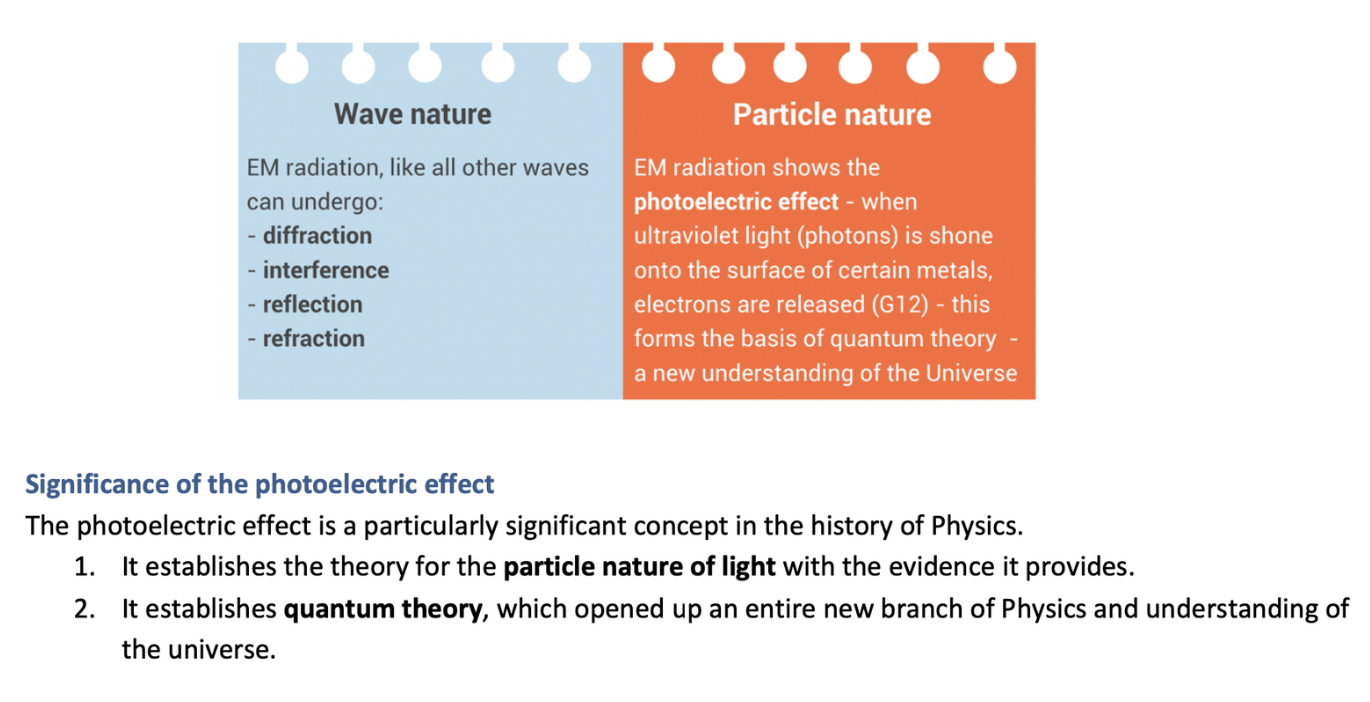
The photoelectric effect supports the particle theory of light because:

Question 14
14.

Which scientist initially explained the photoelectric effect?

Question 15
15.

Which photon is more energetic: A red one or a violet one?

Question 16
16.

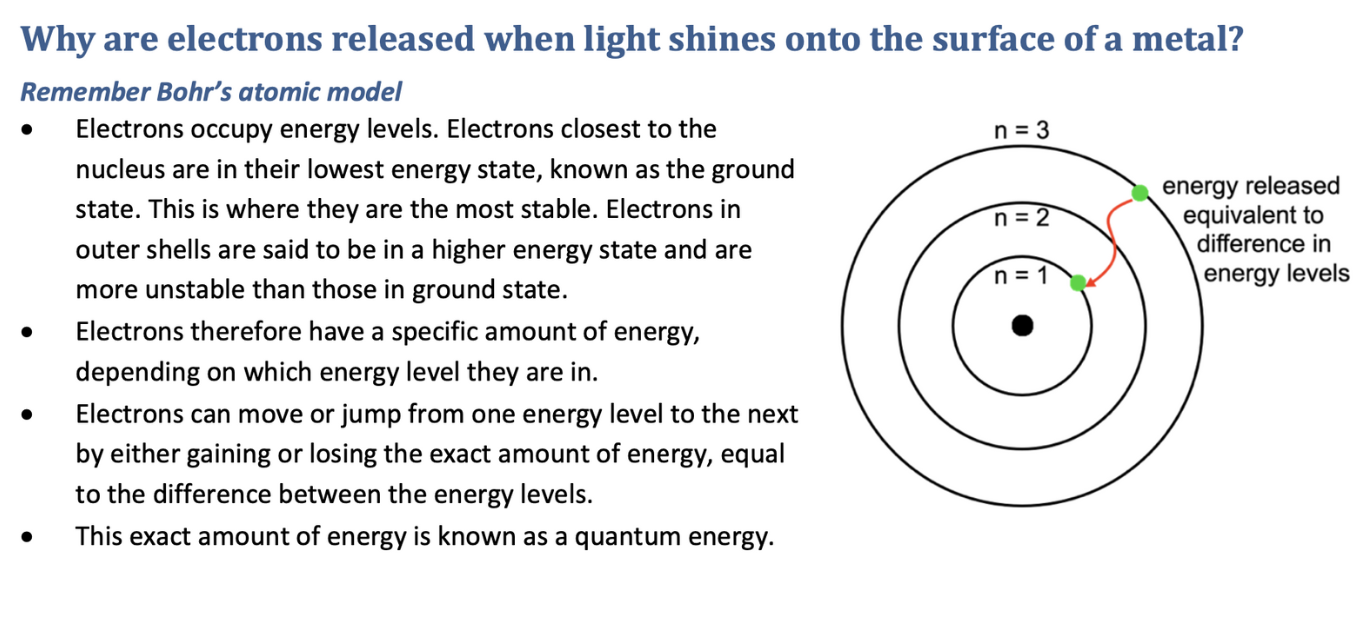
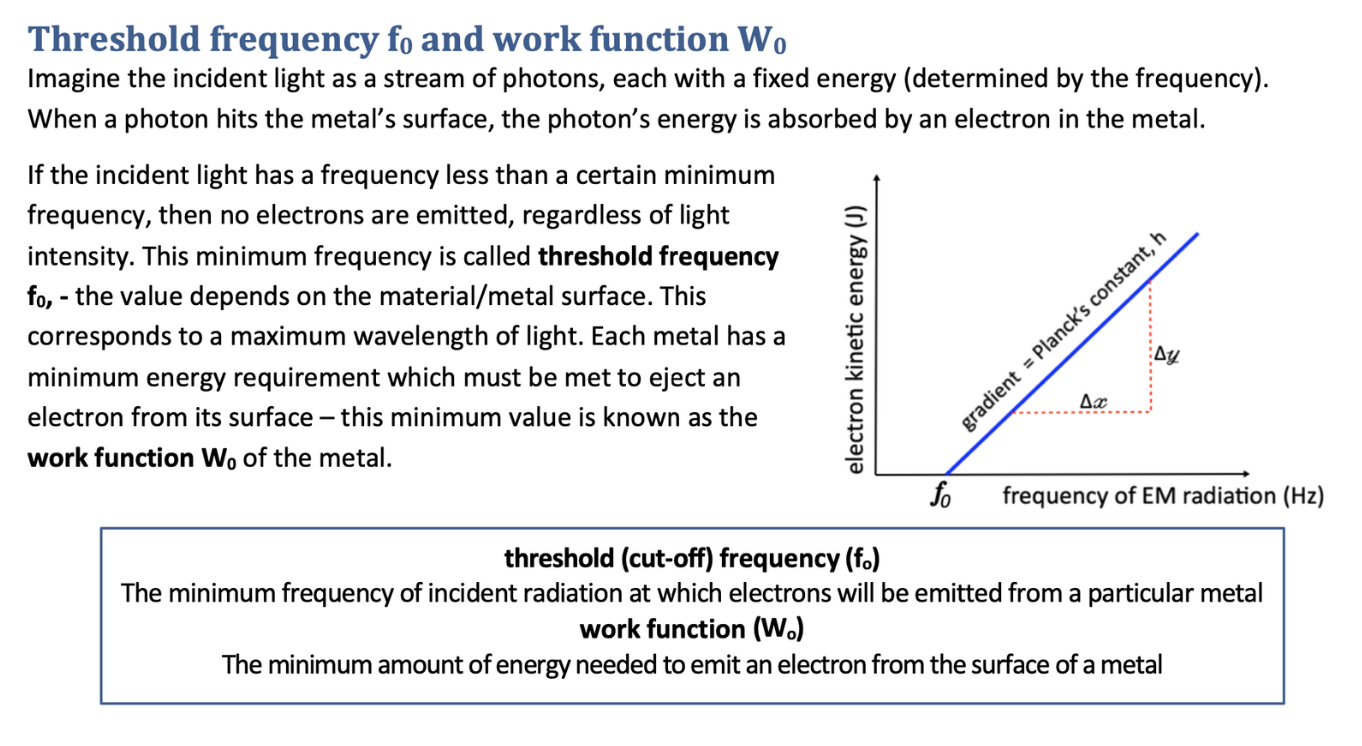
What does 'threshold frequency' signify in the context of the photoelectric effect?

Question 17
17.

What does the 'work function' represent in the context of the photoelectric effect?

Watch this short video on the photoelectric effect.
You can also watch it on You Tube by clicking this link (first 2:43 min)
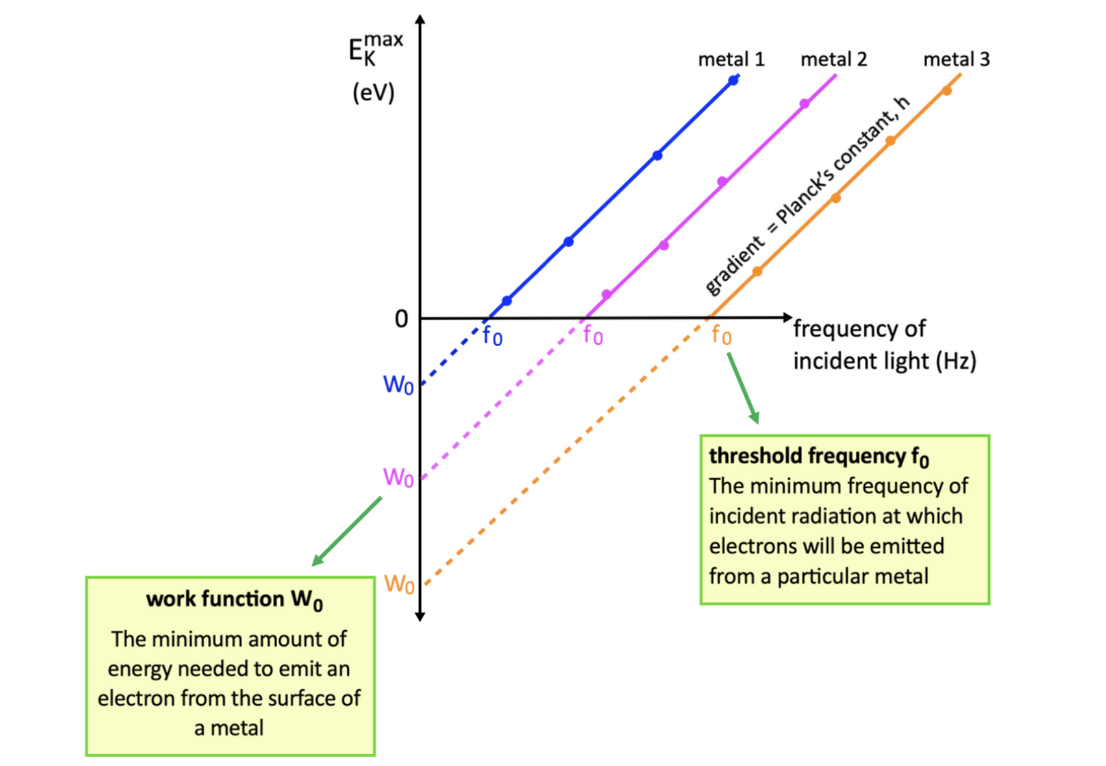
Look at what happens when light of various frequencies is shone onto a metal.

Question 18
18.

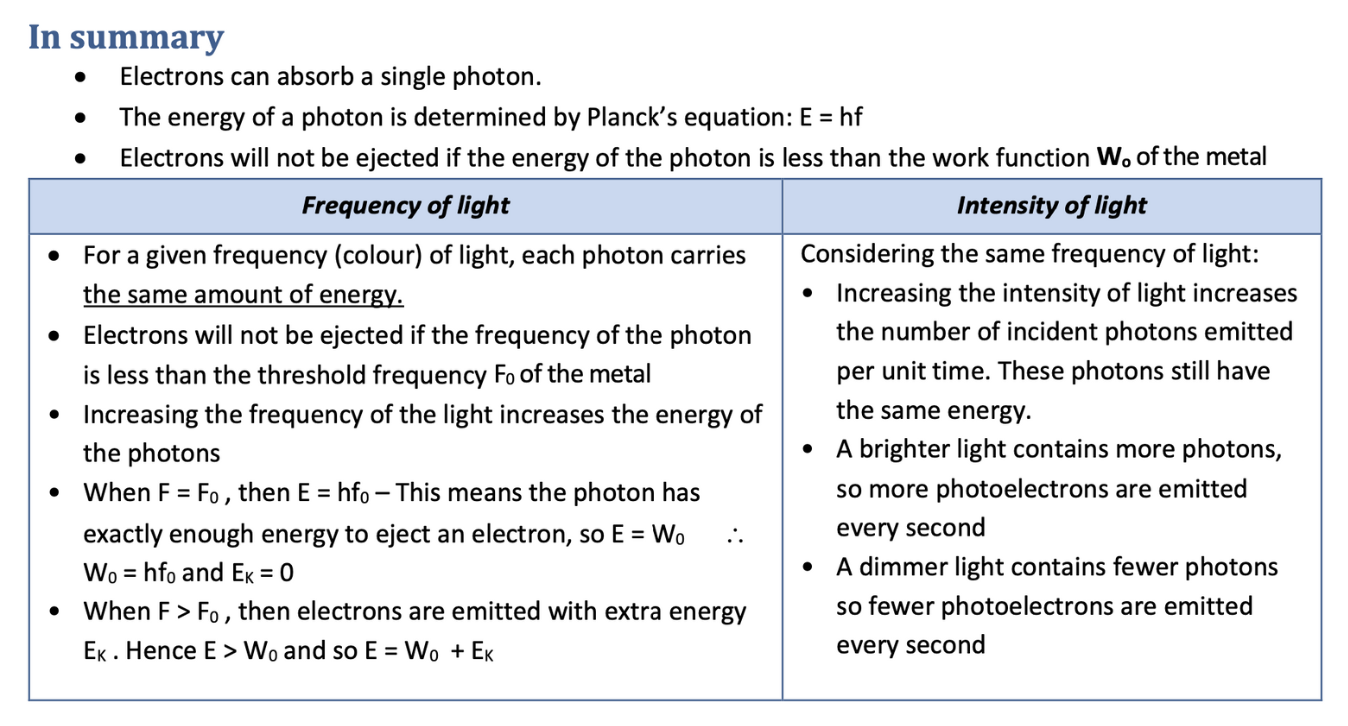
What happens if the frequency of light is below the threshold frequency?

Question 19
19.

According to the photoelectric effect, what determines the kinetic energy of the ejected electrons?


Question 20
20.

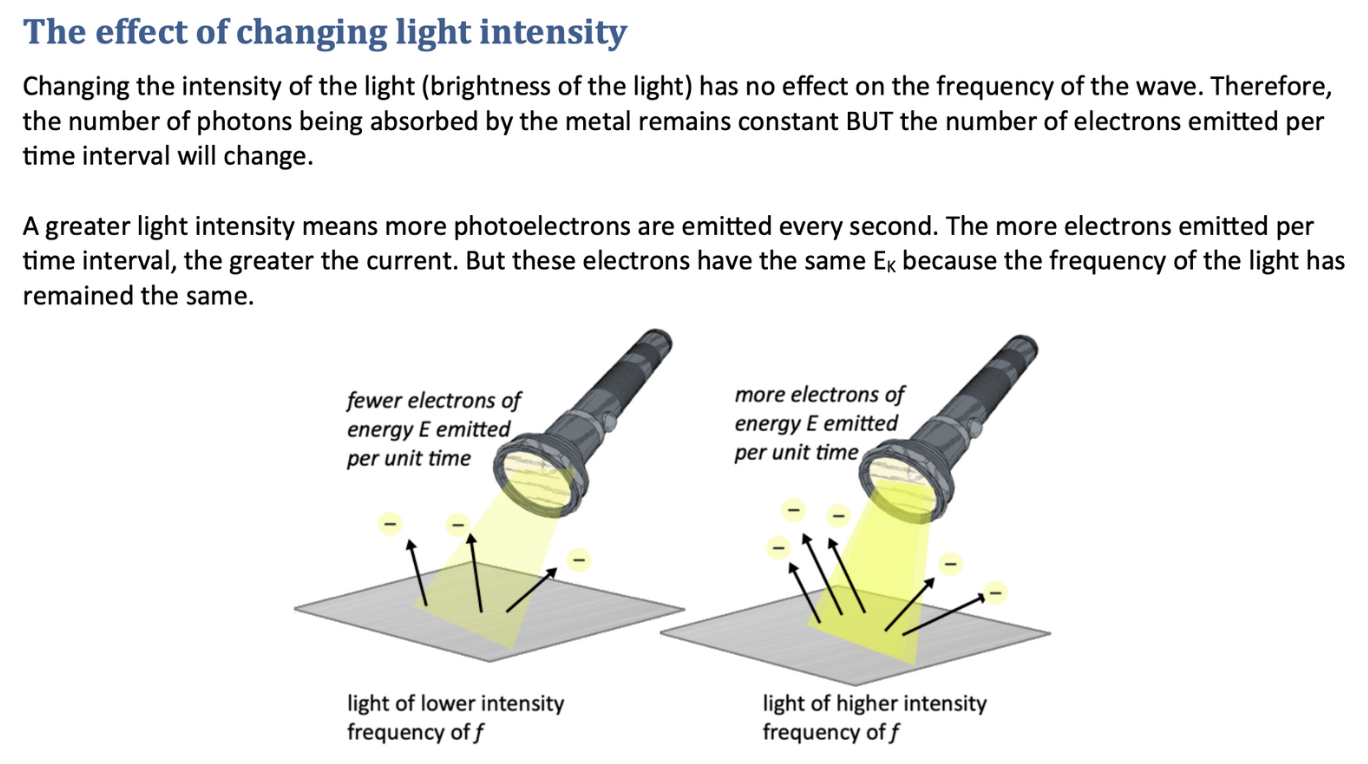
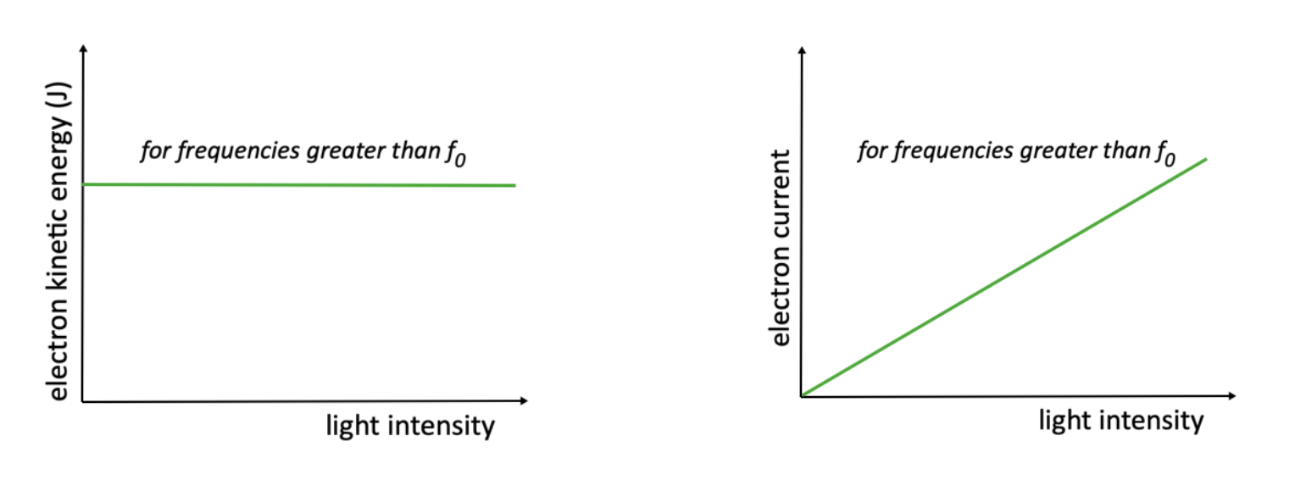
Which factor does NOT affect the number of electrons emitted in the photoelectric effect?

Question 21
21.
Increasing the ______________ of the light, increases the energy of the photon.
Increasing the ______________ of the light, increases the number of photons emitted.
If the frequency of light is ______________ the threshold frequency, then no electrons are emitted.
If the frequency of light is _____________ the threshold frequency, then electrons will be emitted with zero kinetic energy.
If the frequency of light is _________________ the threshold frequency, then electrons will be emitted with kinetic energy.
This kinetic energy value is equal to the energy of a photon minus the __________________ of the metal.
Other Answer Choices:
threshold frequency
intensity
equal to
energy
less than
frequency
work function
greater than
Question 22
22.
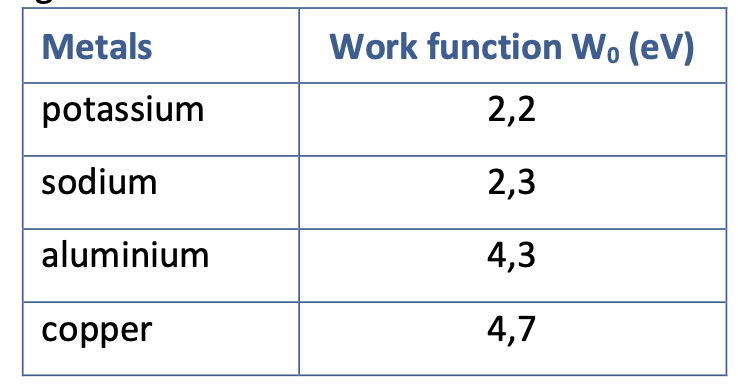
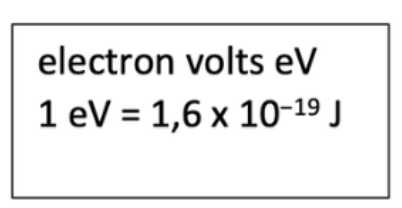
The table below shows the work function (in electron volts) of various metals.
QUESTION: Will the photoelectric effect be observed when light of 710 nm is shone onto the surface of potassium?
ALL OF THESE ANSWERS MUST BE TYPED IN SCIENTIFIC NOTATION
Type the answers for each of these using this as an example: 9,22 x 10⁻¹² should be typed as 9,22 x 10^-12
Step 1: Convert the work function W0 from eV to Joules. Answer: W0 = _______ J.
Step 2: Calculate the threshold frequency f0 of potassium using W0 =hf0. Answer: f0 = _______ Hz.
Step 3: Calculate the frequency of the light using its wavelength. f = _______ Hz.
Step 4: Compare the frequency of the light to the threshold frequency f0. The threshold frequency f0 is _______ (greater than/less than/equal to) the frequency of this light.
Step 5: Therefore, the photoelectric effect _______ (will/will not) be observed.
Question 23
23.
The table below shows the work function (in electron volts) of various metals.
QUESTION: Will the photoelectric effect be observed when light of 710 nm is shone onto the surface of aluminium?
ALL OF THESE ANSWERS MUST BE TYPED IN SCIENTIFIC NOTATION
Type the answers for each of these using this as an example: 9,22 x 10⁻¹² should be typed as 9,22 x 10^-12
Step 1: Convert the work function W0 from eV to Joules. Answer: W0 = _______ J.
Step 2: Calculate the threshold frequency f0 of aluminium using W0 =hf0. Answer: f0 = _______ Hz.
Step 3: Calculate the frequency of the light using its wavelength. f = _______ Hz.
Step 4: Compare the frequency of the light to the threshold frequency f0. The threshold frequency f0 is _______ (greater than/less than/equal to) the frequency of this light.
Step 5: Therefore, the photoelectric effect _______ (will/will not) be observed.
Question 24
24.
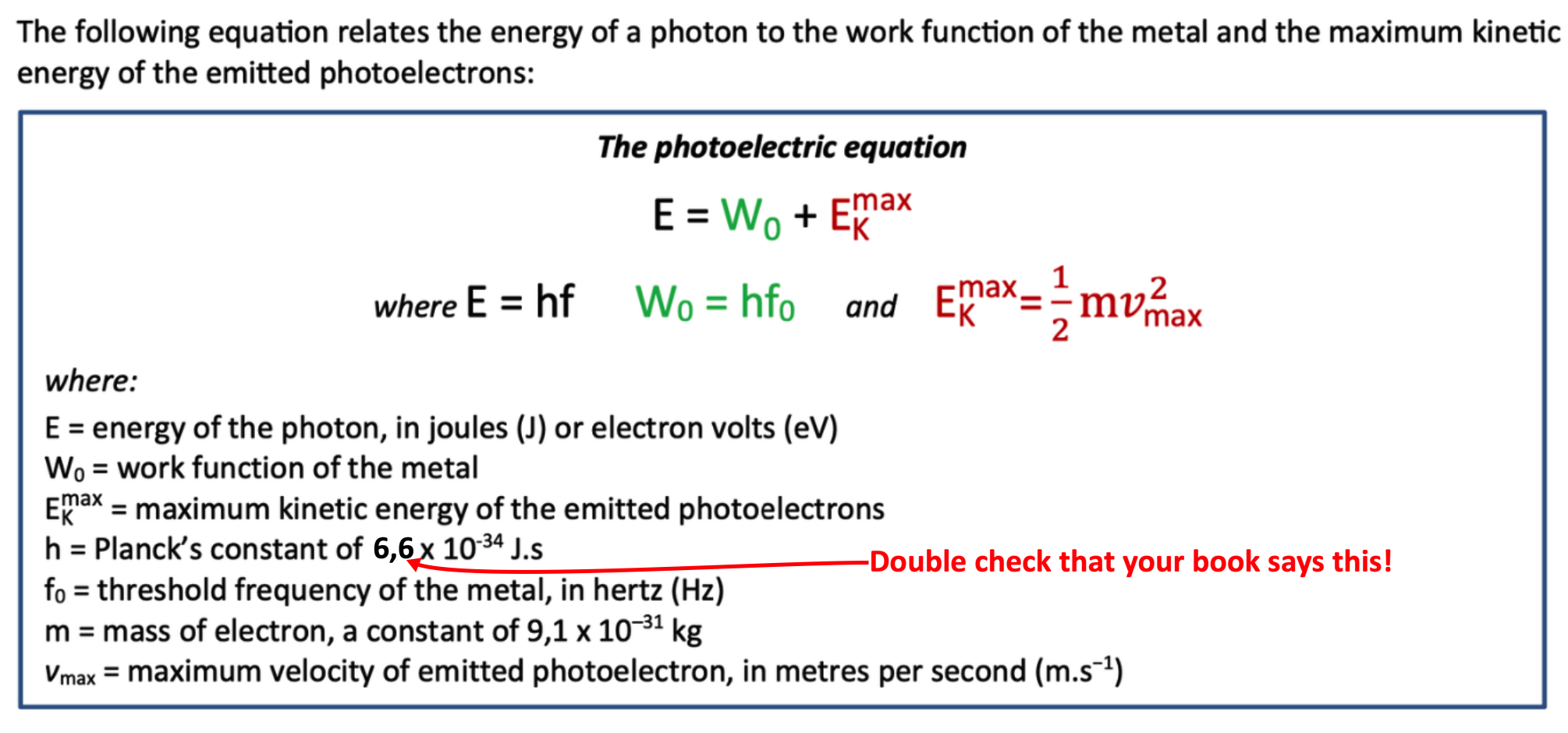
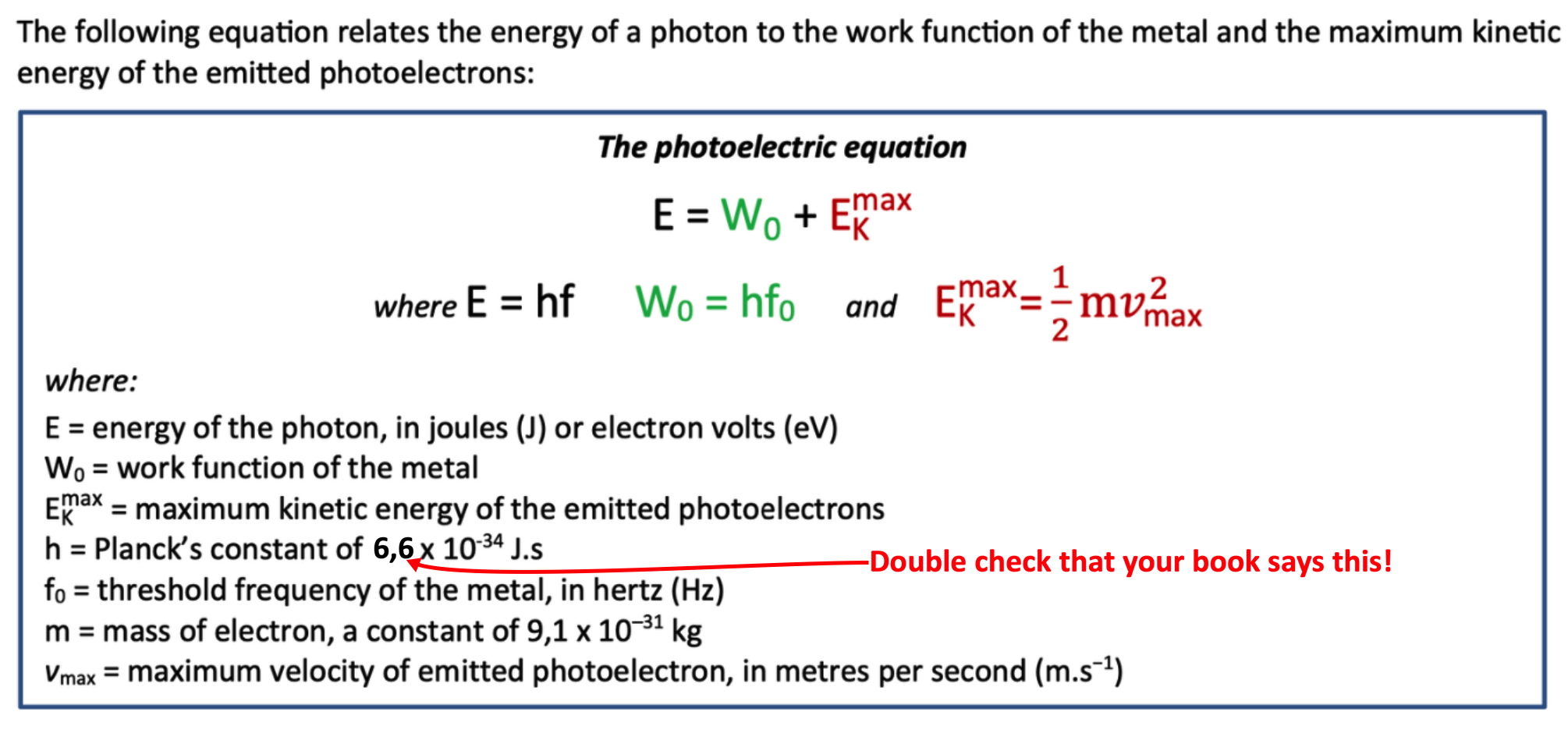
Now use the complete photoelectric equation to calculate the maximum velocity of ejected electrons when light of 310 nm is shone onto the surface of sodium, which has a work function of 2,3 eV.

ALL OF THESE ANSWERS MUST BE TYPED IN SCIENTIFIC NOTATION
Type the answers for each of these using this as an example: 9,22 x 10⁻¹² should be typed as 9,22 x 10^-12

E = _______ J
W0 = _______ J
EK = _______ J
∴ 𝓋 = _______ m.s-1

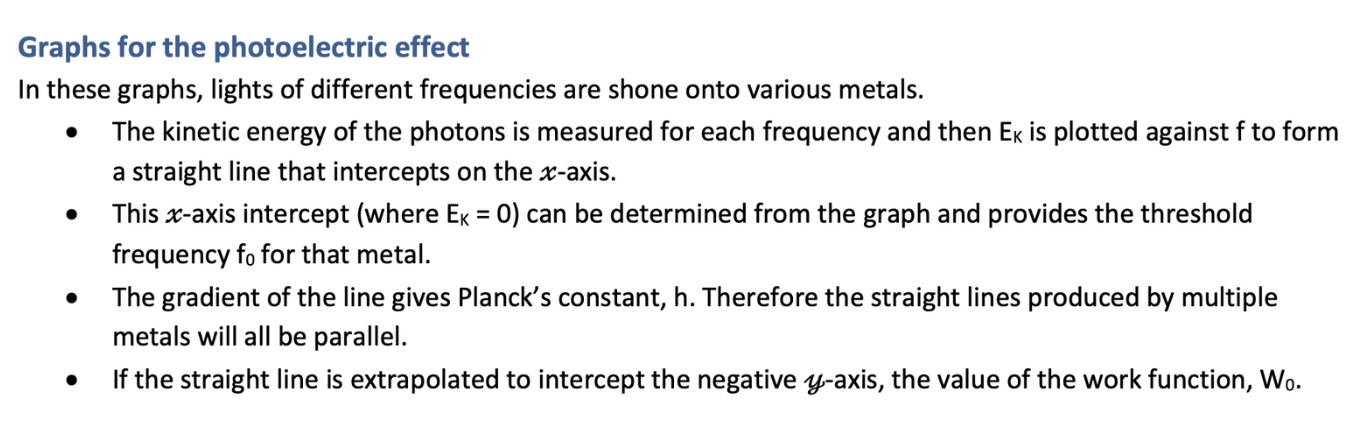
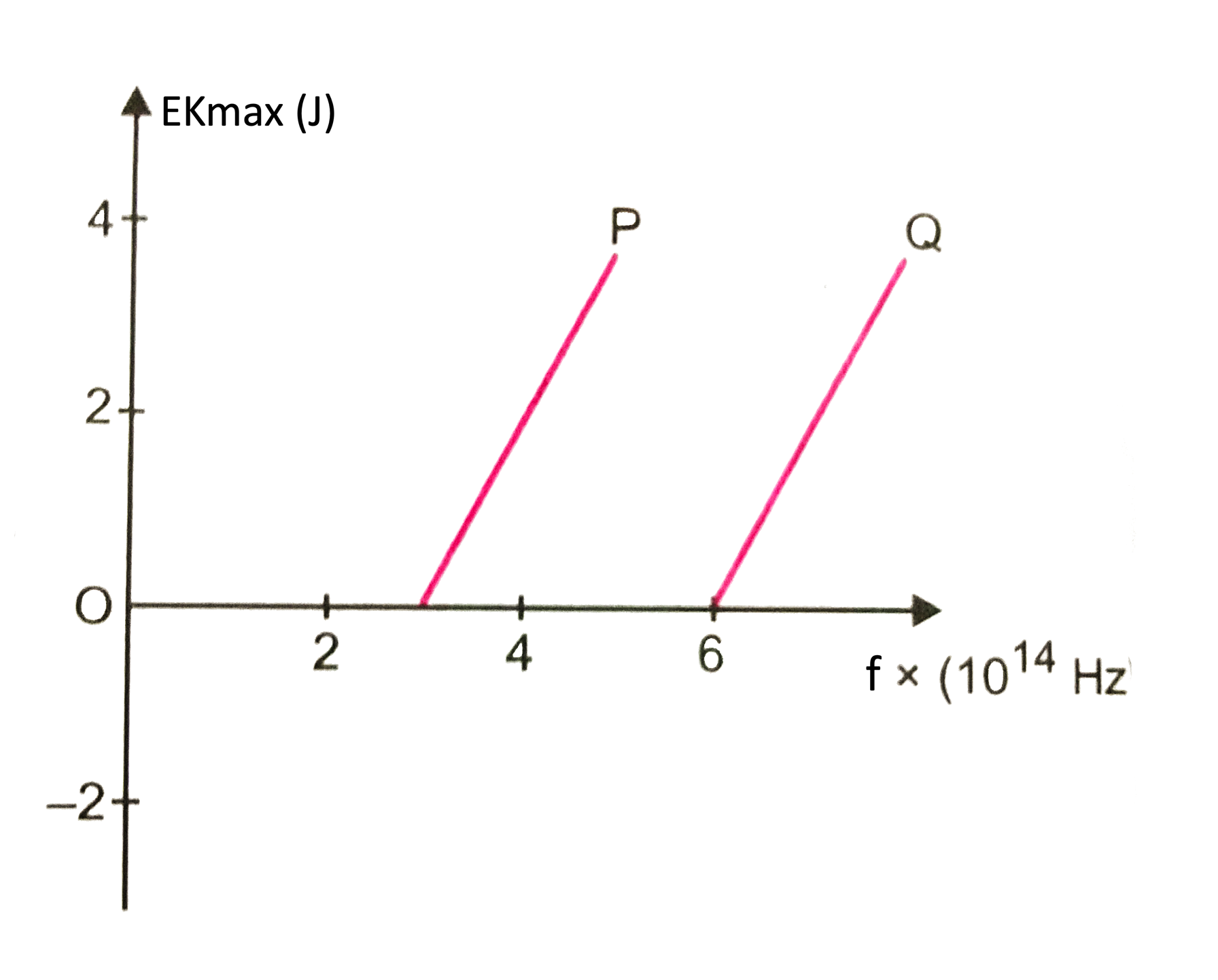
Consider the following photoelectric effect graph obtained for two metals P and Q.

ANSWERS MUST BE TYPED IN SCIENTIFIC NOTATION WHERE APPLICABLE.
Type the answers for each of these using this as an example: 9,22 x 10⁻¹² should be typed as 9,22 x 10^-12
Required
1
Required
1
Required
1
Question 27
27.

Calculate the work function of Q.

Question 28
28.
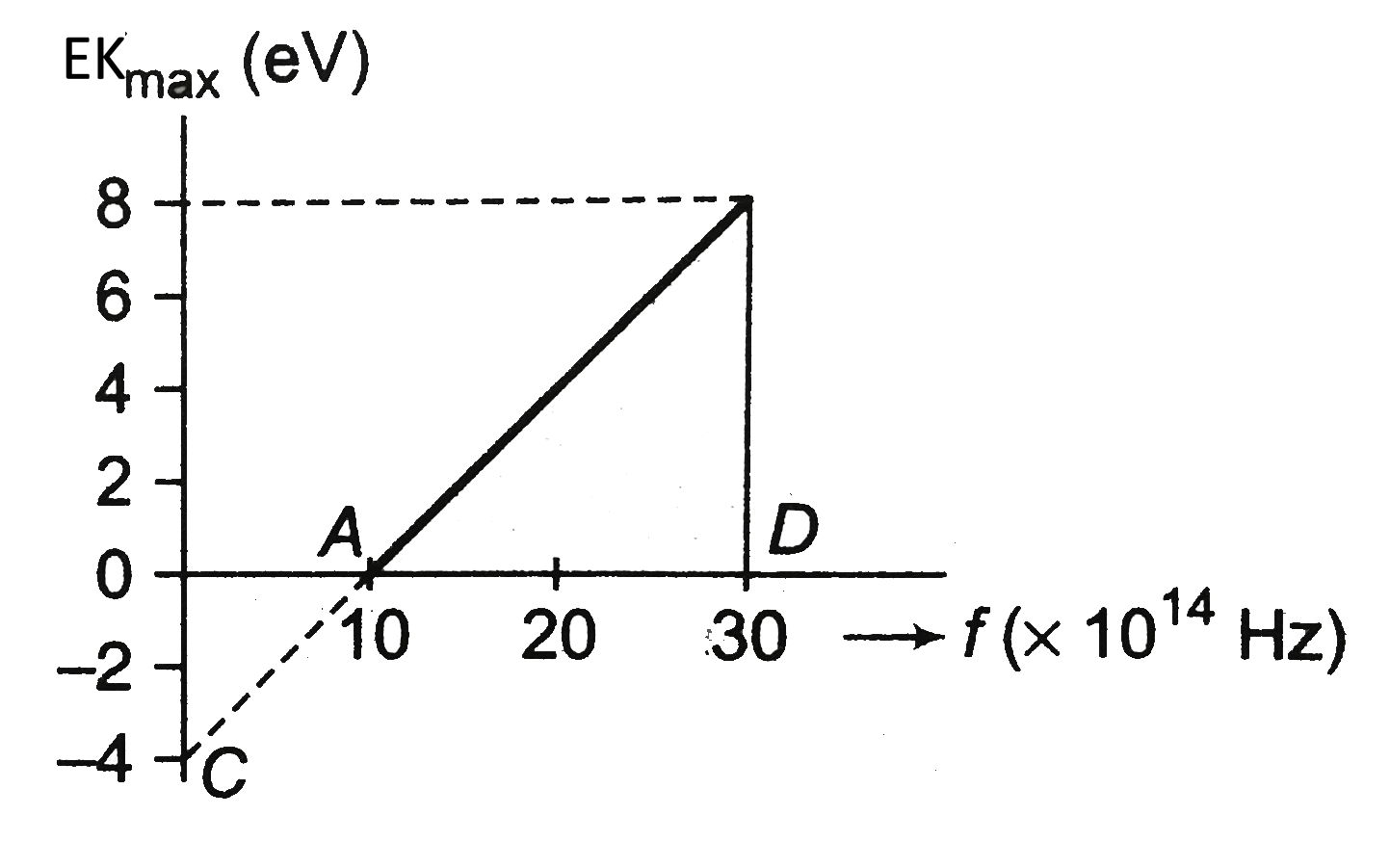
Consider the following graph obtained using data from an investigation of the photoelectric effect.
ANSWERS MUST BE TYPED IN SCIENTIFIC NOTATION WHERE APPLICABLE.
Type the answers for each of these using this as an example: 9,22 x 10⁻¹² should be typed as 9,22 x 10^-12

Write the values of :
Work function = _______ eV
Threshold frequency = _______ Hz
Gradient of graph = _______ J.s which represents _______ constant.
Question 25
25.

Which metal has the highest threshold frequency?

Question 26
26.

Which metal has the greatest work function?