Ɛhia
1
Uranus is the seventh planet from the Sun, and has the third-largest diameter in our solar system. It was the first planet found with the aid of a telescope, Uranus was discovered in 1781 by astronomer William Herschel, although he originally thought it was either a comet or a star.
Uranus is the ____ planet from the sun
Uranus was discovered in 1781 by astronomer William Herschel, although he originally thought it was either a comet or a star. It was two years later that the object was universally accepted as a new planet, in part because of observations by astronomer Johann Elert Bode. Herschel tried unsuccessfully to name his discovery Georgium Sidus after King George III. Instead, the scientific community accepted Bode's suggestion to name it Uranus, the Greek god of the sky, as suggested by Bode.
At first Uranus was thought to be a comet or star.
Uranus has an atmosphere made mostly of molecular hydrogen and atomic helium, with a small amount of methane.
What does Uranus's atmosphere mostly consist of.
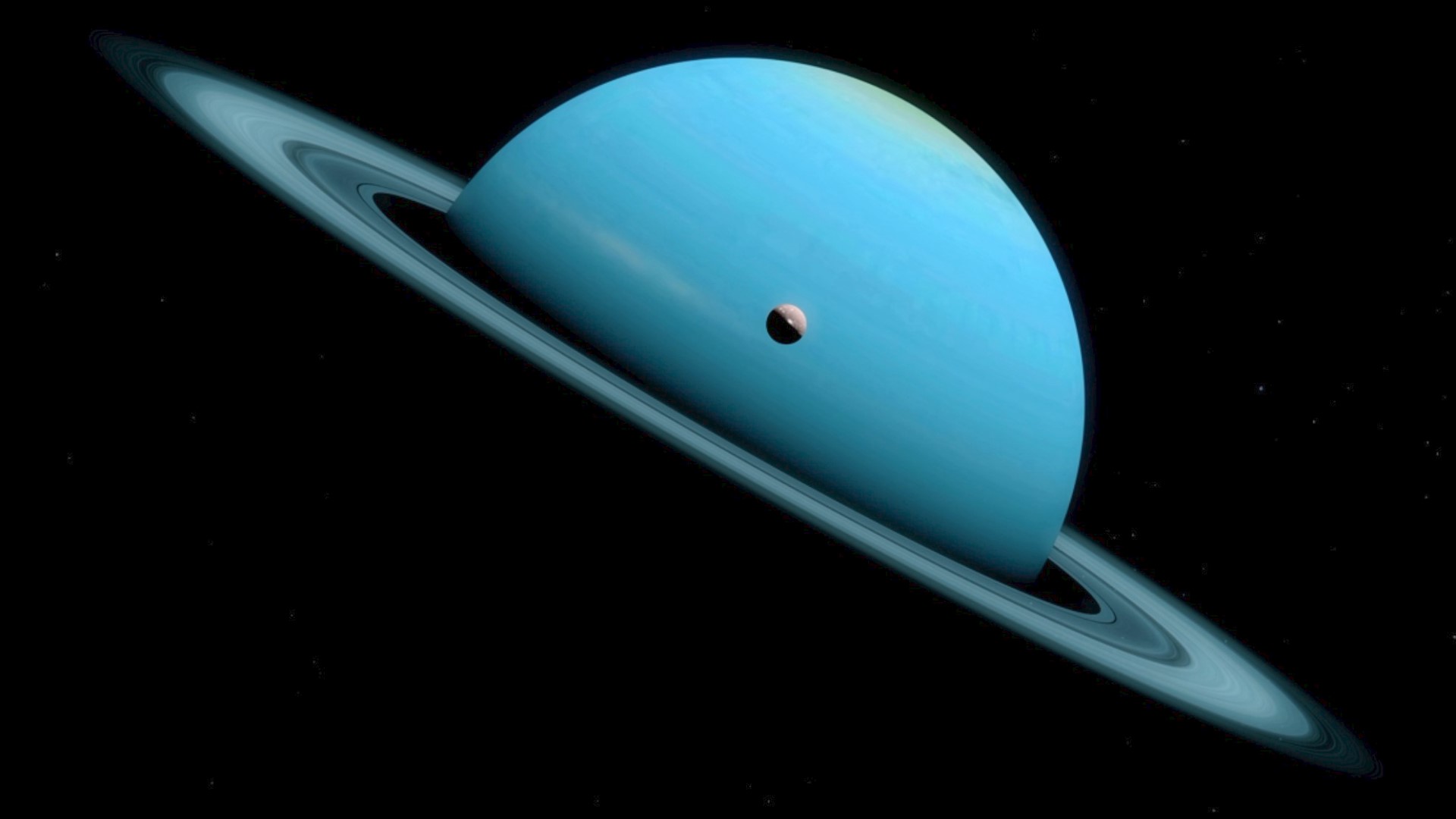
Uranus also has faint rings. The inner rings are narrow and dark. The outer rings are brightly colored and easier to see. Like Venus, Uranus rotates in the opposite direction as most other planets. And unlike any other planet, Uranus rotates on its side.
How man you describe Uranus's rings?
With all the evidence that you have gathered, draw Uranus in the solar system. <Include the sun, earth, and majority of the planets.
I want you to show Uranus rotating either - > around the sun or on its equator.
Structure
Uranus is one of two ice giants in the outer solar system (the other is Neptune). Most (80% or more) of the planet's mass is made up of a hot dense fluid of "icy" materials – water, methane, and ammonia – above a small rocky core. Near the core, it heats up to 9,000 degrees Fahrenheit (4,982 degrees Celsius).
Uranus is slightly larger in diameter than its neighbor Neptune, yet smaller in mass. It is the second least dense planet; Saturn is the least dense of all.
Uranus gets its blue-green color from methane gas in the atmosphere. Sunlight passes through the atmosphere and is reflected back out by Uranus' cloud tops. Methane gas absorbs the red portion of the light, resulting in a blue-green color.
Surface
As an ice giant, Uranus doesn’t have a true surface. The planet is mostly swirling fluids. While a spacecraft would have nowhere to land on Uranus, it wouldn’t be able to fly through its atmosphere unscathed either. The extreme pressures and temperatures would destroy a metal spacecraft.
Uranus has an unusual, irregularly shaped magnetosphere. Magnetic fields are typically in alignment with a planet's rotation, but Uranus' magnetic field is tipped over: the magnetic axis is tilted nearly 60 degrees from the planet's axis of rotation, and is also offset from the center of the planet by one-third of the planet's radius.
Auroras on Uranus are not in line with the poles (like they are on Earth, Jupiter, and Saturn) due to the lopsided magnetic field.
The magnetosphere tail behind Uranus opposite the Sun extends into space for millions of miles. Its magnetic field lines are twisted by Uranus’ sideways rotation into a long corkscrew shape.
Uranus's magnetic field is not tipped over and is perfectly fine.
Try showing Uranus's magnetic fields. You can do this by either drawing the axis, the auroras, or the magnetosphere. Good luck!!
What have you learned about Uranus? List 3 things
How many times would a human experience the seasons from Uranus
Uranus is the solar systems coldest planet?
Uranus spins on its________
Uranus has
What year was Uranus thought of as a new world?
Who gave Uranus its name?
Is Uranus brown or blue?
What year was this new breakthrough
How many years does it take for Uranus to go around the sun?
How many hours does it take for sunlight to hit Uranus?
Uranus has a diameter of 31,519 miles
blue + yellow = green?
Uranus's rings rotate like a ferris wheel?
The auroras on Uranus are lopsided