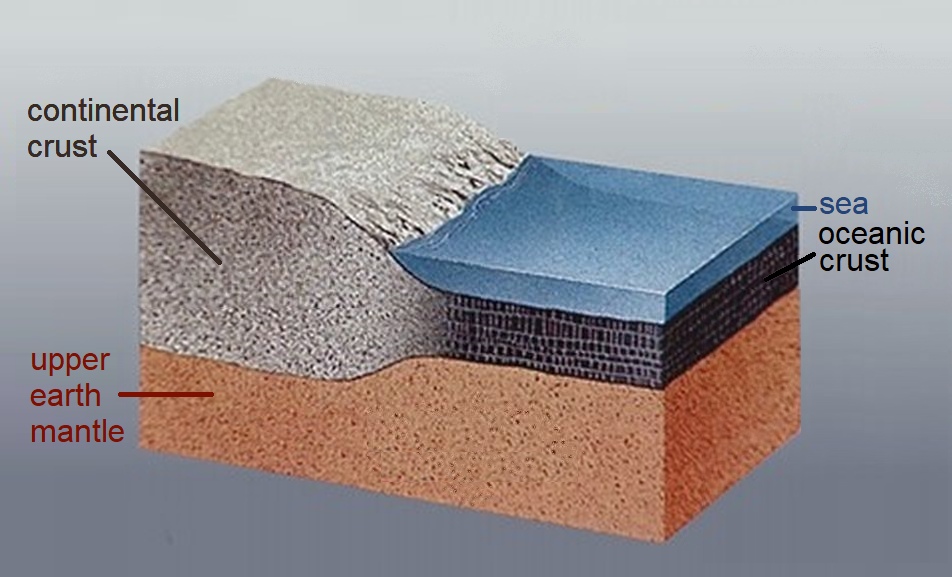
Lets review: Match the characteristics of the oceanic and continental crusts.
Basalt lava rock
Granite rock
very thin (3-5 miles thick)
very dense
very thick (up to 25 miles thick)
very light/not dense
under the oceans
the land and mountains
Oceanic crust
Continental crust
1 point
1
Question 2
2.
The plates that make up the Earth's crust are movable and float on the middle layer - the mantle
1 point
1
Question 3
3.
What is the name of the process where magma in the Earth's mantle rises and cools only to sinks and then is reheated to rise again?
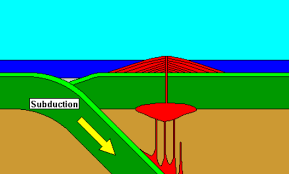
Subduction...think submarine...sub means under
Subduction is a process where one plate moves under another and is forced or sinks due to gravity into the mantle.
Subduction alway creates some type of volcanic activity asit punches a hole in the magma, allowing magma to spill up from the mantle. Regions where this process occurs are known as subduction zones.
Rates of subduction are typically in centimeters per year, with the average rate of being approximately two to eight centimeters per year along most plate boundaries.
1 point
1
Question 4
4.
What is subduction?
1 point
1
Question 5
5.
What is true about subduction?
Two types of subduction
Only oceanic plates, which are stronger and more dense, can subduct.
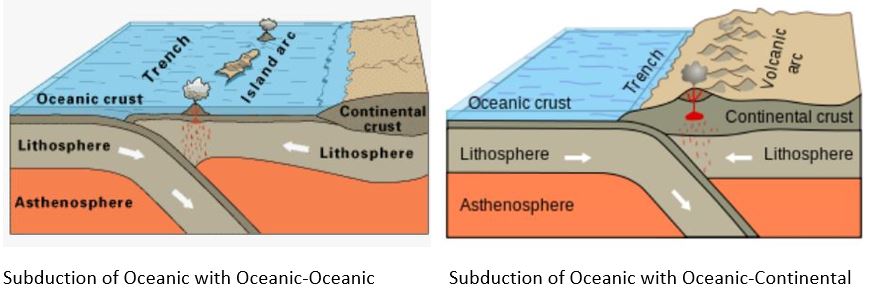
There are two types of subductions: Oceanic-Oceanic and Oceanic-Continental
Oceanic-Oceanic: One is where one oceanic plate subducts or slides below another ocenaic plate. Oceanic plates are thinner yet more dense and do not bend or break . One of the two oceanic plates eventuall gives way and subducts under the other. This causes magma to leak up between them creating volcanic island arcs.
Oceanic-Continental: The other type of subduction is where one oceanic plate subducts under a continetal plate. SInce the oceanic plate is stonger and more dense than the thicker and softer continental plate, the oceanic plate will subduct under and the continetal plate will crumple. This creates volcanic mountain ranges on land.
1 point
1
Question 6
6.
Match the following types of subductions to their characteristics.
one subducts under the other which does nothing
one subducts, one crumples
creates volcanic island arcs
creates volcanic islands on land
Oceanic-Oceanic
Oceanic-Continental
Island Arcs
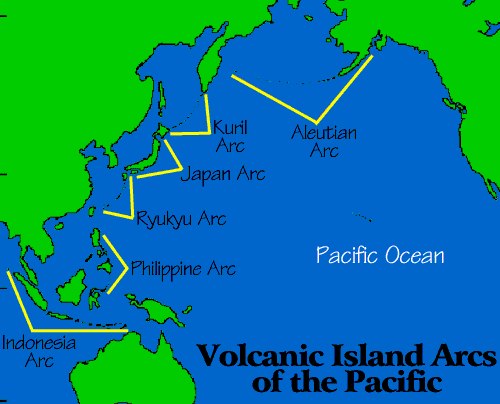
Island arcs are long curved chains of oceanic islands created when one oceanic plate subducts under another oceanic plate. This punches a hole in the mantle, allowing magma to spill up from the ocean floor. As the magma builds up, it forms islands that are volcanic. Some of these volcanic islands may go dormant (sleep) while others are active.
1 point
1
Question 7
7.
What is true about island arcs? You may chose more than one
Island Arc Examples
These are the island arcs created on the west side of the Pacific Ocean Basin.
1 point
1
Question 8
8.
Which of the examples is NOT an island arc? (Use the image above)
The Earth’s crust and upper mantle, is made up of a series of pieces, or tectonic plates, that move slowly over time.

A divergent boundary occurs when two tectonic plates move away from each other. Along these boundaries, earthquakes are common and magma (molten rock) rises from the Earth’s mantle to the surface, solidifying to create new oceanic crust.
1 point
1
Question 9
9.
Which is a NOT divergent boundary?
1 point
1
Question 10
10.
What is true about Divergent boundaries?
The Earth’s crust and upper mantle, is made up of a series of pieces, or tectonic plates, that move slowly over time.
When two plates come together, it is known as a convergent boundary. The impact of the colliding plates can cause the edges of one or both plates to buckle up into a mountain ranges or one of the plates may bend down into a deep seafloor trench. A chain of volcanoes often forms parallel to convergent plate boundaries and powerful earthquakes are common along these boundaries.
At convergent plate boundaries, oceanic crust is often forced down into the mantle where it begins to melt. Magma rises into and through the other plate, solidifying into granite, the rock that makes up the continents. Thus, at convergent boundaries, continental crust is created and oceanic crust is destroyed.
1 point
1
Question 11
11.
Which is a NOT convergent boundary?
1 point
1
Question 12
12.
What is true about convergent boundaries?
The Earth’s crust and upper mantle, is made up of a series of pieces, or tectonic plates, that move slowly over time.
Two plates sliding past each other forms a transform plate boundary. Natural or human-made structures that cross a transform boundary are offset—split into pieces and carried in opposite directions. Rocks that line the boundary are pulverized as the plates grind along, creating a linear fault valley or undersea canyon. Earthquakes are common along these faults. In contrast to convergent and divergent boundaries, crust is cracked and broken at transform margins, but is not created or destroyed.