Water has a natural force that pushes up towards the surface. This is called the buoyant force. The buoyant force comes from the pressure exerted on the object by the water. Pressure increases as depth increases, so the pressure on the bottom of an object is always greater than the force on the top resulting in a net upward force.
The net upward buoyancy force is equal to the weight of water displaced by an object. This force enables an object to float or at least seem lighter. If the weight or density of an object is less than the weight or density of the displaced water when fully submerged, this results in the object tending to rise. This is called Positive Buoyancy. Some natural things that have positive buoyancy are ducks, people, Sargassum seaweed, and air bubbles all float on/to the surface. Some man-made this that float are boats, buoys, some types of plastic trash. If the object has exactly the same density as the water, then its buoyancy equals its weight and the object will remain submerged in the water, but will neither sink nor float; they are suspended or move in the water column. This is called Neutral Buoyancy. Things that have the ability to float suspended in the water column are plankton, both zoo plankton and phytoplankton and some man-made plastic and Styrofoam trash. Natural things that have the ability to move or swim in the water column are nekton such as fish, sharks, whales, seals, and squid. Man-made things that can move in the water column are scuba divers, submarines and some plastic trash like plastic bags. An object with a higher density than the water will sink. This is called Negative Buoyancy. Some living things that are benthic (found on the ocean floor) are sand dollars, crabs, clams, corals, sponges and sea urchins. Man-made things that sink are ship wrecks and some types of metal trash.
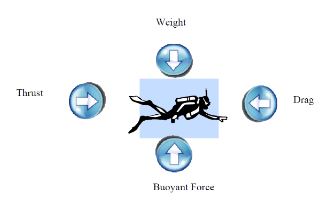
Other forces act on a floating body in the ocean, such as drag (friction due to the density of the fluid) which slows an object down, thrust (the force as the body pushes the water away) which speeds an object up, and weight (body’s affect due to gravity) which pushes the body down toward the ocean floor.
The net weight of a scuba diver can be altered by decreasing or increasing density using air or solid weights. Scuba divers can change their density by adding or releasing air from a buoyancy compensator, or BC, a vest that holds air. Also, by adding or removing solid weights in their weight belts, scuba divers change their net weight and buoyancy.
The density of fresh water is 1 g/cm³. The density of saltwater depends upon the amount of salt dissolved in the water. Cold water can dissolve more salt than warm water, making it more dense. Therefore, the physical releasing air from a buoyancy compensator, or BC, a vest that holds air. Also, by adding or removing solid weights in their weight belts, scuba divers change their net weight and buoyancy.