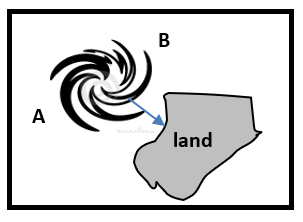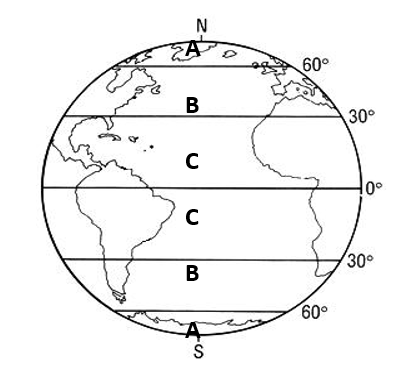
Letter A represents the ....
Letter A represents the ....
The tendency for the path of a moving object to deflect to a certain direction depending on the
hemisphere it is in is called...
What causes the winds to curve?
In the Northern Hemisphere, Global Winds curve to the..
What causes the winds?
Which of the following is NOT TRUE
Place the storms in order from most severe (strong) to least severe (strong).
Hurricane
Tropical Storm
Tropical Depression
The Coriolis effect does NOT effect winds at...
Letter A represents the ....
A _____________________ is when the winds around a hurricane blow water toward the shore and increase the water level at the coast.
Side A and side B both are images of...
Which side is the dirty side fo the storm?
A current is a cohesive stream of seawater that circulates through the ocean.
What are the causes of currents?
What controls the direction of the currents?
How do deep ocean currents form?
Which of the following statements is TRUE about upwelling?
Which of the following statements is/are FALSE about downwelling?
In which boundary current would you expect to find upwelling?
Use the image below for the question below.
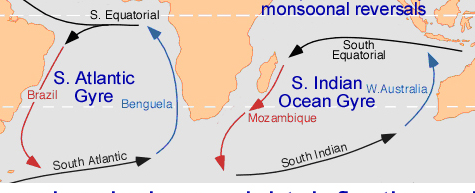
Which of the following is a western boundary current?
Categorize the following statements as Western Boundary Current or Eastern Boundary Current
From the poles to the equator.
Shallow, broad and slow moving cold water
From the equator moving towards the poles.
Nutrient rich/most productive part of ocean..
Deep,narrow and fast, warm water
Western Boundary Current
Eastern Boundary Current
What is true about the picture beolow??
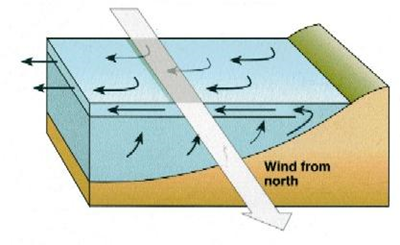
Which of the following leads to downwelling?
Which of the following leads to upwelling? Select all that apply.
The warm water at the equator moves towards poles and the cold water at the poles moves toward the equator. Why is this important?
The cold salty nutrient rich water water sinks at the pole and moves toward the equator. As it reaches the equator the cold water warms up and rise to the surface. Why is this important?
Global warming is causing the temperatures in the poles to rise. This causes the frozen water to melt. As a result the salinity and temperature difference between the poles and equator decreases. What will happen if the temperature and salinity differences between the poles and the equator decrease?