Log in
Sign up for FREE
arrow_back
Library

Unit 1 RETEST: Water Cycle, Water Conservation and Watersheds

star
star
star
star
star
Last updated almost 3 years ago
25 questions
1
1
1
1
1
1
1
1
1
1
3
1
1
1
1
1
1
1
1
1
1
1
1
3
2
Water Distribution and Water Cycle
Question 1
1.

Question 2
2.

Question 3
3.

Question 4
4.

Question 5
5.

Question 6
6.

Question 7
7.

Question 8
8.

Question 9
9.

Question 10
10.

Water Conservation
Question 11
11.

List 3 ways that you can conserve water. Number them 1, 2, and 3.

Enumere 3 formas en las que puede conservar el agua. Numerelos 1, 2 y 3.

Watersheds
Question 12
12.

Question 13
13.

Question 14
14.

Question 15
15.

Question 16
16.

Question 17
17.

Question 18
18.

Question 19
19.

Question 20
20.

Question 21
21.

Question 22
22.

Explain why Urban and city areas flood more often than rural/natural areas using the words permeable and impermeable.

Explique por qué las áreas urbanas y urbanas se inundan con más frecuencia que las áreas rurales / naturales utilizando las palabras permeable e impermeable.

Question 23
23.

Question 24
24.

Question 25
25.

Give 2 ways to prevent flooding AND Explain how each can prevent flooding. Number your respinses.

Dé 2 formas de prevenir inundaciones Y Explique cómo cada una puede prevenir inundaciones. Numere sus respuestas.

The water cycle is considered a renewable cycle because the water that we use today is the same water that was on the earth millions of years ago.

El ciclo del agua se considera un ciclo renovable porque el agua que usamos hoy es la misma que estaba en la tierra hace millones de años.
True
False
Which of the following are way that water moves from the land to the atmosphere?

¿Cuál de las siguientes estan una forma en que el agua se mueve de la tierra a la atmósfera?
Evaporation
Infiltration
Sublimation
Precipitation
What percent of the Earth's surface is made of water?

¿Qué porcentaje de la superficie de la Tierra está compuesta de agua?
3%
90%
71%
50%
Only 3% of ALL the water on Earth is Freshwater.

Solo el 3% de TODA el agua de la Tierra es agua dulce.
True
False
Of the freshwater of Earth, 75% is found in glaciers and 24.7% is found in underground.

Del agua dulce de la Tierra, el 75% se encuentra en los glaciares y el 24,7% se encuentra bajo tierra.
True
False
Place the locations of water in order from largest amount to smallest amount.

Coloque las ubicaciones de agua en orden de mayor a menor cantidad.
Atmospheric moisture
Saltwater in the Ocean
Groundwater
Lakes, rivers, and streams
Water frozen in glaciers
Which of the following statements is true?

¿Cuál de las siguientes afirmaciones es verdadera?
After drinking, animals get rid of water by precipitating.
Después de beber, los animales se deshacen del agua por precipitación.
One way animals get water in by infiltration
Una forma en que los animales obtienen agua infiltration.
Plants drinking is called root uptake.
Las plantas que beben se llama absorción de la raíz.
Which of the following statements is true?

¿Cuál de las siguientes afirmaciones es verdadera?
Surface Runoff is caused by the sun’s heat
Escorrentía superficial es causados por el calor del sol.
The sun’s heat causes water to evaporate off of lakes and river
El calor del sol hace que el agua se evapore de los lagos y ríos.
Infiltration occurs because of the sun’s heat.
La infiltración ocurre debido al calor del sol.
Which of the following statements is true?

¿Cuál de las siguientes afirmaciones es verdadera?
Precipitation is how water leaks underground
La precipitación es la forma en que el agua se filtra bajo tierra
Precipitation comes down as rain, snow, or hail
La precipitación cae en forma de lluvia, nieve o granizo
Precipitation is when animal sweat evaporates into the atmosphere.
La precipitación es cuando el sudor de los animales se evapora a la atmósfera.
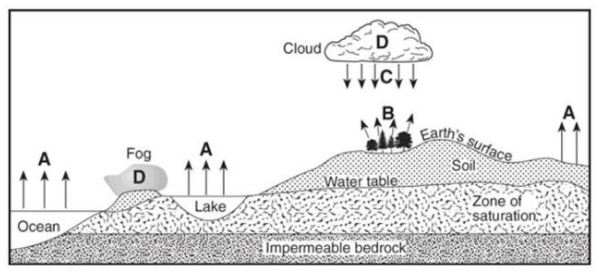
Look at this diagram of the water cycle. What are two water cycle processes NOT shown by arrows in the diagram?

Mira este diagrama del ciclo del agua. ¿Cuáles son dos procesos del ciclo del agua que NO se muestran con flechas en el diagrama?
Infiltration and Runoff
Precipitation and freezing
Transpiration and Condensation
Evaporation and Melting
What is true about a drainage basin and a watershed?

¿Qué es cierto acerca de una cuenca hidrográfica y una cuenca hidrográfica?
They are the same thing, interchangeable.
Son lo mismo, intercambiables.
A drainage basin is the parts (roads/buildings/ hills/trees) that affect where the water travels; the watershed is the geographic (land) area that transports of water and sediments into the river.

Una cuenca de drenaje son las partes (caminos / edificios / colinas / árboles) que afectan por donde viaja el agua; la cuenca es el área geográfica (terrestre) que transporta agua y sedimentos al río.
A watershed is the parts (roads/buildings/ hills/trees) that affect where the water travels; the drainage basin is the geographic (land) area that transports the water and sediments into the river

Una cuenca hidrográfica son las partes (carreteras / edificios / colinas / árboles) que afectan por donde viaja el agua; la cuenca de drenaje es el área geográfica (terrestre) que transporta el agua y los sedimentos al río
What divides a watershed?

¿Qué divide una cuenca?
The watershed or drainage basin is divided by the person who owns the property.
la persona dueña de la propiedad
The divide is created by the political government in which the watershed or drainage basin is found
creado por el gobierno político
The watershed or drainage basin divide is created by where the river flows
donde fluye el río.
The divide is created by the highest points of land surrounding the watershed or drainage basin
puntos más altos de tierra que rodean la cuenca
What factors interact with water to form a watershed? Select all that apply.

¿Qué factores interactúan con el agua para formar una cuenca?
Climate
Geology of the land (hills, streams)
Man-made Geography (buildings, roads)
Amount of rainfall
What happens to pollution in a watershed?

¿Qué sucede con la contaminación en una cuenca?
It washes into to the nearest stream
Se lava en el arroyo más cercano
It can pollute things downstream
Puede contaminar cosas río abajo
It stays in the same place
Se queda en el mismo lugar
Point source pollution is when the pollution is coming from a specific location, making it easy to identify the source.
La contaminación de fuente puntual es cuando la contaminación proviene de una ubicación específica, lo que facilita la identificación de la fuente.
True
False
Point source pollution is pollution that is caused by widely dispersed (found all over) sources of pollutants.
La contaminación de fuente puntual es la contaminación causada por fuentes de contaminantes ampliamente dispersas (que se encuentran por todas partes)
True
False
Which of the following statements about aquatic macroinvertebrates is FALSE?

¿Cuál de las siguientes afirmaciones sobre los macroinvertebrados acuáticos es FALSA?
Aquatic macroinvertebrates can be used to determine stream quality by counting the number of pollution tolerant and pollution intolerant species present in the stream.
Los macroinvertebrados acuáticos se pueden utilizar para determinar la calidad del arroyo contando el número de especies tolerantes a la contaminación e intolerantes a la contaminación presentes en el arroyo.
Aquatic macroinvertebrates are organisms without backbones that are large enough to see with the naked eye.
Los macroinvertebrados acuáticos son organismos sin columna vertebral que son lo suficientemente grandes como para verlos a simple vista.
The presence of many species that are sensitive to pollution in a stream indicates poor stream health.
La presencia de muchas especies que son sensibles a la contaminación en un arroyo indica una mala salud del arroyo.
Select all of the statements that are TRUE about the amount of water that infiltrates into the ground in its given area.

Seleccione todas las afirmaciones que sean VERDADERAS sobre la cantidad de agua que se infiltra en el suelo en su área determinada.
Rural/natural area: 50%
Urban/city (Ciudad) area: 50%
Rural/natural area: 75%
Rural/natural area: 100%
Urban/city (Ciudad) area: 32%
What is true about biotic and abiotic parts of an ecosystem? Select all that apply.

¿Qué es cierto sobre las partes bióticas y abióticas de un ecosistema?
Abiotic parts are living (viviendo) and biotic are non-living (sin vida)
Biotic parts are living (viviendo) and abiotic are non-living (sin vida)
Biotic includes fish, plants, insects
Biótico incluye peces, plantas, insectos.
Abiotic includes rocks, sand, water, air
Abiótico incluye rocas, arena, agua, aire.
Floodplains are defined (definida) as...
None of these
ninguno de esos
Area around a waterway that periodically floods with too much water
Área alrededor de una vía fluvial que periódicamente se inunda con demasiada agua
Area where flood water is stored
Área donde se almacena el agua de la inundación
Area where no flooding occurs
Área donde no ocurren inundaciones
One thing that can both increase and decrease a stream is...

Una cosa que puede aumentar y disminuir un flujo es ...
Bridge
Fence
Building
Dam
Sort the following into the correct category.

Ordene lo siguiente en la categoría correcta.
Pumping from a well
Groundwater flow up
Water evaporates into the air
Flooding
Rainfall
Water table decreases
Water infiltrates into the soil
Water table rises
Items that are associated with a Gaining stream
Items that are associated with a Losing stream