Log in
Sign up for FREE
arrow_back
Library
Unit 1 Test: Water Cycle, Water Conservation and Watersheds
By CAITLIN Holgado
star
star
star
star
star
Share
share
Last updated over 2 years ago
28 questions
Add this activity
1
1
1
1
1
1
1
1
1
1
1
1
2
1
1
1
1
1
1
1
1
1
1
1
1
1
1
2
Water Distribution and Water Cycle
Question 1
1.
The water cycle is considered a renewable cycle because water cannot be created or destroyed, it just changes forms.
True
False
Question 2
2.
Which of the following is
NOT
a way that water moves from the land to the atmosphere?
Evaporation
Sublimation
Transpiration
Precipitation
Question 3
3.
~71% of Earth's surface is covered with water.
True
False
Question 4
4.
Only 3% of the water on Earth is saltwater.
True
False
Question 5
5.
Of the freshwater of Earth, 75% is found underground and 24.7% is found in Glaciers.
True
False
Question 6
6.
Of the freshwater on Earth, 0.27% is found in rivers and lakes and 0.003% is found in the atmosphere
True
False
Question 7
7.
Which of the following statements is false?
After
drinking
, animals get rid of water by precipitating.
One way animals get water in by
drinking and eating.
Plants
drinking
is called root uptake.
Question 8
8.
Which of the following statements is false?
The
sun’s heat
causes water to evaporate off of lakes and river
Perspiration and melting is caused by the
sun’s heat
Infiltration occurs because of the
sun’s heat
.
Question 9
9.
Which of the following statements is false?
Precipitation comes down as rain, snow, or hail
Precipitation is how water leaks underground
Precipitation comes from the atmosphere after condensing
Question 10
10.
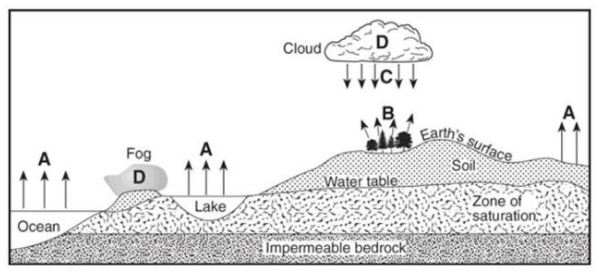
Look at this diagram of the water cycle. What are two water cycle processes NOT shown by arrows in the diagram?
Precipitation and freezing
Evaporation and Melting
Infiltration and Runoff
Transpiration and Condensation
Question 11
11.
Look at this diagram of the water cycle. Which of the following is correct?
B - Evaporation
D - Condensation
A - Transpiration
C - Infiltration
Water Conservation
Question 12
12.
The world is at risk of running out of clean and accessible drinking water.
True
False
Question 13
13.
Which of the following are ways that we can conserve water? Select all that apply.
Wash your car in the middle of a concrete street
Collect rain water to use for watering plants
Repair leaks in the house
Turn off the water while brushing your teeth
Add a brick to the toilet bowl so that it does not refill with as much water
Take longer showers
Watersheds
Question 14
14.
What is
true
about a drainage basin and a watershed?
A
watershed
is the parts (roads/buildings/ hills/trees) that affect where the water travels; the
drainage basin
is the geographic (land) area that transports the water and sediments into the river
A
drainage basin
is the parts (roads/buildings/ hills/trees) that affect where the water travels; the
watershed
is the geographic (land) area that transports of water and sediments into the river.
None of the above
They are the same thing, interchangeable.
Question 15
15.
What divides a watershed?
The divide is created by the political government in which the watershed or drainage basin is found
The watershed or drainage basin is divided by the person who owns the property
The divide is created by the highest points of land surrounding the watershed or drainage basin
The watershed or drainage basin divide is created by where the river flows
Question 16
16.
What factors interact with water to form a watershed?
Climate
Amount of rainfall
Geology of the land (hills, streams)
Man-made Geography (buildings, roads)
All of the above
Question 17
17.
What happens to pollution in a watershed?
It stays in the same place
It washes into to the nearest stream
It can pollute things downstream
Both B and C
Question 18
18.
Which of the statements below is TRUE?
It is easy to identify the source of nonpoint source pollution.
Point source pollution is pollution that is caused by widely dispersed (found all over) sources of pollutants.
Point source pollution is when the pollution is coming from a specific location, making it easy to identify the source.
Nonpoint source pollution stays in one place and typically is not carried into water bodies by surface runoff.
Question 19
19.
Which of the following statements about aquatic macroinvertebrates is
FALSE?
Aquatic macroinvertebrates are organisms without backbones that are large enough to see with the naked eye.
Aquatic macroinvertebrates can be used to determine stream quality by counting the number of pollution tolerant and pollution intolerant species present in the stream.
Aquatic macroinvertebrates live on, under, and around rocks and sediment on the bottoms of lakes, rivers, and streams.
The presence of many species that are sensitive to pollution in a stream indicates poor stream health.
Question 20
20.
What percent of precipitation
infiltrates
into the ground for each type of area?
Rural/natural area: 75% --- Urban/city area: 32%
Rural/natural area: 100% --- Urban/city area: 50%
Rural/natural area: 50% --- Urban/city area: 32%
Rural/natural area: 32% --- Urban/city area: 50%
Question 21
21.
What is true about
biotic and abiotic
parts of an ecosystem?
Biotic parts are living and abiotic are non-living
Abiotic includes rocks, sand, water, air
Biotic includes fish, plants, insects
All of these are true
Question 22
22.
Floodplains are defined as...
None of these
Area where no flooding occurs
Area where flood water is stored
Area around a waterway that periodically floods with too much water
Question 23
23.
Urban and city areas flood more often than rural/natural areas because...
Urban areas have more
permeable
areas that make water stay stagnant
Urban areas have more
impermeable
areas that allow water to transpire
Urban areas have more
permeable
areas that allow water to infiltrate
Urban areas have more
impermeable
areas that make water stay stagnant
Question 24
24.
What happens in a gaining stream?
Water evaporates at a high rate
Water table rises
Causes flooding if it goes over the banks
Both B and C
Question 25
25.
Where does the water go in a losing stream?
Evaporates into the air
Infiltrates into the soil
Both A and B
None of the above
Question 26
26.
One thing that can both increase
and
decrease a stream is...
Dam
Building
Fence
Bridge
Question 27
27.
Which of the following are examples of non-point source pollution?
Leaking waste barrels
Black Smoke from a Factory
Pet Waste
Pesticides
Storm water Run off
Tanker truck leaking chemicals
Question 28
28.
Give 3 ways to prevent flooding AND Explain
HOW
each can prevent flooding. Number your responses 1, 2, and 3.