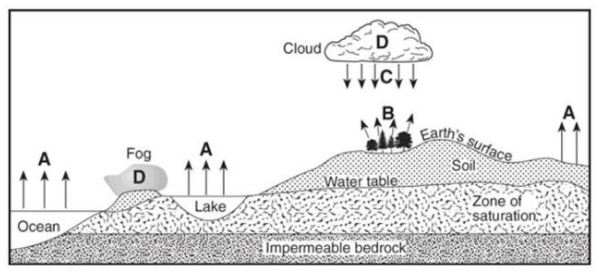
Look at this diagram of the water cycle. What are two water cycle processes NOT shown by arrows in the diagram?
Look at this diagram of the water cycle. What are two water cycle processes NOT shown by arrows in the diagram?
The water cycle is considered a renewable cycle because water cannot be created or destroyed, it just changes forms.
Which of the following is NOT a way that water moves from the land to the atmosphere?
~71% of Earth's surface is covered with water.
Only 3% of the water on Earth is saltwater.
Of the freshwater of Earth, 75% is found underground and 24.7% is found in Glaciers.
Of the freshwater on Earth, 0.27% is found in rivers and lakes and 0.003% is found in the atmosphere
Which of the following statements is false?
Which of the following statements is false?
Which of the following statements is false?
Look at this diagram of the water cycle. What are two water cycle processes NOT shown by arrows in the diagram?
Look at this diagram of the water cycle. Which of the following is correct?
The world is at risk of running out of clean and accessible drinking water.
Which of the following are ways that we can conserve water? Select all that apply.
What is true about a drainage basin and a watershed?
What divides a watershed?
What factors interact with water to form a watershed?
What happens to pollution in a watershed?
Which of the statements below is TRUE?
Which of the following statements about aquatic macroinvertebrates is FALSE?
What percent of precipitation infiltrates into the ground for each type of area?
What is true about biotic and abiotic parts of an ecosystem?
Floodplains are defined as...
Urban and city areas flood more often than rural/natural areas because...
What happens in a gaining stream?
Where does the water go in a losing stream?
One thing that can both increase and decrease a stream is...
Which of the following are examples of non-point source pollution?
Give 2 ways to prevent flooding AND Explain HOW each can prevent flooding. Number your responses 1, 2, and 3.
1. You can prevent flooding by ________ because this will ______
2.