Which statement is true? You may chose more than one.
Which statement is true? You may chose more than one.
Alfred Wegener and Pangaea
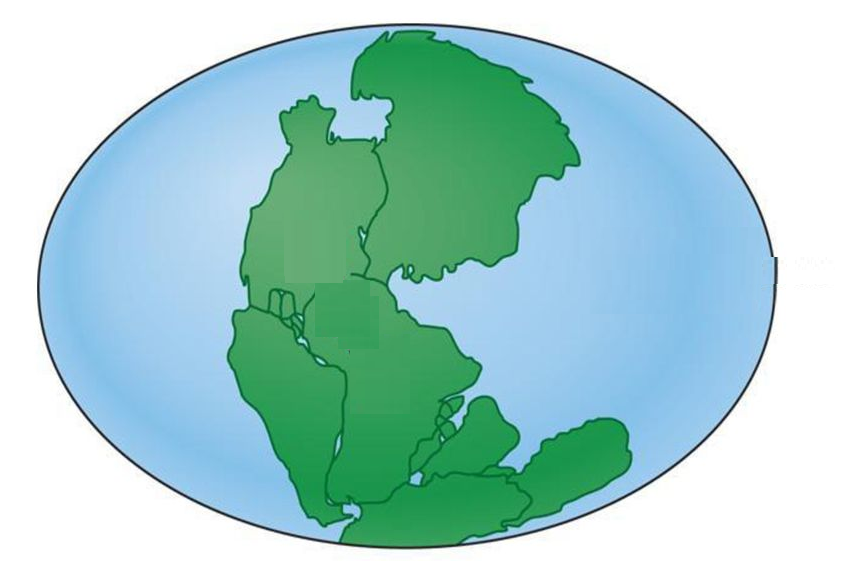
In 1912, a German meteorologist and polar explorer named Alfred Wegener proposed what was at the time a startling idea. He proposed that in the distant past all the Earth’s continents had been a single giant continent. Wegener called this continent Pangaea (pronounced pan-GEE-ah). Surrounding Pangaea, he said, was a single large ocean he called Panthalassa (pan-tha-LA-sa).
Which statement is true? You may chose more than one.
Over the years, since the first accurate maps, others (including Leonardo da Vinci and Sir Francis Bacon) had observed how well the continents could be pieced together like a puzzle. However, Wegener was the first to formally propose a process that explained the fit and present placement of the continents.
Why did Wegener believe all the continents started out as one single giant continent that later broke apart?
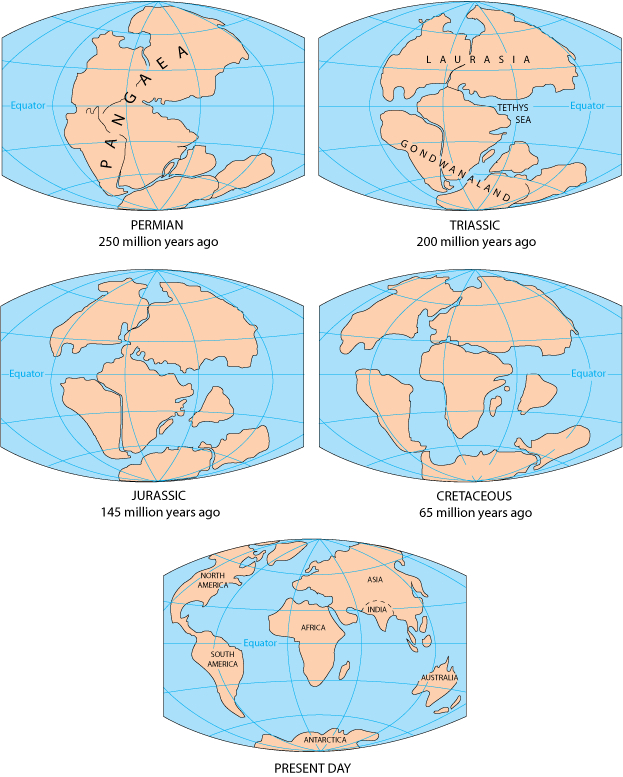
Wegener theorized that because the less dense continents floated on the molten rock of the mantle, Pangaea broke by floating apart into separate pieces. The separate continents reached their present locations by drifting apart for more than 200 million years. The theory that the continents were once a single landmass that drifted apart (and are still doing so) is called the theory of continental drift.
The idea that the continents were one giant continent that broke apart and is still moving is called
Wegener believed the continents moved because the less dense continents floated on the molten rock of which layer of the Earth?
How long do scientists believe the continents have been moving/drifting?
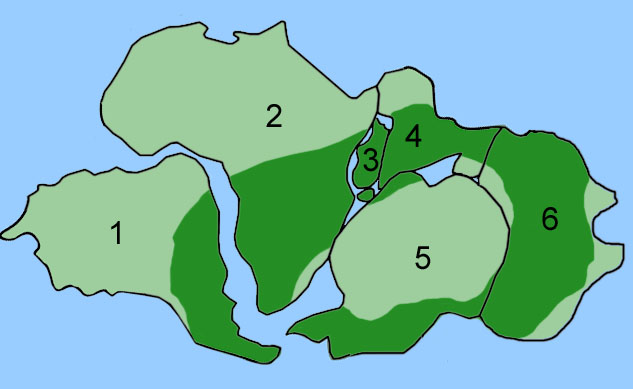
In the 1600s, the first accurate world maps became available. People noticed that the continents apparently fit together like jigsaw-puzzle pieces. This was the first evidence of continental drift. It was hundreds of years later that Wegener began to see further evidence from other sources.
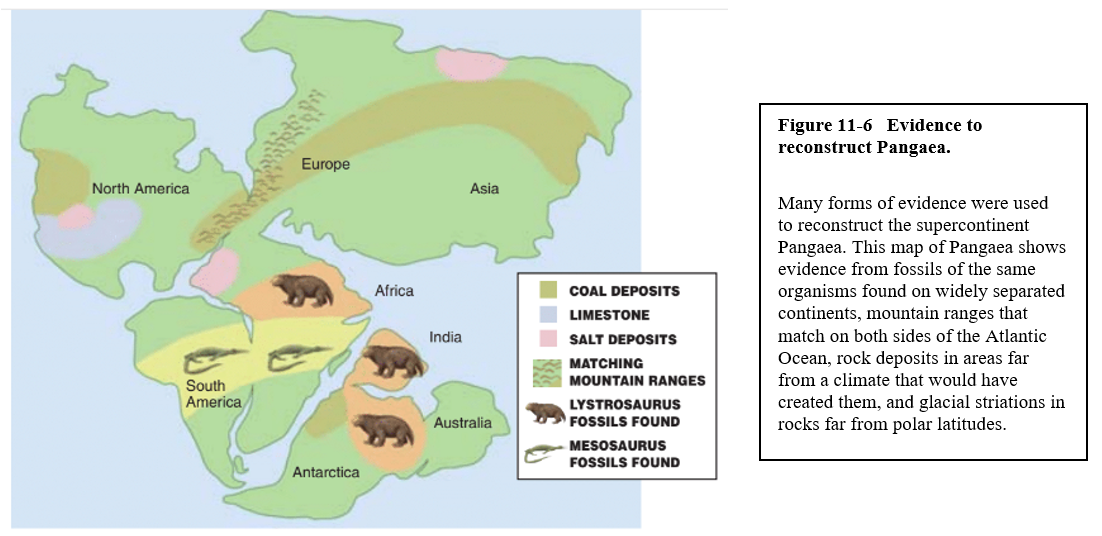
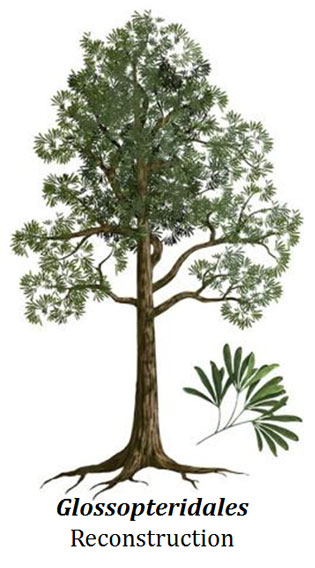
In 1855, the German scientist Edward Suess found fossils of the extinct Glossopteris fern tree in South America, Africa, Australia, India, and Antarctica (see dark green). Typically, seeds can be spread by wind, water or being eaten animals and as the animals travel, they deposited the seeds in their feces/waste in new locations. Glossopteris seeds were too heavy to travel by wind and too fragile to survive the trip across the salty oceans so they must have been spread by traveling animals. To Wegener and other early believers of continental drift, this suggested that these landmasses must have once been much closer together for the fern to have spread so widely.
Why did Edward Suess believe that the fossil seeds of Glossopteris helped support the theory that Pangaea was one giant continent that broke apart? You may choose more than one.
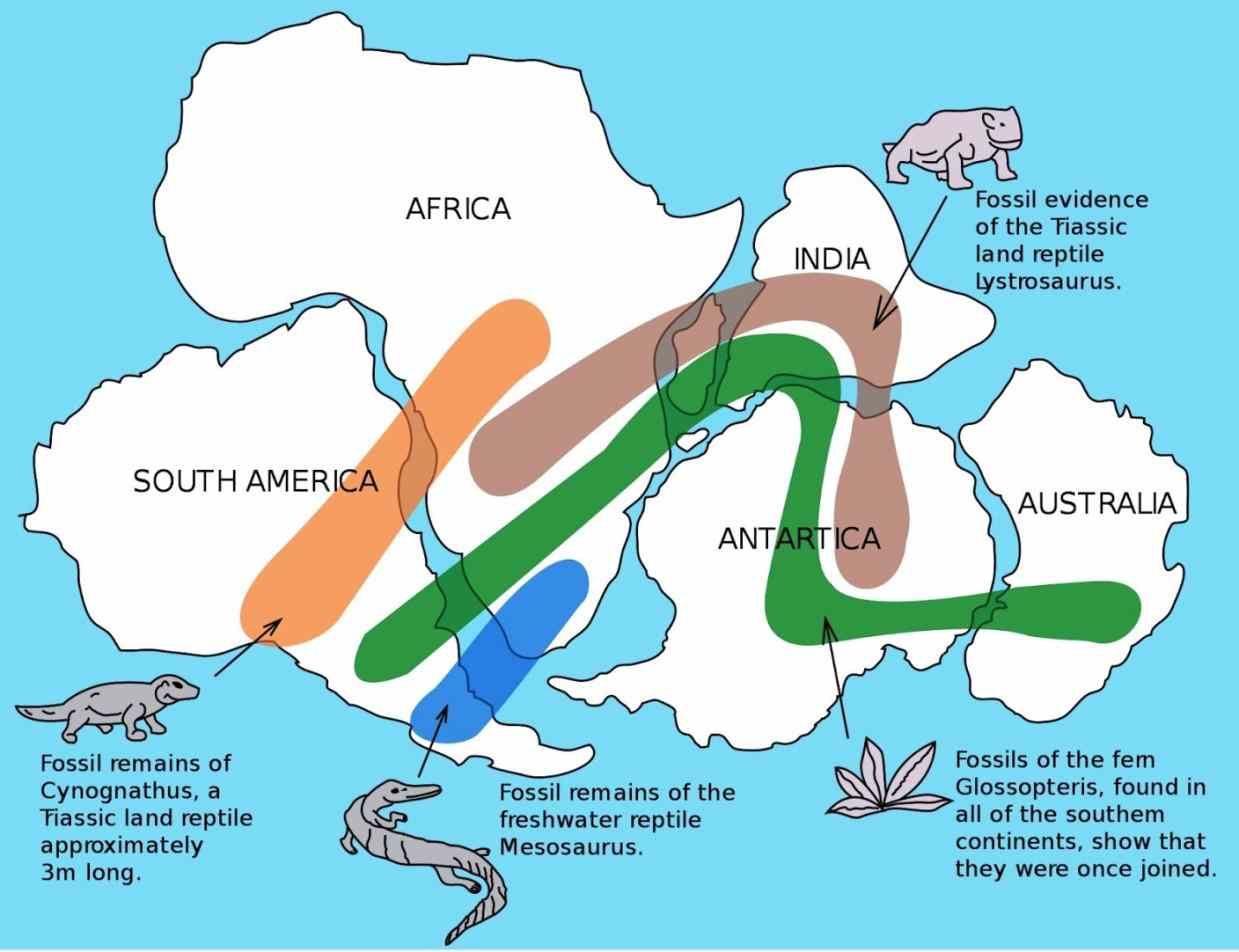
Continental drift proponents also studied the distribution of animals and fossils. Two examples were the extinct aquatic reptile Mesosaurus and an extinct bear-like animal called Lytrosaurus. Based on the distribution of fossils for these animals, Wegener and others who supported the theory of continental drift hypothesized that Pangaea had split into two continents about 200 million years ago. They called the hypothetical northern continent Laurasia. It included today’s North America, Greenland, and Eurasia. They named the southern continent Gondwanaland, which included the remaining continents.
Fossils of two extinct animals found on “touching continents” gave evidence that Pangaea split apart into two separate land masses about 200 million years ago. Use the information from the map above for the following question.
Which of the following stements are correct? Select all that apply.
What did the scientists of the time belive was true.
Wegener also saw the distribution of coal as evidence. In 1908, the famed polar explorer Ernest Shackleton discovered coal in the Antarctic. Scientists theorize that coal originates when geological processes bury plants in warm, swampy climates faster than it can decompose. Pressure and heat alter the vegetation, eventually turning it into coal. Since Antarctica doesn’t presently have the appropriate climate for this kind of vegetation, Wegener reasoned, it must have in the past been in a different place with a different climate.
Why did Wegener belive the location coal is found was evidence of Pangaea?
Despite these examples and other evidences, the theory of continental drift wasn’t widely accepted while Wegener was still alive. This may have partly been because Wegener was a meteorologist, not a geologist. He was therefore not taken seriously by much of the geological community. A scientific weakness in his theory, however, was that he couldn’t explain how continents could drift.
Wegener suggested that the Earth’s rotation and tides moved the continents. Calculations, however, showed that these forces were too small to account for continental drift. Another criticism was that the jigsaw puzzle of the continents had gaps. Wegener disappeared in 1930 during an expedition in Greenland. He never knew that years later the plate tectonics theory would provide an explanation for how continents move, making his theory widely accepted. Additionally, it was found that including the continental shelves filled the gaps in the jigsaw puzzle.
Which of the following were holes in Wegeners theory while he was alive?
What discoveries were made after Wegener's death that strongly supported his theory of continental drift?
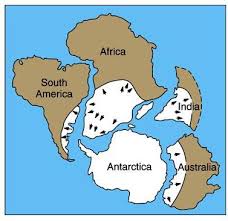
Today most scientists accept the theory of continental drift. As glaciers slide across the land, they leave bedind scrape marks on the land and leave rocks and other sediments pushed into the earth. These glacial rock deposits on landmasses are found too far from the cold altitudes where glaciers form—even during an ice age. The conclusion is that these areas must have once been closer to the poles. See diagram to the right. -->
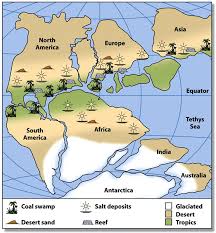
Also, hundreds of millions of years old salt deposits, which are formed in very hot dry areas near the ocean, have been found at places that are wetter, cooler and nowhere near the ocean where salt deposits form. See diagram to the left.
Limestone or reef deposits, which are the remains of coral reefs, have been found in the northcentral United States and other places far from warmer, tropical areas where corals grow. Again, the conclusion is that these areas must have once been at places with different climates. See diagram to the left.
Why did Wegener believe the location of glacial deposits was evidence of Pangaea?
What other things helped Wegener belived in Pangaea?
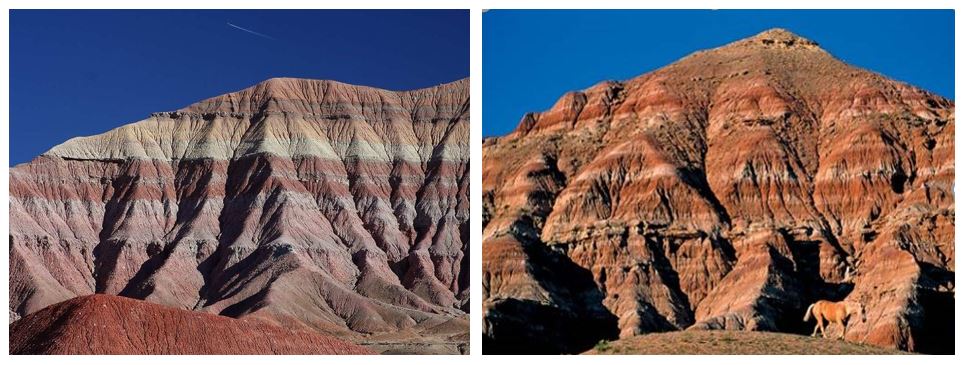
Scientists also point to similarities in mountain ranges. The Cape Mountains in Africa were part of the Sierras in South America. Some mountains have different rock layers made of different combination of minerals. These minerals are brought in from flooding and windstorms carrying in different types of soils and elements (calcium, aluminum, iron, magnesium, potasssium, silicon). These layer on top of each other over a long period of time to form this type of mountain. Every mountain is very different because of the different elements in the area. When a continent breaks apart, the mountains on the continet are also broken apart.
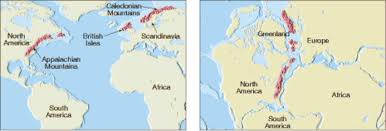
Scientists point to similarities in the layers of different mountain ranges on different continents. The Caledonian mountain range in Scotland have the same layers as the mountains in Norway (Scandinavian mountains), northern Africa (Atlas mountains), Canada (Newfoundland mountians), and the US (Appalachian mountains). It is believed that all of these were at one time part of the same Caledonian range.
What other evidence helped Wegener belived in Pangaea? You may chose more than one
Math the explanation with each evidence that supports that the land masses have moved.
| Draggable item | arrow_right_alt | Corresponding Item |
|---|---|---|
Matching mountain ranges | arrow_right_alt | Deposits are made from the remains of coral reefs and deposits were found at latitudes coral doesn’t grow. |
Limestone Deposits | arrow_right_alt | Created in very hot dry areas near the ocean, but have been found at places that are wetter, cooler and nowhere near the ocean. |
Salt deposits | arrow_right_alt | Deposits on some landmasses are found too far from the cold altitudes where glaciers form. |
Glacial Rock Deposits | arrow_right_alt | Ranges with similar height, rock layerings, and mineral distributions have been found on different continents. |
Look at the image above. What are 3 things that support the theory of continental drift and why?