Plate Tectonics Practice

Last updated over 2 years ago
16 questions
Plate Tectonics Practice
The 2 layers of the Crust


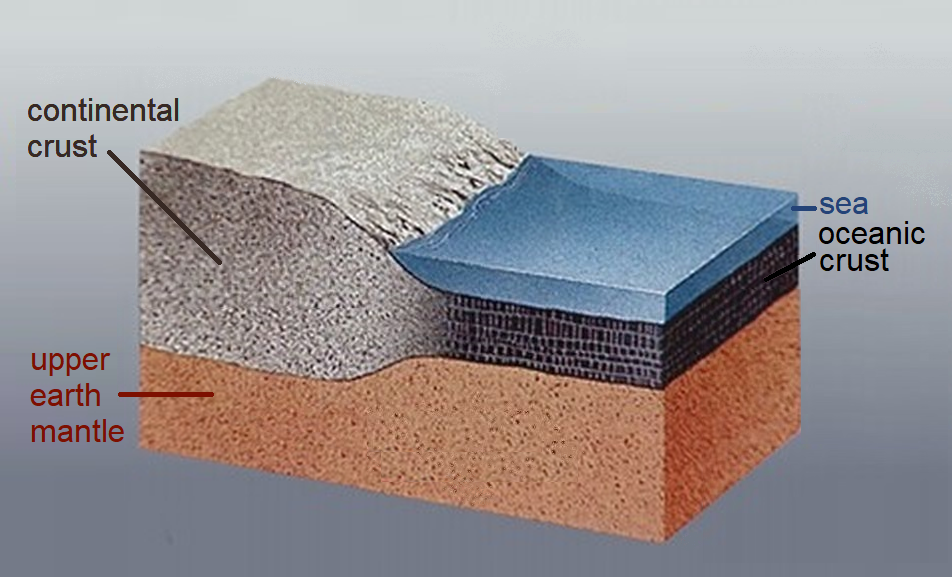
The crust that makes up the continents is up to 25 miles thick and made up of granite rock which is very thick but light.
Hints: Continental granite, Thick, Mountains, Light/not as dense, Above the water.

The crust under the oceans is called oceanic crust which is made of basalt lava rock that is very thin but dense. It is only 3-5 miles thick.
Hints: Oceanic basalt rock, Dense, Sinks under the water, Thin, Being squished under the weight of the water
1

Lets review: Match the characteristics of the oceanic and continental crusts

  • Basalt lava rock
  • Granite rock
  • very thin (3-5 miles thick)
  • very dense
  • very thick (up to 25 miles thick)
  • very light/not dense
  • under the oceans
  • the land and mountains
  • Oceanic crust
  • Continental crust

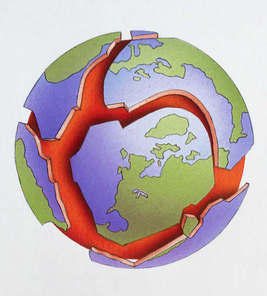
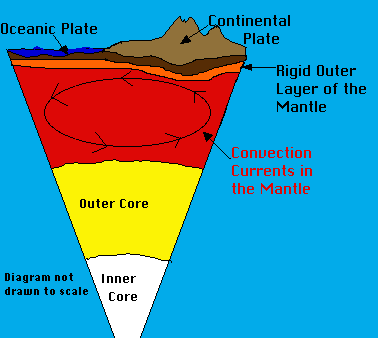
The crust of the Earth is broken into many pieces called plates. The plates "float" on the soft, movable mantle which is located below the crust. The mantle is composed of very hot, dense rock. This layer of rock even flows like wet concrete. This flow is due to great temperature differences from the bottom to the top of the mantle. The movement of the mantle is the reason that the plates of the Earth move!
1

These plates that make up the Earth's crust are movable and float on the middle layer - the mantle

1

What is true about the mantle? You may chose more than one.

Convection Currents


The mantle is made of much denser, thicker material, because of this the plates "float" on it like oil floats on water.
Many geologists believe that the mantle "flows" because of convection currents. Convection currents are caused by the very hot material at the deepest part of the mantle rising, then cooling, sinking again and then heating, rising and repeating the cycle over and over. When the convection currents flow in the mantle they also move the crust. The crust gets a free ride with these currents.
1

What is the name of the process where magma in the Earth's mantle rises and cools only to sinks and then is reheated to rise again?

Theory of Continental Drift


According to the theory of continental drift, the world was made up of a single continent through most of geologic time. That continent eventually separated and drifted apart, forming into the seven continents we have today.
Theory of Plate Tectonics


Plate tectonics is the theory that Earth's outer shell is divided into several plates that glide over the mantle, the rocky inner layer above the core.

The force behind plate tectonics is convection currents in the mantle. Hot material near the Earth's core rises, and colder mantle rock sinks. Think... like a pot boiling on a stove. The convection current drive plates tectonics through a combination of pushing and spreading apart the seafloor and pulling and sinking downward at other areas.

From the deepest ocean trench to the tallest mountain, plate tectonics explains the features and movement of Earth's surface in the present and the past.
Theory of Seafloor Spreading


Seafloor spreading occurs at plate boundaries that seperate or divide. As tectonic plates slowly move away from each other, heat from the mantle's convection currents makes the crust thinner and less dense. The less-dense material rises, often forming a mountain or elevated area of the seafloor. Eventually, the crust cracks and magma flows out, then hardens.
1
Draggable itemCorresponding Item
the idea that the Earth's crust is made up of continetal plates which have moved over time and are still moving
The Theory of Continental Drift
the idea that the convection currents in the mantle are pushing apart the oceanic crust and causing magma to spill up and creat underwater volcanic mountain ranges
The Theory of Plate Tectonics
the idea that the continents were one giant continent called Pangaea that broke apart and are still moving today
The Theory of Seafloor Spreading
Subduction ...think submarine...sub means under
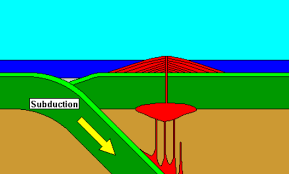
Subduction is a process where one plate moves under another and is forced or sinks due to gravity into the mantle.

Subduction alway creates some type of volcanic activity as it punches a hole in the magma, allowing magma to spill up from the mantle. Regions where this process occurs are known as subduction zones.

Rates of subduction are typically in centimeters per year, with the average rate of being approximately two to eight centimeters per year along most plate boundaries.
1

What is subduction?

1

What is true about subduction?

Two types of subduction

Only oceanic plates, which are stronger and more dense, can subduct.

There are two types of subductions: Oceanic-Oceanic and Oceanic-Continental
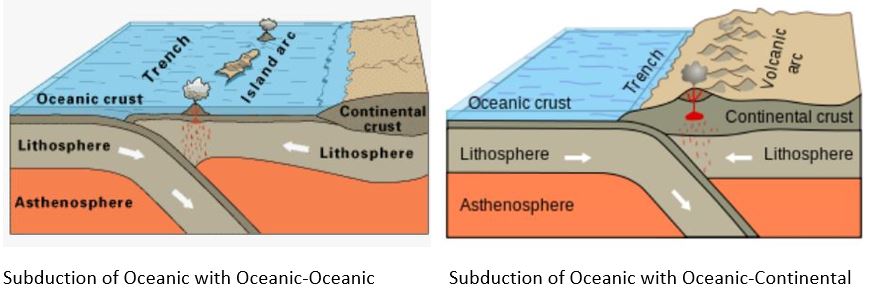
Oceanic-Oceanic: One is where one oceanic plate subducts or slides below another oceanic plate. Oceanic plates are thinner yet more dense and do not bend or break . One of the two oceanic plates eventually gives way and subducts under the other. This causes magma to leak up between them creating volcanic island arcs.

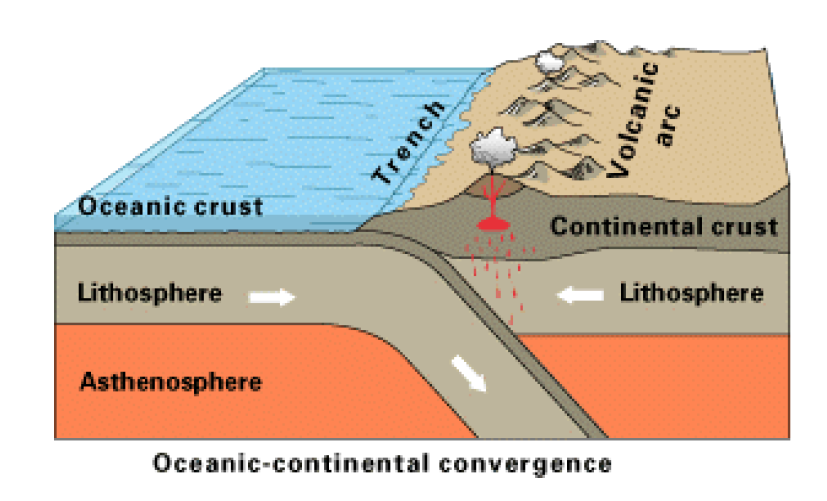
Oceanic-Continental: The other type of subduction is where one oceanic plate subducts under a continental plate. Since the oceanic plate is stonger and more dense than the thicker and softer continental plate, the oceanic plate will subduct under and the continetal plate will crumple. This creates volcanic mountain ranges on land.
1

Match the following types of subductions to their characteristics.

  • one subducts under the other which does nothing
  • one subducts, one crumples
  • creates volcanic island arcs
  • creates volcanic islands on land
  • Oceanic-Oceanic
  • Oceanic-Continental
Island Arcs


Island arcs are long curved chains of oceanic islands created when one oceanic plate subducts under another oceanic plate. This punches a hole in the mantle, allowing magma to spill up from the ocean floor. As the magma builds up, it forms islands that are volcanic. Some of these volcanic islands may go dormant (sleep) while others are active.
1

What is true about island arcs? You may chose more than one

Island Arc Examples


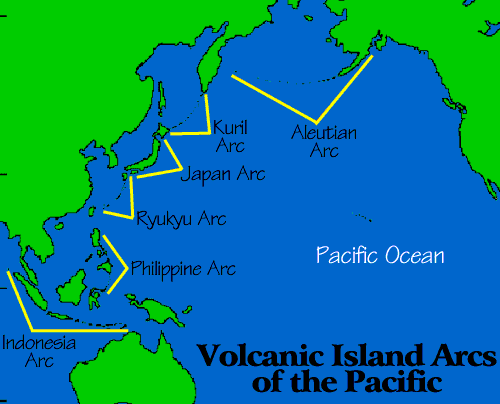
These are the island arcs created on the west side of the Pacific Ocean Basin. Not all volcanic islands are considered island arcs. Only island chains that are formed due to the interaction of two oceanic plates diverging are considered island arcs. Island chains such as the Hawaiian Islands are created in the middle of a plate, not at the edge. These types of island chains are called hotspot islands. They occur when the plate slides over a hotspot in the mantle and magma busrts through creating a volcanic island.
1

Which example is NOT an island arc?

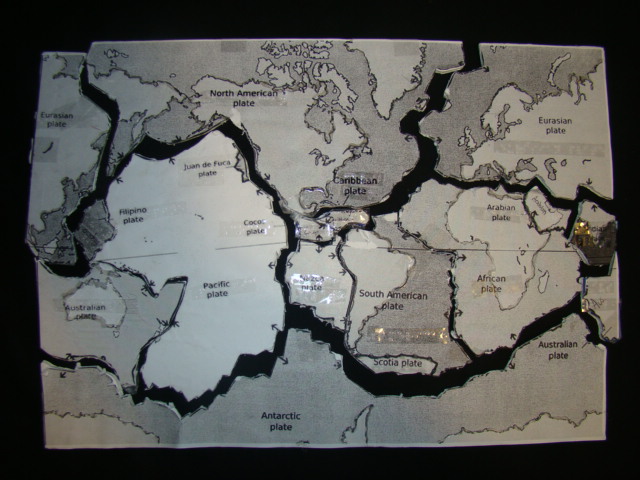
The Earth’s crust and upper mantle, is made up of a series of pieces, or tectonic plates, that move slowly over time.

Divergent Boundary
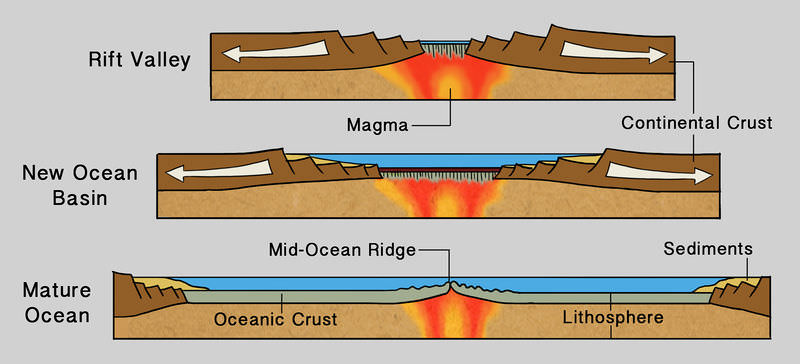
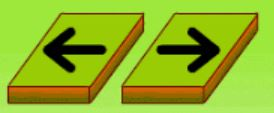
A divergent boundary occurs when two tectonic plates move away from each other. Along these boundaries, earthquakes are common and magma (molten rock) rises from the Earth’s mantle to the surface, solidifying to create new oceanic crust. When continental plates diverge, they first forma rift valley. After a long period of time, the rift valley becomes so deep that the magma below surfaces and creates new oceanic crust. The oceanic crust is then filled with more water as the seafloor spreads over time.


Convergent Boundary
When two plates come together, it is known as a convergent boundary. The impact of the colliding plates can cause the edges of one or both plates to buckle up into a mountain ranges or one of the plates may bend down into a deep seafloor trench. When two continental plates are converging, both plates to buckle up into a mountain ranges.
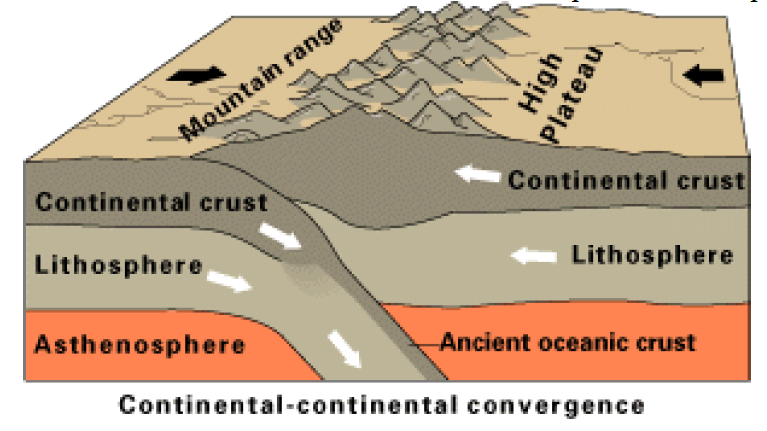


When a continental and oceanic plate are converging, a chain of volcanoes often forms parallel to convergent plate boundaries and powerful earthquakes are common along these boundaries. Oceanic crust is often forced down into the mantle where it begins to melt. Magma rises into and through the other plate, solidifying into granite, the rock that makes up the continents. Thus, at convergent boundaries, continental crust is created and oceanic crust is destroyed.


Transform Boundary
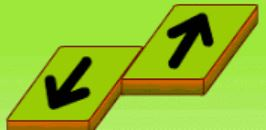
Two plates sliding past each other forms a transform plate boundary. Natural or human-made structures that cross a transform boundary are offset—split into pieces and carried in opposite directions. Rocks that line the boundary are pulverized as the plates grind along, creating a linear fault valley or undersea canyon. Earthquakes are common along these faults. In contrast to convergent and divergent boundaries, crust is cracked and broken at transform margins, but is not created or destroyed.
1

Which of the following is not a divergent boundary?

1

What is true about Divergent boundaries?

1

Which is a NOT convergent boundary?

1

What is true about Convergent boundaries?

1

Which is a NOT transform boundary?

1

What is true about Transform boundaries?