Log in
Sign up for FREE
arrow_back
Library

B - Waves and Tides TEST

star
star
star
star
star
Last updated almost 3 years ago
30 questions
1
1
1
1
1
1
1
1
1
1
1
1
1
1
1
1
1
1
1
1
1
1
1
1
1
1
1
4
1
1
Instructions: Select the best answer for each question.
Question 1
1.

Question 2
2.

Question 3
3.

Question 4
4.

Question 5
5.

Question 6
6.

Question 7
7.

Question 8
8.

Question 9
9.

Question 10
10.

Question 11
11.

Question 12
12.

Question 13
13.

Question 14
14.

Question 15
15.

Question 16
16.

Question 17
17.

Question 18
18.

Question 19
19.

Question 20
20.

Question 21
21.

Question 22
22.

Question 23
23.

Question 24
24.

Question 25
25.

Question 26
26.

Question 27
27.

Question 28
28.

Draggable itemarrow_right_altCorresponding Item
arrow_right_alt
arrow_right_alt
arrow_right_alt
arrow_right_alt
Question 29
29.

Question 30
30.

In a diurnal tide, time from high tide to high tide averages 6 hours and 12.5 minutes.
True
False
An ocean wave is an energy transmission that moves water along with the energy.
True
False
Galveston has spilling breakers along its beaches.
True
False
Ebb currents are incoming tide flow. Flood currents are outgoing tide flow.
True
False
Restoring forces create waves, and disturbing forces destroy waves.
True
False
White caps are the white part of a wave when the wave breaks on a beach or obstacle.
True
False
What type of wave is created as energy travels through water?
Radical
Orbital
Longitudinal
Wave speed is equal to...
Wavelength divided by height.
Wavelength divided by period.
Height divided by wavelength.
Which of the following are disturbing forces?
Coriolis effect
Wind
A and B
Which of the following are restoring forces?
Coriolis effect
Surface tension
All of them
If a wave has a wavelength of 60 meters, height of 30 meters, and a period of 6 seconds, what is the speed/velocity of the wave? Think carefully!
20 m/sec
10 m/sec
0.5 m/sec
Factors that can affect the maximum size of a wave include
Wind Speed
Duration
All of them
What factors are needed to get a fully developed sea?
Maximum size waves can have a high wind speed, short duration and a large fetch.
Maximum size waves can have a high wind speed, long duration and a large fetch.
None of these will create a fully developed sea.
Fully developed seas can have waves that are bigger than maximum theoretical size.
They are called rogue waves and form from constructive interference.
They are called tides and form from constructive interference.
None of these are true; there can be no waves larger than those in a fully developed sea.
When a wave breaks on the shore...
The crest is travelling more quickly than the trough
The crest collapses due to gravity.
All of these are true.
A tsunami wave...
has a speed of up to 600mph
speeds up as it approaches shallow water.
increases in height as it approaches shallow water
A and C
Tsunamis cause...
Massive flooding
Loss of life
All of the above
A tsunami can be formed by
Earthquakes/Tectonic Plate movements
Landslides/explosions
Volcanic activity
All of the above
Deep waves are __________ in shape with a ________ motion. Shallow waves are _________ in shape with a ____________ motion.
Pointed, circular; round, ellipse
Round, circular; pointed, ellipse
Pointed, ellipse, round, circular
Which statement is False about Tsunamis?
Tsunamis are more likely to occur in the Pacific Ocean.
No tsunamis occur near the “Ring of Fire”.
International tsunami detection systems are found in many locations in the ocean.
Tsunamis don't destroy ships in the open sea because...
wave height in the deep ocean is very low - about 3 feet.
they don’t move through the sea.
none of the above. Tsunamis frequently destroy ships on the open sea.
Tides are caused by...
the Coriolis effect.
primarily the moon’s gravity, with some effect from the sun.
the sun’s gravity only.
A single high and low tide daily is called a ____ tide. Two unequal high and low tides daily is called a ____ tide.
DInural, Semidiurnal
Diurnal, mixed
Mixed, diurnal
During ____ tides the sun and moon align relative to Earth. During ____ tides, they are at right angles to Earth.
Neap, Spring
Spring, Summer
Spring, Neap
Summer, Neap
Spring tides are different than neap tides because spring tides ____
have high tides that are higher and low tides are lower.
have very little change between high and low tide
occur during full and new moon
Wave breakers crash onto the beach. Which type of breaker is the most dangerous?
Surging
Spilling
Plunging
Why does a wave break?
The crest continues to move fast and eventually over runs the trough
The wave falls over due to gravity.
All of the above
Match the label to the correct part of the wave.
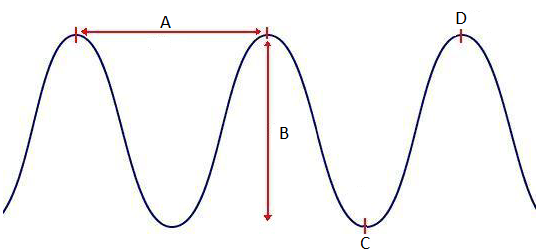
B
Wavelength
C
Wave Height
D
Trough
A
Crest
Which part of the tsunami wave reaches the shore first?
Trough
Altitude
Orbital
Arrange the sequence of the event that leads to tsunami.
Waves slow down to about 45 mph due to bottom friction but there is still a huge amount of energy so it piles up and the wave increases in height up to 50 feet As the top crest of the wave moves faster than the bottom trough, the waves increases in height and break, smashing onto land with an enormous amount of energy pretty much destroying everything in its path
Disturbance that sends out a huge wave of energy into the water
Water recedes near the disturbance and waves with wavelengths up to several hundred miles long spread in all directions