Ocean currents flow like vast rivers in predictable paths. Some ocean currents flow at the surface; others flow deep within water. Some currents flow for short distances; others cross entire ocean basins and even circle the globe.
If you would like to listen to this information read aloud, please click the play button. Otherwise, read the paragraphs and answer the questions below.
Importance of Currents (P1)
Ocean currents are important because they help regulate global climate. The equator receives more sunlight than the poles. This makes the equatorial water warmer compared to the polar waters. Currents move heat from the equator toward the poles and cold water from the poles to the equator. This prevents extreme conditions at the poles and equator. Ocean currents are also critically important to sea life. They carry nutrients and food to organisms that live permanently attached in one place, and carry reproductive cells and ocean life to new places.
Causes of Currents (P2 - P5)
Major surface ocean currents in the open ocean are set in motion by the wind. Winds drags on the surface of the water as it blows. The water starts flowing in the same direction as the wind. Other factors include the shape of the coastline and seafloor and the rotation of the Earth which influence the path of surface currents.
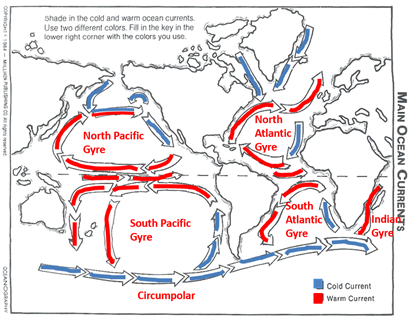
In the Northern Hemisphere, for example, predictable winds called trade winds blow from east to west just above the equator. The winds pull surface water with them, creating currents. As these currents flow westward, the Coriolis effect—a force that results from the rotation of the Earth—deflects them. The currents then bend to the right, heading north. At about 30 degrees north latitude, a different set of winds, the westerlies, push the currents back to the east producing a closed clockwise loop. The same thing happens below the equator in the Southern Hemisphere, except that here the Coriolis effect bends surface currents to the left, producing a counter-clockwise loop.
Large rotating currents that start near the equator are called subtropical gyres. There are five main gyres: the North and South Pacific Subtropical Gyres, the North and South Atlantic Subtropical Gyres, and the Indian Ocean Subtropical Gyre.
Movement of Currents (P6)
Cold water (from the poles) is more dense than warm water (form the equator). Denser water tends to sink, while less dense water tends to rise. Cold-water currents occur as the cold water at the poles sinks and slowly moves toward the equator. Warm-water currents travel out from the equator along the surface, flowing up toward the poles to replace the sinking cold water