Log in
Sign up for FREE
arrow_back
Library

Re-Test - Currents, Winds, Storms

star
star
star
star
star
Last updated almost 3 years ago
26 questions
Required
1
Required
1
Required
1
Required
1
Required
1
Required
1
Required
1
Required
1
Required
1
Required
1
Required
1
Required
1
Required
1
Required
1
Required
1
Required
1
Required
1
Required
0
Required
1
Required
3
Required
1
Required
1
Required
1
Required
1
Required
1
Required
1
Question 1
1.

Question 2
2.

Question 3
3.

Question 4
4.

Question 5
5.

Question 6
6.

Question 7
7.

Question 8
8.

Question 9
9.

Question 10
10.

Question 11
11.

Question 12
12.

Question 13
13.

Question 14
14.

Question 15
15.

Question 16
16.

Question 17
17.

Question 18
18.

Question 19
19.

Question 20
20.

Question 21
21.

Question 22
22.

Question 23
23.

Question 24
24.

Question 25
25.

Question 26
26.

The tendency for the path of a moving object to deflect to a certain direction depending on the
hemisphere it is in is called...
The Coriolis Effect
Curved Path Theory
Thermohaline Circulation
What causes the winds to curve?
Avatar, the last air bender
Thermohaline circulation
Earth's rotation
In the Northern Hemisphere, Global Winds curve to the..
They do not curve
Left
Right
What causes the winds?
Unequal heating of the Earth
Humidity differences
Friction
Which of the following is NOT TRUE
Winds move the ocean currents
Winds create waves on the ocean and other water bodies
Winds deliver nutrients to the surface waters from the deep
Place the storms in order from most severe (strong) to least severe (strong).
Hurricane
Tropical Storm
Tropical Depression
The Coriolis effect does NOT effect winds at...
The poles
The equator
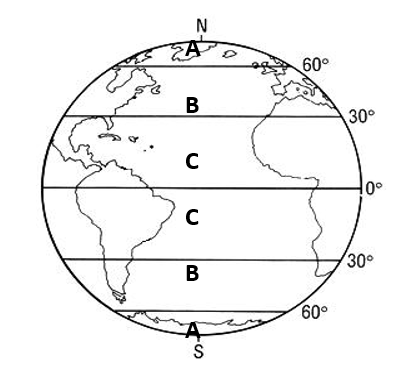
Letter A represents the ....
Trade winds
Westerlies
Polar Easterlies
A _____________________ is when the winds around a hurricane blow water toward the shore and increase the water level at the coast.
Tsunami
Flood
Storm Surge
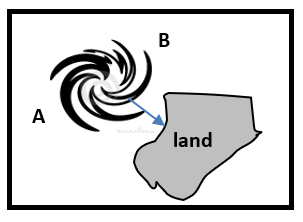
Side A and side B both are images of...
Upwelling
Downwelling
Which side is the dirty side fo the storm?
Side A
Side B
A current is a cohesive stream of seawater that circulates through the ocean.
False
True
What are the causes of currents?
All of the above
Water density variations due to salinity
Temperature variations
What controls the direction of the currents?
Placement of the continents
Direction of the winds
Coriolis Effect
All of the above
How do deep ocean currents form?
As warm, dense water sinks, deep currents flow with other warm ocean water.
As warm, dense water sinks, deep currents flow beneath cold ocean water.
As cold, dense water sinks, deep currents flow beneath warm ocean water.
Which of the following statements is TRUE about upwelling?
Upwelling spreads surface pollution to different ocean layers
Upwelling brings warm, nutrient-rich water up to keep the food chains well supplied with much needed nutrients
Upwelling brings cold, nutrient-rich water up to keep the food chains well supplied with much needed nutrients
Which of the following statements is/are FALSE about downwelling?
Downwelling of warm water brings much needed oxygen down to the lower layers of the ocean
Downwelling increases the number of storms and hurricanes
Downwelling spreads surface pollution to different ocean layers
None of the above are false
In which boundary current would you expect to find upwelling?
Western
Eastern
Use the image below for the question below.
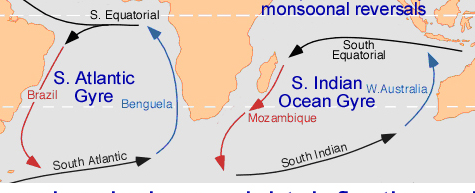

Which of the following is a western boundary current?
Brazil
South Indian
W. Australia
Categorize the following statements as Western Boundary Current or Eastern Boundary Current
From the equator moving towards the poles.
Nutrient rich/most productive part of ocean..
From the poles to the equator.
Deep,narrow and fast, warm water
Shallow, broad and slow moving cold water
Western Boundary Current
Eastern Boundary Current
What is true about the picture beolow??
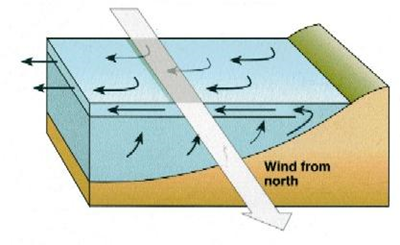
Upwelling in the Northern Hemisphere
Downwelling in the Southern Hemisphere
Downwelling in the Northern Hemisphere
Which of the following leads to downwelling?
Winds moving the water toward the land/ coastline
Surface ocean water diverges
Winds moving the water away from the land/ coastline
Which of the following leads to upwelling? Select all that apply.
Winds moving the water away from the land/ coastline
Surface ocean water converges
Winds moving the water toward the land/ coastline
Surface ocean water diverges
The warm water at the equator moves towards poles and the cold water at the poles moves toward the equator. Why is this important?
Prevents the movement of the magnetic fields at the pole
Prevents overheating of the equatorial water and over freezing of the polar water
Moves water around so it is not stagnant
The cold salty nutrient rich water water sinks at the pole and moves toward the equator. As it reaches the equator the cold water warms up and rise to the surface. Why is this important?
The warm water has more nutrients and as it sinks at the pole it increases the nutrients available at the bottom of the ocean
The cold water has more nutrients as it rises to the surface it increases the amount of nutrients available closer to the ocean surface.
The cold water has more oxygen as it rise to the surface it increases the amount of oxygen available closer to the ocean surface.
Global warming is causing the temperatures in the poles to rise. This causes the frozen water to melt. As a result the salinity and temperature difference between the poles and equator decreases. What will happen if the temperature and salinity differences between the poles and the equator decrease?

The area covered by the global conveyor belt will decrease
The global conveyor belt will keep moving as it is not affected by the temperature of the oceans
The global conveyor belt will slow down and eventually stop.