Log in
Sign up for FREE
arrow_back
Library

Chem Unit 4 Homework 1 Formative

star
star
star
star
star
Last updated about 1 month ago
10 questions
Please answer the following questions as a review of atomic history, using this link as a reference.
https://chem.libretexts.org/Courses/Oregon_Institute_of_Technology/OIT%3A_CHE_201_-_General_Chemistry_I_(Anthony_and_Clark)/Unit_2%3A_The_Structure_of_the_Atom/2.1%3A_A_History_of_Atomic_Theory
1
1
1
1
1.5
1.5
2
2
2
2
Question 1
1.
In ancient times, the Greeks philosophized and debated about the composition of matter.
__________ postulated that a smallest, indivisible piece of matter must exist, while __________ thought that matter, like numbers, could be sliced in half infinitum.
Question 2
2.
In the 1600's and 1700's, scientists started using methods of experimentation to gain knowledge.
Lavoisier first recognized and formulated the Law of __________ stating that matter is neither created nor destroyed during chemical reactions.
Proust realized that a specific compound has a defining mass-ratio of its ingredient elements and stated the Law of __________.
Question 3
3.
__________ developed the first atomic theory and the concept that elements are made of tiny atoms that can combine to form compounds. In his mind's eye, Dalton envisioned atoms to look like __________.
Question 4
4.
The first fundamental particle to be discovered was the __________.
J.J. Thomson recognized that all metals are able to emit negative particles through his work with __________.
Question 5
5.
After identifying different types of radiation, Ernest Rutherford used __________ to conduct the Gold Foil Experiment.
During the experiment, the radiation particles were deflected by something small, dense, and positively charged in the center of the atoms of gold. This central part of the atom is now called the __________.
Continuing his investigations, Rutherford eventually discovered the fundamental particle that holds the positive charge in an atom, the __________.
Question 6
6.
Neils Bohr proposed a reason why each element is able to emit a specific set colors when its atoms are energized through his work with __________. Bohr realized that the __________ must be organized in specific energy levels around the nucleus of the atom.
Being difficult to find because they have no charge, the __________ were the last fundamental particles to be discovered.
Question 7
7.

Please organize the models of the atom, by creator, in chronological order with the first model at the top and the most recent model at the bottom of the list.

  1. Neils Bohr
  2. J.J. Thomson
  3. John Dalton
  4. Ernest Rutherford
  5. Erwin Schroedinger
Question 8
8.

Please organize the models of the atom, by description, in chronological order with the first model at the top and the most recent model at the bottom of the list.

  1. Solid, uniform sphere
  2. Empty sphere with a small, dense nucleus and electrons in the mostly-empty region around the nucleus
  3. Empty sphere with electrons organized in specific energy levels orbiting the nucleus
  4. Solid sphere with negative particles dispersed throughout a positively-charged material
Question 9
9.

Please organize the models of the atom, by key discovery, in chronological order with the first model at the top and the most recent model at the bottom of the list.

  1. Each element emits only some specific colors, never the full rainbow
  2. Atoms combine in specific, whole-number ratios
  3. Most alpha radiation can travel through a thin sheet of gold foil, but a few will bounce back at acute angles as if being deflected by something
  4. Every metal has small, negative particles that can flow out of the atom when they are given enough energy
Question 10
10.

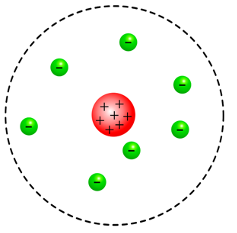
Please organize the models of the atom, by descriptive image, in chronological order with the first model at the top and the most recent model at the bottom of the list.

  1. Raisin Bun Model
  2. Organized electrons
  3. Solid, uniform sphere
  4. Cloud (or wave) model [picture of cotton candy]

  5. Central nucleus