Which characteristic of life is best shown by the diagram?
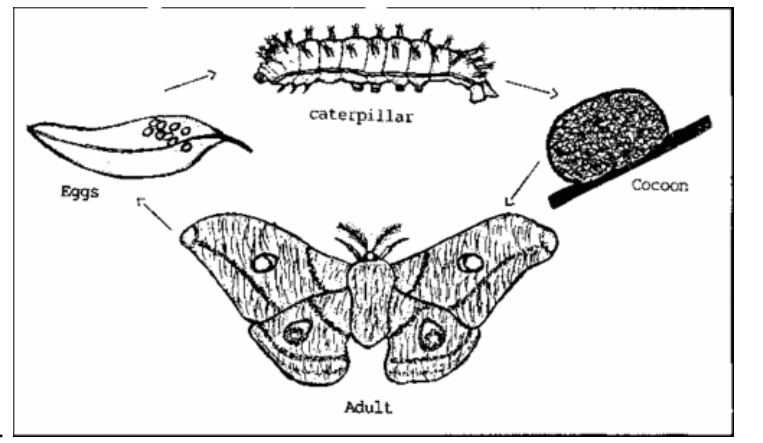
Which characteristic of life is best shown by the diagram?
Take at least 7-10 bullet point notes on your reading here. Your notes will be shared with your groupmates so they should be on important points that will allow your groupmates to answer the questions WITHOUT having to go back to your reading.
Why are living things similar to each other?
Select the 5 common properties of living organisms.
What is true both of a cat and a single-celled bacteria?
Nearly all the energy of living things initially comes from...
Energy is-
Why do all living organisms need energy?
Most cells can only be viewed under a microscope.
All cells have at least some structures in common, such as
Why is the nucleus so important in a cell?
JIGSAW B - Read the following sections from The Characteristics of Life reading: "Living Organisms Respond to Their Environment", "Living Things Grow and Reproduce", and "Living Things Maintain Stable Internal Conditions".
Directions: Take bullet point notes to share with the rest of your group and answer the questions below.
Take at least 7-10 bullet point notes on your reading here. Your notes will be shared with your groupmates so they should be on important points that will allow your groupmates to answer the questions WITHOUT having to go back to your reading.
Which of the following is NOT an example of maintaining homeostasis?
Organisms respond to
Eyes are one means for an organism to receive information about their environment.
Organisms that do not
Describe the genetic difference between asexual and sexual reproduction.
Maintaining a balance inside the body or cells of organisms is known as
Which characteristic of life is best shown by the diagram?
Explain the concept of homeostasis. Give an example.
Take at least 7-10 bullet point notes on your reading here. Your notes will be shared with your groupmates so they should be on important points that will allow your groupmates to answer the questions WITHOUT having to go back to your reading.
A compound found mainly in living things is known as an
Organic compounds make up-
Why is carbon essential to life on Earth?
What organic molecule first formed about 4 billion years ago?
A compound has a
What is necessary to form a compound?
What makes a compound organic? Is water an organic compound since it is in our bodies? Why or why not?
Take at least 7-10 bullet point notes on your reading here. Your notes will be shared with your groupmates so they should be on important points that will allow your groupmates to answer the questions WITHOUT having to go back to your reading.
Carbon has the ability to form
Why is carbon essential for life? Give at least 2 reasons.
Carbon can form a huge variety of very large and complex molecules. There are nearly 10 million carbon-based compounds in living things!
The millions of organic compounds can be grouped into just four major types:
Describe the functions of each of the 4 types of organic compounds and explain how they function in a cell.
Please list anyone who did not do their part of the jigsaw.