Ch. 1 Quiz Practice Lessons 1.1 & 1.2
star
star
star
star
star
Last updated over 3 years ago
20 Nsɛmmisa
Ɛhia
1
Ɛhia
1
Ɛhia
1
Ɛhia
1
Ɛhia
1
Ɛhia
1
Ɛhia
1
Ɛhia
1
Ɛhia
1
Ɛhia
1
Ɛhia
1
Ɛhia
1
Ɛhia
1
Ɛhia
1
Ɛhia
1
Ɛhia
1
Ɛhia
1
Ɛhia
1
Ɛhia
1
Ɛhia
1
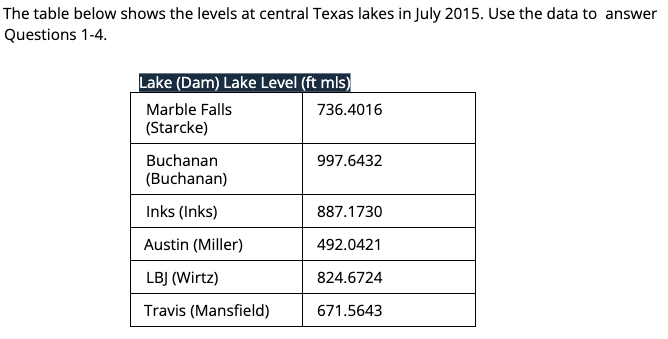
What is the level of Lake LBJ (Wirtz) rounded to three decimal places?
What is the level of Lake Travis (Mansfield) rounded to three decimal places?
How much more water was in Lake LBJ than in Lake Travis? Round to three decimal places.
Which lake had the highest lake level in July 2015?
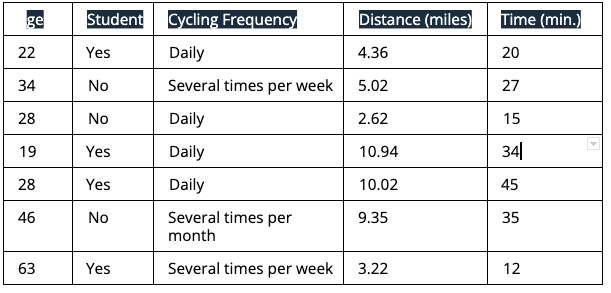
The table to the right shows data collected from several Austin cyclists after they completed a biking trip.
Use the table to answer Questions 5-10.
How many individuals in the dataset were students who cycled daily?
How many individuals in the dataset cycled for longer than 25 minutes?
What units are used to measure the variable Distance?
How far did the cyclist who bikes several times per month travel during their trip?
What was the speed of the cyclist who was a 28-year-old student?
Round to 3 decimal places.
(Speed can be found by dividing distance by time.)
Suppose a researcher wanted to determine if a relationship exists between the distance traveled and how long the trip lasted.
Which are the variables of interest in this study? Select all the correct answers.
Which of the following variables fall on the nominal scale?
Which of the following variables fall on the ordinal scale?
Which of the following variables fall on the continuous scale?
Which of the following variables fall on the discrete scale?
Match the following examples to the type of variable represented.
| Draggable item | arrow_right_alt | Corresponding Item |
|---|---|---|
A course evaluation scale: poor, okay, good. | arrow_right_alt | Categorical, Nominal |
The number of players on a sports team. | arrow_right_alt | Numerical, Continuous |
A college student’s major.
| arrow_right_alt | Numerical, Discrete |
The time it takes to complete an exam. | arrow_right_alt | Categorical, Ordinal |
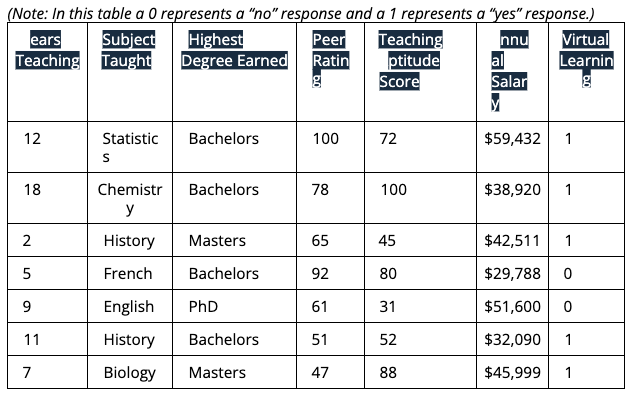
The table to the right represents data collected on a few candidates for a teaching award.
Use the table to answer Questions 6-10.
The Virtual Learning variable falls on which scale?
The Highest Degree Earned variable falls on which scale?
What can be said about the variables Highest Degree Earned and Subject Taught?
What can be said about the variables Teaching Aptitude Score and Virtual Learning?
Suppose a researcher wanted to determine if a relationship existed between a teacher’s salary and the highest degree they’ve earned. In order to conduct her test, she needs to use two categorical variables.
What should she do before she begins?