Log in
Sign up for FREE
arrow_back
Library

Period 1, Day 2 Classwork: Causes of Spanish Colonization

star
star
star
star
star
Last updated almost 2 years ago
13 questions
Note from the author:
0
1
0
1
1
1
1
1
0
Content Objective: I will be able to identify at least two causes of Spanish colonization
Standard Objective: I will be able to contextualize the surrounding time period of a primary source text.

Absent? Just want to review the notes? Click here for the slides.
Content Objective: I will be able to identify at least two causes of Spanish colonization
Standard Objective: I will be able to contextualize the surrounding time period of a primary source text.

Absent? Just want to review the notes? Click here for the slides.

Warm Up: Please answer the following questions based on your understanding of last night’s reading.

Question 1
1.

One interesting historical fact I learned is…

If you didn't do the reading, come back to this question by the end of the lesson.

Question 2
2.

Do you think there is a difference between the term “Native American” and “Indians”? Explain.

Question 3
3.

Question 4
01:03
keyboard_arrow_down
1
Question 4
4.

Why is the children’s rhyme, “In 1492, Columbus sailed the ocean blue” inaccurate?

Question 5
5.
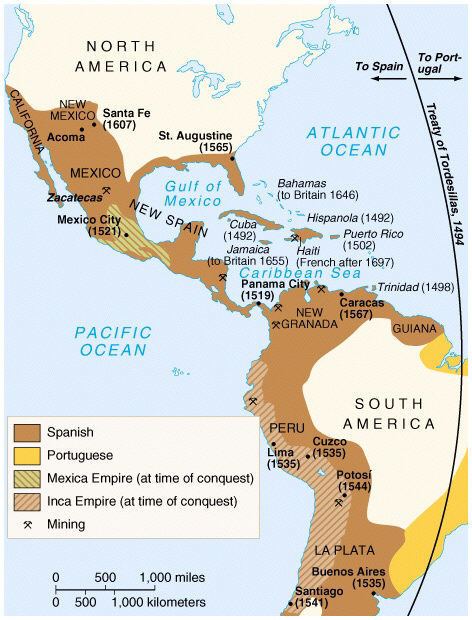
Portuguese _______ in the 1400s inaugurated an era of aggressive European expansion across the Atlantic. The Spanish, threatened by the Portuguese monopoly on enslaved Africans and expansion in the Atlantic, started their own _______ project with Christopher Columbus in 1492.

Colonization (noun) - the action or process of taking _______ of an area and sending your own people to live there.
0
Question 6
6.

Why do you think a nation would want to colonize an area?

Question 7
7.

Draggable itemarrow_right_altCorresponding Item
arrow_right_alt
arrow_right_alt
arrow_right_alt

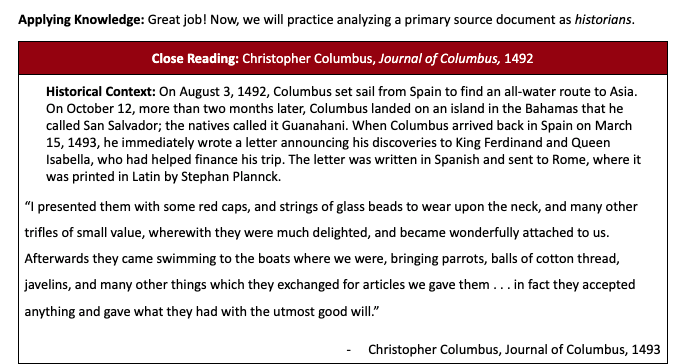
Applying Knowledge: Great job! Now, we will practice analyzing a primary source document as historians.

Question 8
8.

Question 9
9.

1
Question 11
11.

1
Question 13
13.

Please rate how well you understood the reading on a scale from 1 to 4. If you have any questions, ask them in the "Show Your Work" area.
1 - I do not understand the reading yet.
2 - I need to re-read.
3 - I can understand the reading on my own.
4 - I can explain the reading to someone else.
Match each of the 3 G's to the appropriate definition!
Glory
New sources of wealth (trade with Asia)
Gold
Converting natives to Christianity (Catholicism)
God
Gaining power & status (for self & country)
Sourcing: When given a text to analyze on the SAT Reading and APUSH exams, what is the very first thing you should read?
You should read the answers first and look for them in the text.
You should read the question stem first so you can determine what to look for when you read.
You should read the source information to access prior knowledge you may have about the author or date.
You should read the text first, of course. What a silly question!
On the AP or SAT exam, what should you do if you encounter a word you don't know?
Look it up.
Look for clues in the text.
Ask the test proctor.
Panic!
Question 10
10.

Okay let's practice! As used in line 2, "trifles" most nearly means

Under "Show Your Work," please include the specific words/phrases that you used as clues.
chocolates
animals
weapons
things
Question 12
12.

Exit Ticket: Please rate how well you understood the lesson on a scale from 1 to 4:
1- I need to seek out extra help from someone else.
2 - I need to find resources and relearn on my own.
3 - I understood the lesson on my own, and should pass on the knowledge!
4 - I was able to successfully explain and help someone else’s understanding.
Historical Context: What do you know was happening in history at the time this document was created?
Roughly 90 percent of the Native American population perished.
Europeans were competing with one another for control of land and trade.
The first humans entered the Americas from nomadic Asian hunter-gatherer tribes.
The supercontinent Pangea drifted apart into 7 different continents.
Exit Ticket: Based on your understanding of the historical context, Columbus’ description the Taíno people as “wonderfully attached to us” and “accepted anything and gave what they had with the utmost good will” would lead to the
emergence of competition between European powers in the Americas
outbreak of rebellion by the Pueblo Indians
spread of maize culture from American Indians to the Spanish colonists
exploitation and eventual decimation of Native Americans in the “New” World.