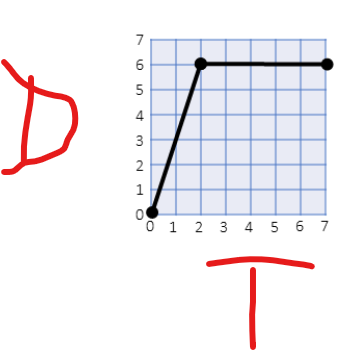
1
Draw the velocity vs time graph to match the displacement vs time graph on the left.
Draw the velocity vs time graph to match the displacement vs time graph on the left.
Draw the velocity vs time graph to match the displacement vs time graph on the left.
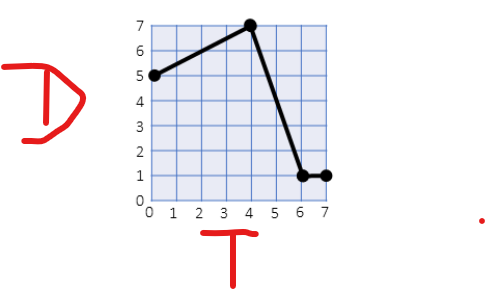
Draw the velocity vs time graph to match the displacement vs time graph on the left.
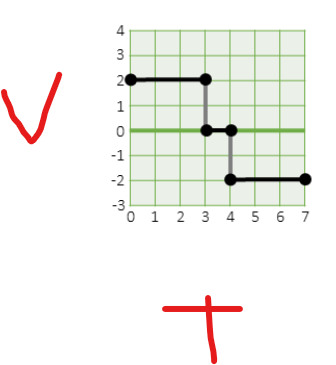
Draw the displacement vs time graph to match the velocity vs time graph on the left. The starting displacement is plotted for you on the graph.
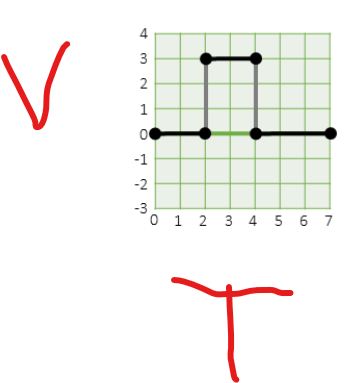
Draw the displacement vs time graph to match the velocity vs time graph on the left. The starting displacement is plotted for you on the graph.
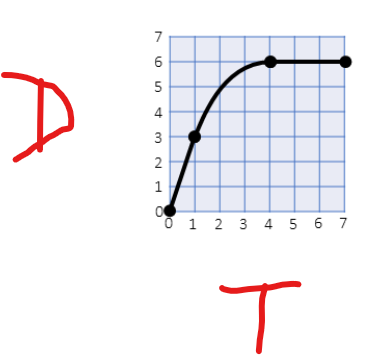
Draw the velocity vs time graph to match the displacement vs time graph on the left.
Draw the acceleration vs time graph to match the displacement vs time graph on the left.
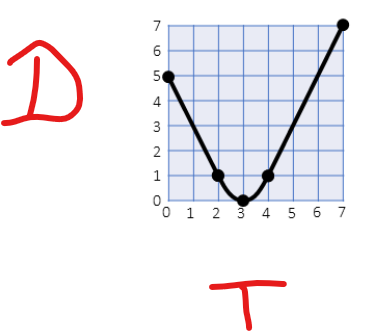
Draw the velocity vs time graph to match the displacement vs time graph on the left.
Draw the acceleration vs time graph to match the displacement vs time graph on the left.
A football quarterback runs 15.0 m straight forward 2.50 s. He is then hit and pushed 3.00 m straight backward in 1.75 s. He breaks the tackle and runs straight forward another 21.0 m in 5.20 s. Calculate his average velocity (a) for each of the three intervals and (b) for the entire motion.
If you divide the total distance traveled on a car trip (as determined by the odometer) by the time for the trip, (a) are you calculating the average speed or the magnitude of the average velocity? (b) Under what circumstances are these two quantities the same?
As the Earth rotates through one revolution, a person standing on the equator traces out a circular path whose radius is equal to the radius of the earth (6.38 × 10⁶ m). What is the average speed of this person in meters per second? Miles per hour?
A cheetah can accelerate from rest to a speed of 30.0 m/s in 7.00 s. What is its acceleration?
If a car is accelerating in the positive direction and is currently moving in the negative direction, (a) is it speeding up or slowing down? (b) How about if the acceleration is positive and the velocity is positive?
A motorcycle has a constant acceleration of 2.5 m/s2. Both the velocity and acceleration of the motorcycle point in the same direction. How much time is required for the motorcycle to change its speed from (a) 21 to 31 m/s, and (b) 51 to 61 m/s?
A runner accelerates to a velocity of 5.36 m/s due west in 3.00 s. His average acceleration is 0.640 m/s2, also directed due west. What was his velocity when he began accelerating?