1
1
1
1
1
1
1
1
1
1
1
1
1
1
1
1
1
1
Physical vs. Chemical changes
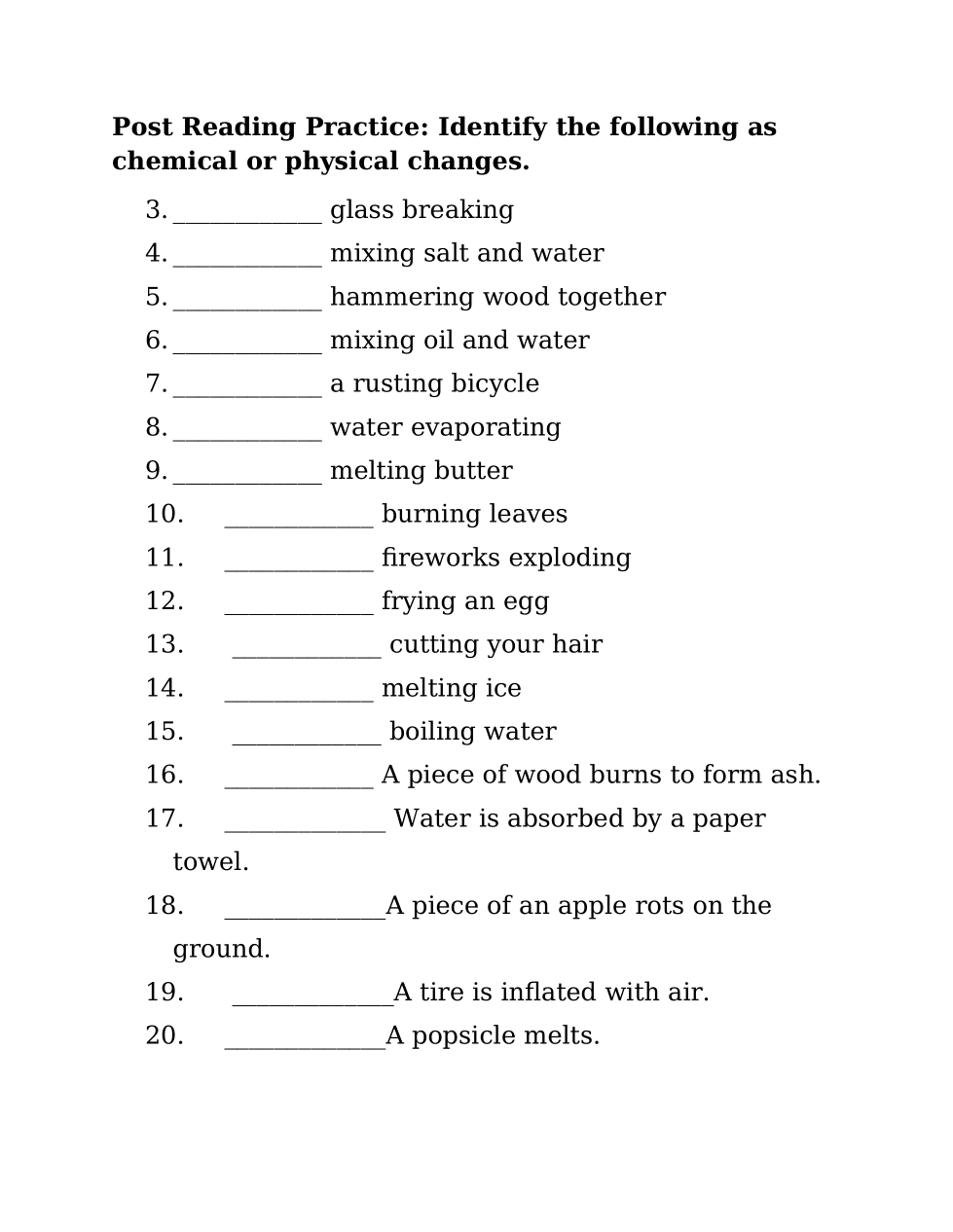
Substances can undergo chemical or physical changes, which affect the substances in different ways. A physical change in a substance doesn't change what the substance is. In a chemical change where there is a chemical reaction, a new substance is formed and energy is either given off or absorbed. For example, if a piece of paper is cut up into small pieces it still is paper. This would be a physical change in the shape and size of the paper. If the same piece of paper is burned, it is broken up into different substances that are not paper.
Physical changes can be reversed; chemical changes cannot be reversed without extraordinary means, if at all. For example, a cup of water can be frozen when cooled and then can be returned to a liquid form when heated. If a person decided to mix sugar into water to make sugar water, this would be a physical change because the water could be left out to evaporate and the sugar crystals would remain, meaning you could change the substance back to water and sugar. However, if a person made a recipe for a cake with flour, water, sugar and other ingredients and baked them together, you could not separate the ingredients once it’s baked together. Baking the cake would be a chemical change since this can’t be reversed.
Would water evaporating from a boiling pot be a chemical or physical change? Explain.
Would a banana rotting be a chemical or physical change? Explain.
*Think about can you turn the banana back
Answer questions 21 and 22 based on the description below:
In an investigation, a dripless wax candle is massed and then lighted. As the candle burns, a small amount of liquid wax forms near the flame where the wax melted. After 10 minutes, the candle’s flame is extinguished and the candle is allowed to cool. The cooled candle is massed.
Identify one physical change that takes place in this investigation.
State one observation that indicates a chemical change has occurred in this investigation.
Is this a chemical or physical change? Explain. (provide observations of what happened)
Is this a chemical or physical change? Explain. (provide observations of what happened)
Are your observations in this demonstration qualitative or quantitative?
Use the thermometer to determine the temperature of the water.
Use the thermometer to determine the temperature of the water.
Is this a chemical or physical change? Explain.
Is this a qualitative or quantitative observation?
Answer question 30 based on the following scenario:
A group of students do an activity with baking soda and vinegar. The steps of the activity are listed below.
A. Pour 100 g of vinegar into a flask.
B. Measure the temperature of the vinegar.
C. Add 10 g of baking soda to the flask.
D. Observe as the contents of the flask bubble.
E. Measure the temperature of the contents of the flask and observe any change in temperature.
Describe one piece of evidence that a chemical change occurs when baking soda is added to vinegar.