9/13 Nitrogen Cycle Stations
star
star
star
star
star
Last updated about 1 year ago
14 Nsɛmmisa
1
1
1
1
1
1
1
1
1
1
1
1
1
1
Submit your Nitrogen Cycle table here
Using the reading to answer the questions below:
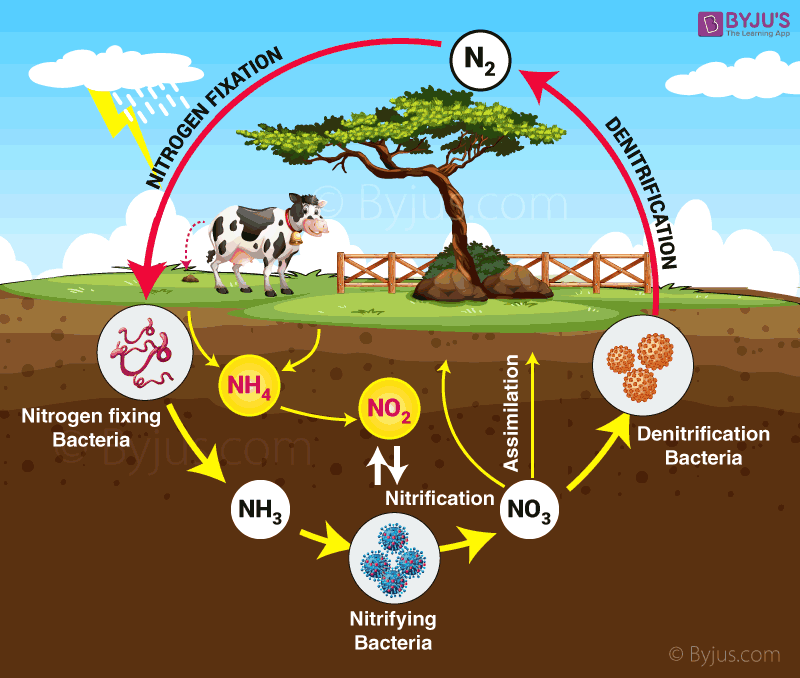
Nitrogen is important to life because it is used to build the proteins and DNA that are found in every living thing. This means that without nitrogen, you would not be alive! As you can imagine, an important process in ecosystems is the recycling of nitrogen through its biotic (living) and abiotic (nonliving) parts.
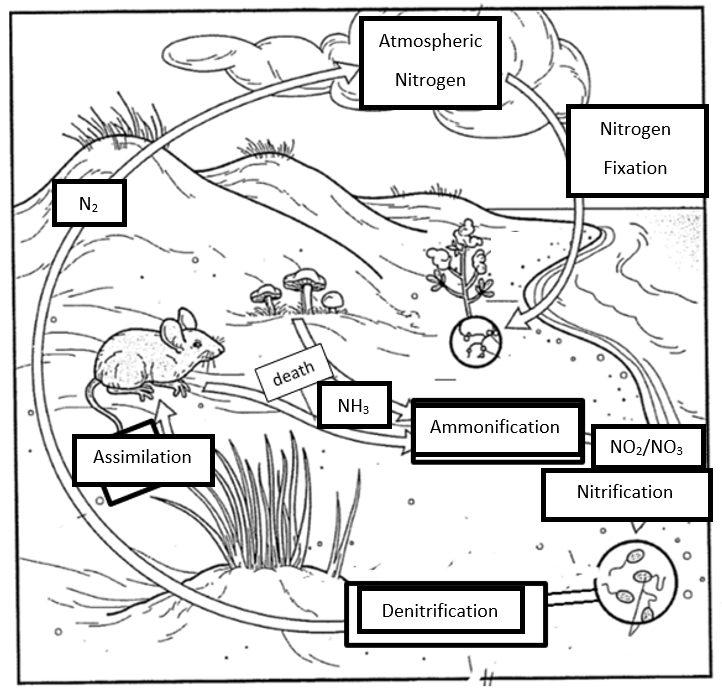
If you look closely at the diagram provided above, you will notice that there are many ways in which nitrogen cycles through nature.
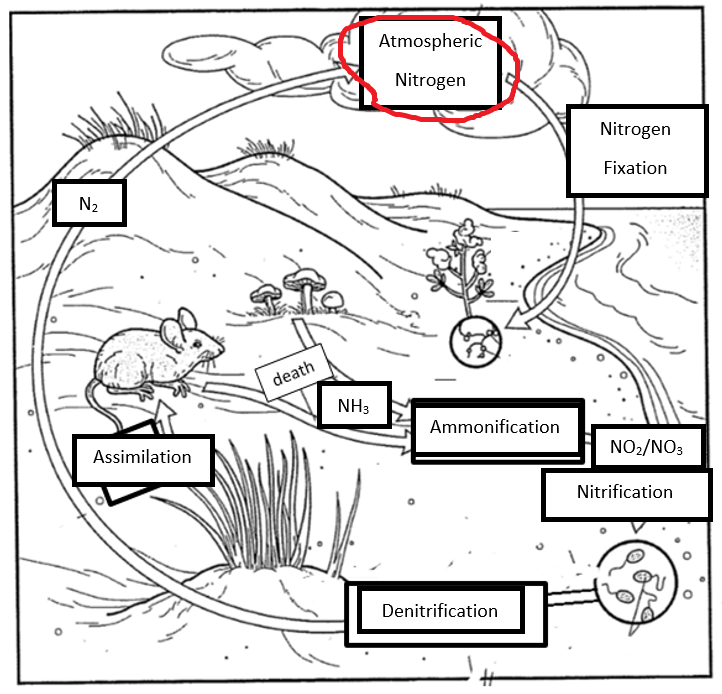
Atmosphereic Nitrogen: The nitrogen cycle starts where the biggest supply of nitrogen is found, in the atmosphere. Approximately 78% of the air you breathe is made of nitrogen gas. Unfortunately, like almost every other organism, we cannot actually use nitrogen gas directly – that’s where bacteria come into play.
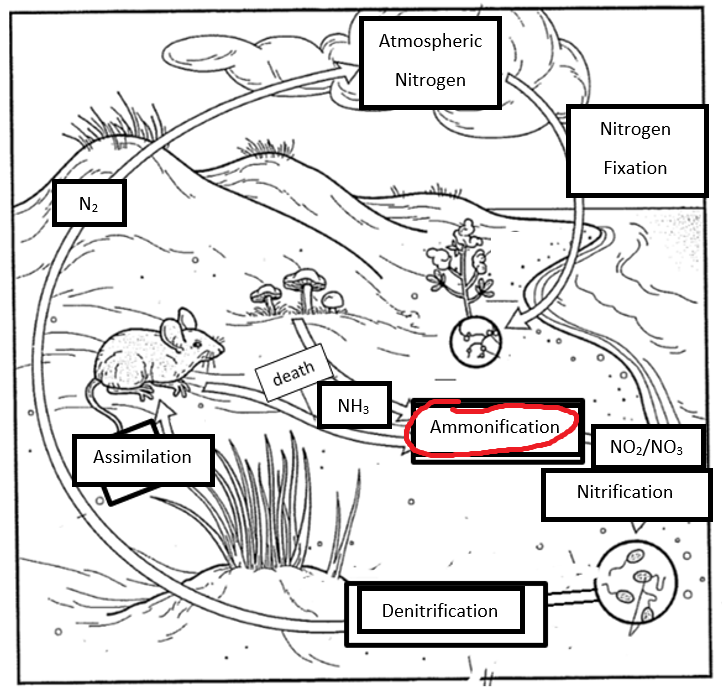
Ammonification: Nitrogen gas from the atmosphere is fixed into organic nitrogen by nitrogen-fixing bacteria. This organic nitrogen enters terrestrial food webs. It leaves the food webs as nitrogenous wastes in the soil. Neither plants nor animals can get nitrogen directly from the atmosphere. Ammonification occurs when bacteria found in the roots of plants change nitrogen gas into a form that plants can use called ammonia. Ammonia can then be taken in by plants, so they get the nitrogen they need to survive. Ammonification of this nitrogenous waste by bacteria and fungi in the soil converts the organic nitrogen to ammonium ion—NH4+
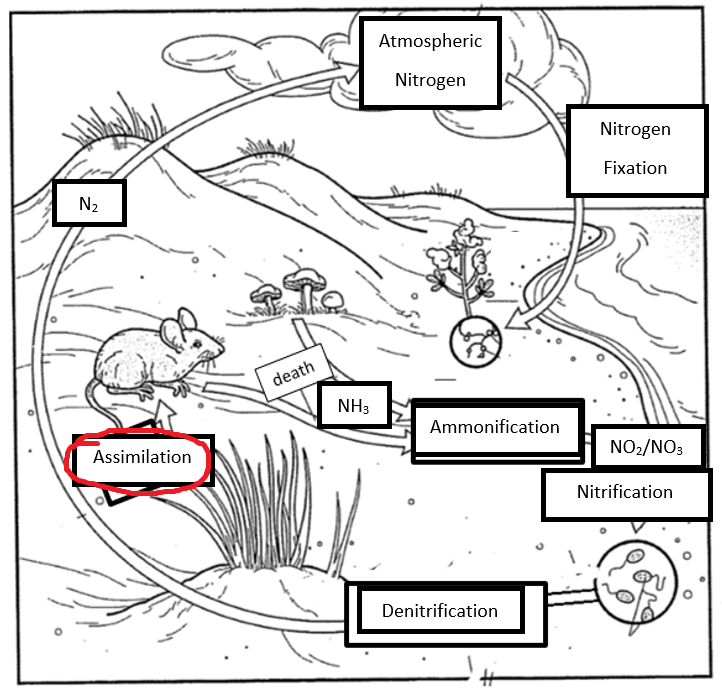
In order to get the nitrogen they need to survive, animals must eat plants (we call these animals herbivores). Animals that do not eat plants, must eat the herbivores to get the nitrogen they need. The process of plants and animals taking in nitrogen is called assimilation. Think of assimilation as plants and animals "eating" nitrogen.
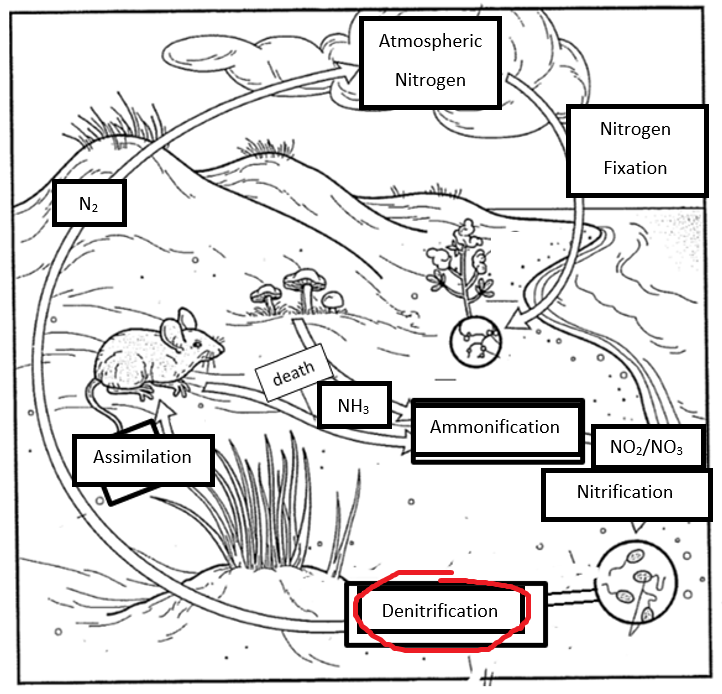
Once a plant or animal dies, it decomposes. As the decomposition occurs, the nitrogen found in the dead organism is returned to the soil. Then, a different type of bacteria, changes the useable nitrogen in the soil, back to nitrogen gas through a process of called denitrification. And the cycle starts all over again.
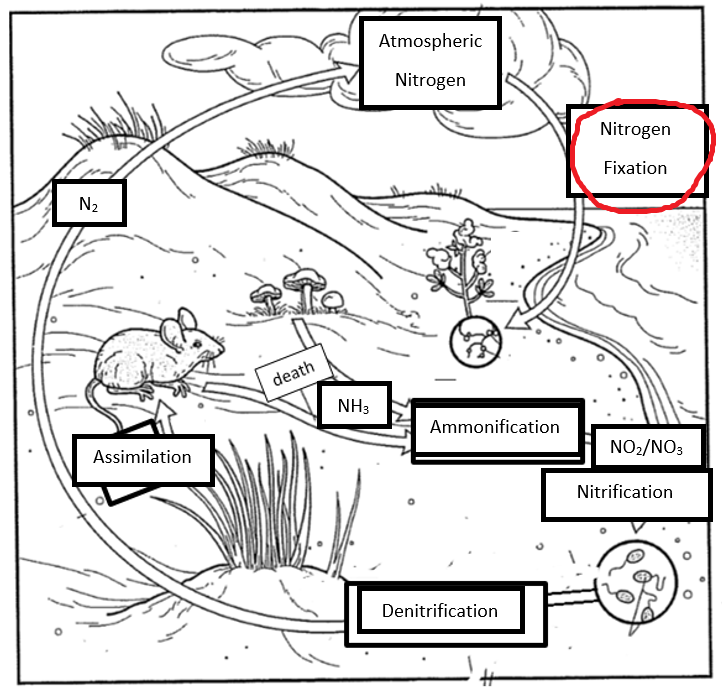
Nitrogen enters the living world by way of bacteria and other single-celled prokaryotes, which convert atmospheric nitrogen — N2—into biologically usable forms in a process called nitrogen fixation. Some species of nitrogen-fixing bacteria are free-living in soil or water, while others are beneficial symbionts that live inside of plants.
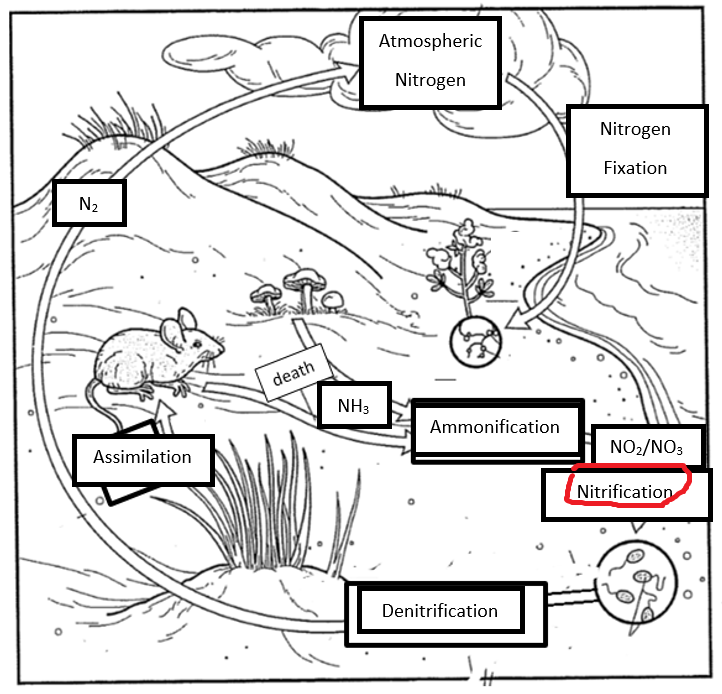
Prokaryotes play several roles in the nitrogen cycle. Nitrogen-fixing bacteria in the soil and within the root nodules of some plants convert nitrogen gas in the atmosphere to ammonia. Nitrifying bacteria convert ammonia to nitrites or nitrates. Ammonia, nitrites, and nitrates are all fixed nitrogen and can be absorbed by plants.
What percent of the air is nitrogen?
What happens to the nitrogen found in the remains of dead organisms?
What is assimilation?
What is the major reservior of nitrogen?
How does nitrogen get to the soil?
Process by which ammonium is changed into nitrates by bacteria.
Process when the plants absorb nitrates from the soil into their roots.
Process when extra nitrogen in the soil is put back out into the air.
Ammonification is part of the decaying process. When a plant or animal dies, decomposers like fungi and ________turn the nitrogen back in ammonium so it can reenter the nitrogen cycle.
Denitrification is performed by
How do herbivores obtain (get) the nitrogen they need?
Match the steps of the nitrogen cycle to their definition
| Draggable item | arrow_right_alt | Corresponding Item |
|---|---|---|
Nitrogen gas | arrow_right_alt | The process of plants and animals taken in nitrogen |
Nitrification | arrow_right_alt | The process of converting nitrogen gas into a usable form, by either bacteria or lightning |
Ammonification | arrow_right_alt | Process where a type of bacteria, changes the useable nitrogen in the soil, back to nitrogen gas |
Nitrogen fixation | arrow_right_alt | Bacteria converting nitrogen compounds into NH3 (ammonia) or NH4+ (ammonium) |
Denitrification | arrow_right_alt | makes up about 78% of Earth's atmosphere by volume |
Assimilation | arrow_right_alt | Bacteria converting ammonia (NH3) to nitrates (NO3) and nitrites (NO2) |
Draw the arrows for the nitrogen cycle here.