Turn to the next clean page in your composition book.
This time, instead of glueing down a notes page, you will make your own.
Use the two previous pages to help you divide this page in the same way - create a space for notes, drawing, analogy, and summary. Label each section. You can grab a ruler from the supply shelves to help.
Remember to label the top of your notes with the title, 1.3 Density.
Since ice is less dense than water, it will float.
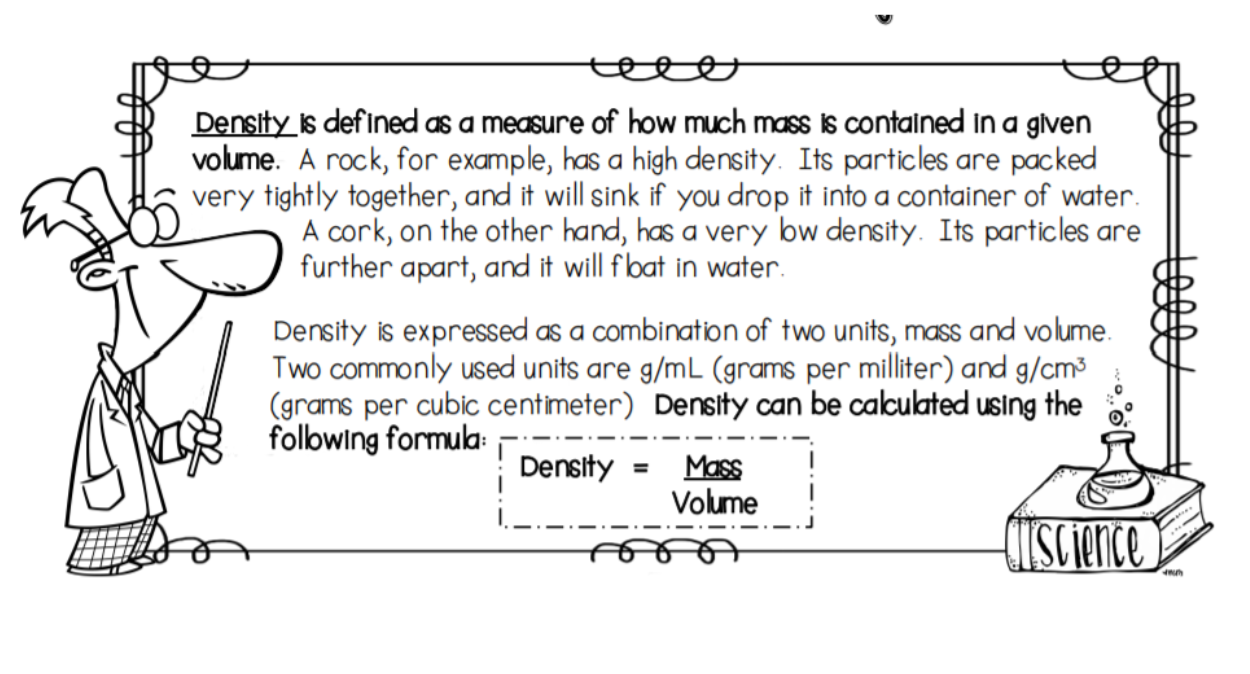
Density is a measure of how much weight is in a given volume.
An object that is more dense will sink below an object that is less dense.
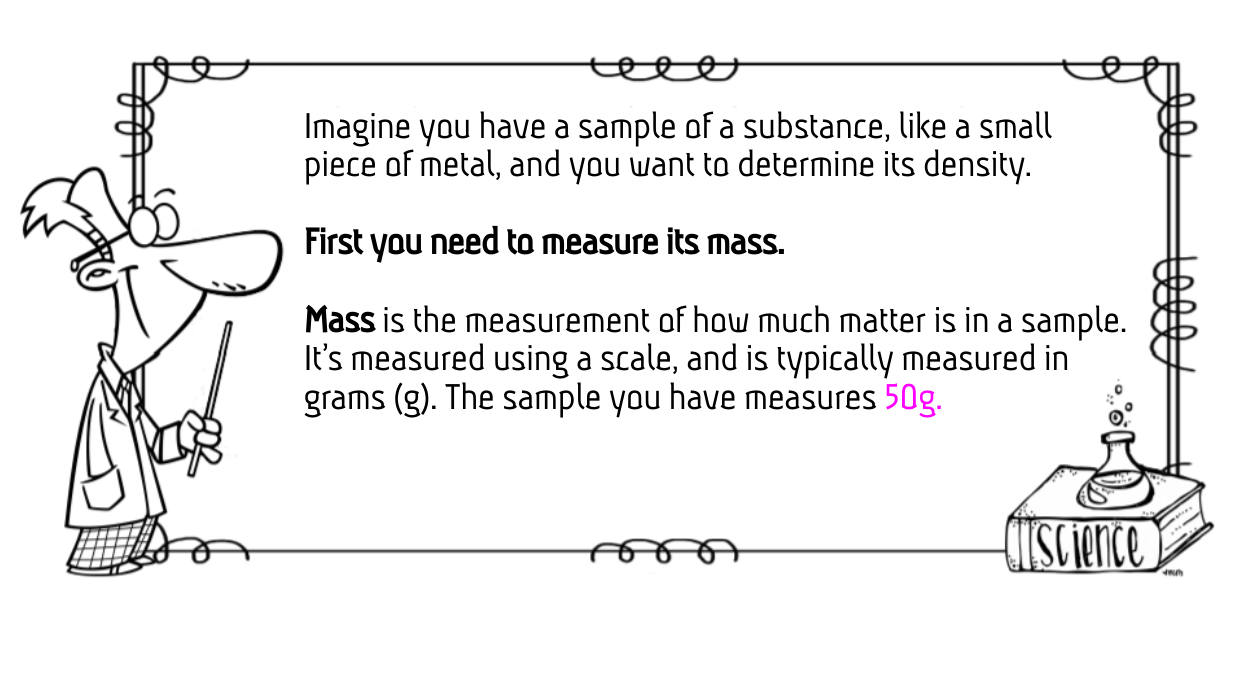
Mass is a measure of how many particles there are in a sample of a substance.
Volume is measured using a scale.
Mass is measured in grams.
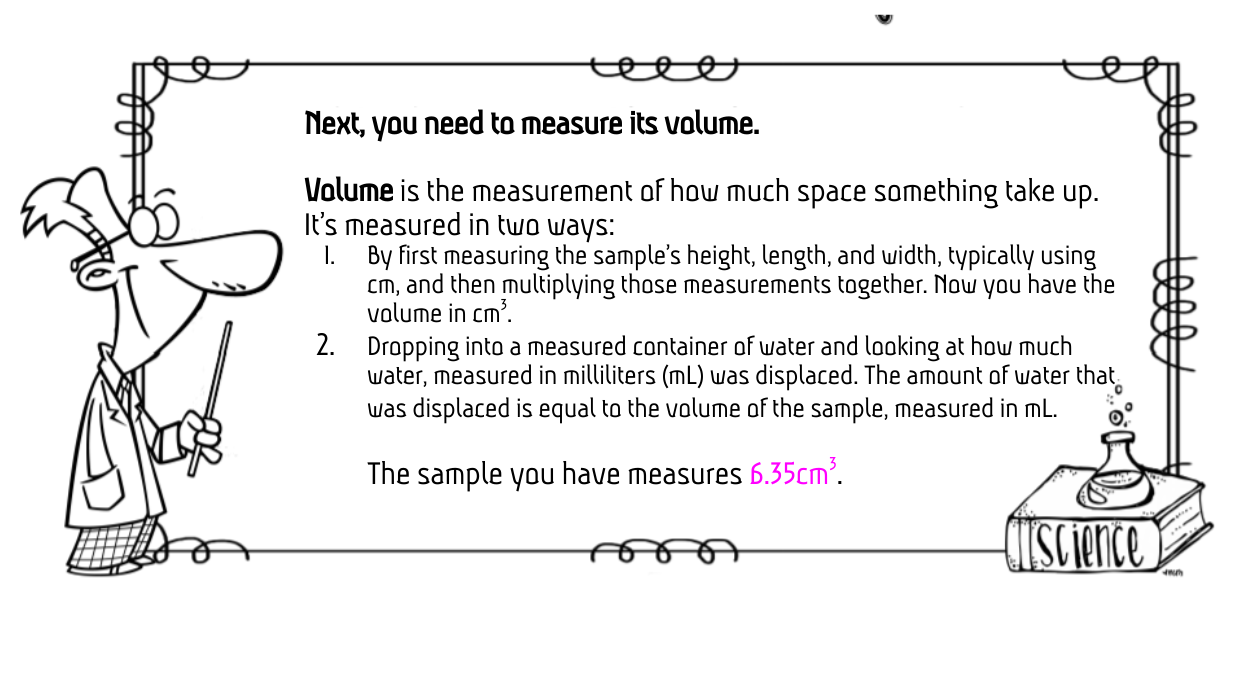
Volume is always measured in cubic centimeters (cm3).
You can measure volume in two ways, both require a ruler.
Volume is a measurement of the amount of space something takes up.
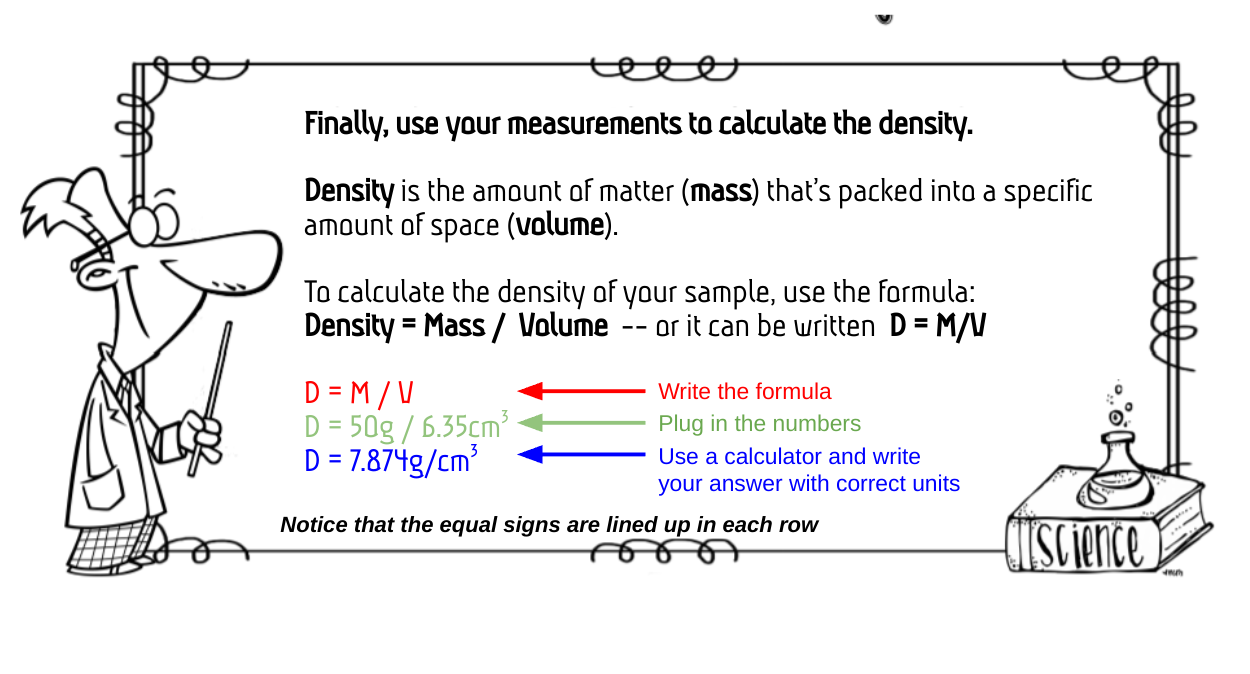
Density is a measure of how many particles are packed into a specific place.
The unit for density depends on the units for mass and volume.
You calculate density by taking the volume of the sample and and dividing it by the mass of the sample.
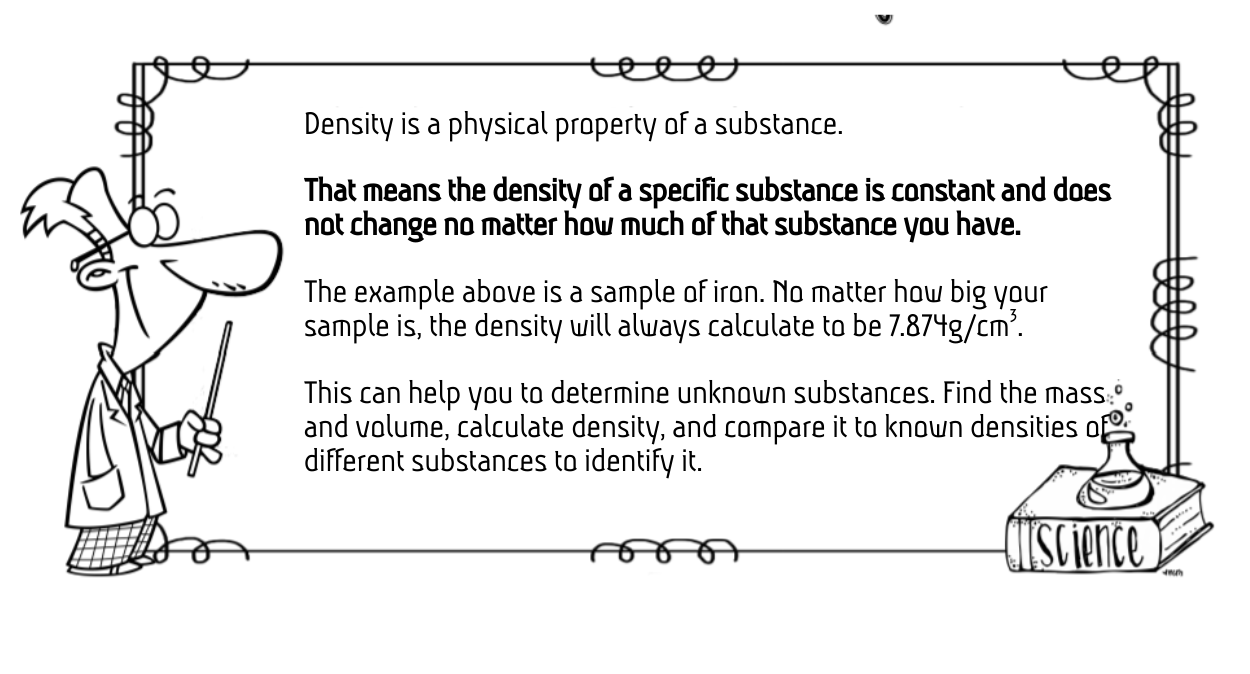
The density of a susbtance changes based on the size of the sample you're measuring.
If you know the density of a specific, you can use density to identify unknown samples.

Use a calculator to determine the density.
First calculate the volume based on the measurement, then calculate the density.
Use displacement to measure the volume, then calculate the density. You can enlarge the pic if needed.
Use a calculator to determine the density.
First calculate the volume, then use it to determine the density.
Use displacement to measure the volume, then calculate the density. You can enlarge the pic if needed.