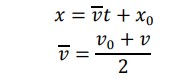
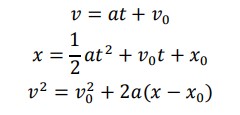
On the AP Physics Exam you will be given these three equations.
xo= intial position
x= final position
vo = intial velocity
v = final velocity
You will not be given these two simpler equations, but you will find them helpful in solving the problems today.
The bar over the v means average velocity.
A marble is dropped from 2.5 m and hits the ground in 0.71 s. What is the final velocity before it hits the ground? (Hint: what is its initial velocity?)
An Olympic-class sprinter starts a race with an acceleration of 4.50 m/s2. What is her speed 2.40 s later?

Freight trains can produce only relatively small accelerations and decelerations. What is the final velocity of a freight train that accelerates at a rate of 0.0500 m/s2 for 8.00 min, starting with an initial velocity of 4.00 m/s?
If the train can slow down at a rate of 0.550 m/s2, how long will it take to come to a stop from this velocity?
How far will it travel to stop?
A car skids to a stop to try to avoid hitting a deer. The car skids 21 m in 2.3 s. How fast was the car originally going?

If a moose can accelerate at 2.1 m/s2 from rest, how much time will it take for it to accelerate to a speed of 4 km/h?

How long did the acceleration last?
Calculate the acceleration
When you try to stop your car in an emergency, there is some time before you can react. Your car is going 25 m/s and your reaction time is 0.20 s, then after you hit your brakes it accelerates at - 9.5 m/s2. How far will hour car travel before it stops?