Log in
Sign up for FREE
arrow_back
Library

6th Grade Benchmark Test - Hess (25 Questions) (Summer 2023)

star
star
star
star
star
Last updated 23 days ago
25 questions
1
1
1
1
1
1
1
1
1
1
1
1
1
1
1
1
1
1
1
1
1
1
1
1
1
Question 1
1.

Different types of solids behave differently due to their crystalline structure. Which statement best describes plastic?

Question 2
2.

Matter can be described and classified by its observable properties. One property of solids, liquids, and gases is they all have volume. Which statement best defines the volume of an object?

Question 3
3.

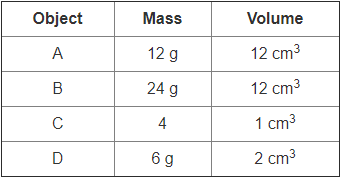
Mary was studying the physical properties, so she measured the mass and volume of four objects shown in the table. Which object in the table has the greatest density?
Question 4
4.

Mina is attending cooking school, where she prepares different mixtures of ingredients. She works with both homogeneous and heterogeneous mixtures. Today she is using honey and salsa. What kind of mixtures are these ingredients?

Question 5
5.

Darius tears pages of newspaper into pieces to start a campfire. What kind of change is taking place as the paper is torn?

Question 6
6.

While Karen was cooking dinner, she noticed that several ingredients went through chemical and physical changes. Which cooking process is an example of a physical change?

Question 7
7.

Amir is helping his uncle in his restaurant, where he notices many examples of physical and chemical changes. Which one of the following describes both a physical and chemical change?

Question 8
8.

When a substance has large or strongly attracted particles, they do not flow freely. For example, water flows very quickly compared to honey. Which property of liquids does this example illustrate?

Question 9
9.

Maria buys an air purifier to separate a mixture of dust and allergens from the air. Which type of separation method does an air purifier use?

Question 10
10.

On a hot summer day, Tameka spilled water on the sidewalk, but a few hours later there was no evidence of the water. What most likely happened to the water?

Question 11
11.

In the 1600s, Robert Boyle conducted experiments for situations in which the volume of a gas is changed. Which of the following describes Boyle’s Law?

Question 12
12.

After using an air mattress, Lucy opens the valve to deflate it and air begins rushing out of the mattress. When will the air most likely stop rushing out of the mattress?

Question 13
13.

Lisa conducts an experiment of gas trapped in a container. She keeps the volume of the gas constant but increases the temperature. Which statement correctly explains what will happen to the pressure?

Question 14
14.

Walt is taking an overnight backpacking trip on the Appalachian Trail in Georgia. He picks up his backpack from the ground, puts it on his back, and walks five miles before he stops and puts the pack down near a stream. He stands near the stream and fishes for dinner, but doesn't catch anything. “I guess I’ll have soup for dinner!” he thinks, and lights a fire to heat up his soup. At what point in the day did Walt do the most work, according to the scientific definition of the word?

Question 15
15.

Beth is taking a trip on an airplane. Which statement explains what happens to the gravitational potential energy of the plane as it takes off and soars higher?

Question 16
16.

Scientists use measurements of air temperature to predict how air masses will behave. On a warm day, if a very cold air mass suddenly rushed in, what could scientists predict about what would happen to the air mass and the resulting change in energy?

Question 17
17.

There is a popular saying that “an apple a day keeps the doctor away.” Believing the advice, Samar picks an apple off a tree in the backyard and takes a bite. What happens to the energy stored in the apple when it is eaten?

Question 18
18.

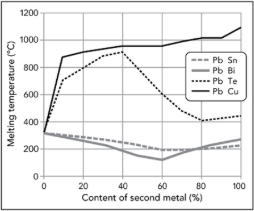
A chemist is comparing the melting temperature of different lead alloys. The chemist is interested in amounts between 40% and 60% of the second metal. Which alloy contains particles with the greatest change of kinetic energy in this span?

Question 19
19.

A glass of ice water sat out in the sun, and the ice absorbed heat and eventually became liquid water. What did the states of the ice and the liquid water have in common?

Question 20
20.

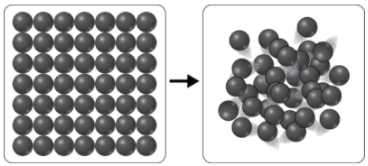
The diagrams show the arrangement of the particles in a sample of a material. The particles in the left diagram undergo a change in state, resulting in the arrangement in the diagram on the right. What change of state most likely took place?

Question 21
21.

When circumstances are right, most materials undergo a process called thermal expansion. Which statement best describes the cause and effect of thermal expansion?

Question 22
22.

How is the thermal expansion of a metal door related to kinetic energy?

Question 23
23.

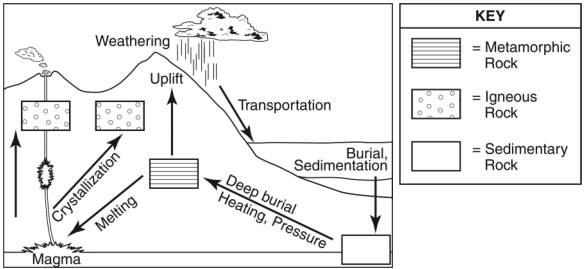
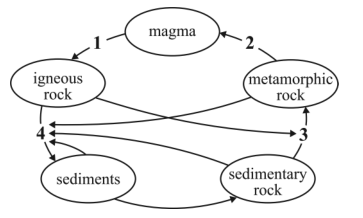
A rock cycle diagram is shown below. What happens to rocks at location 3 in the diagram?

Question 24
24.

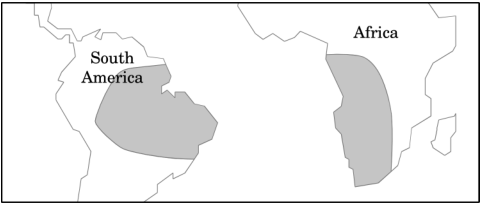
The shaded areas of this diagram represent where fossils of a land dwelling animal were found on the continents of South America and Africa. What does this evidence suggest?

Question 25
25.

Use the information below to answer the following question(s). Layers of sedimentary rocks are exposed in a deep canyon. A geologist finds fossils of shelled animals within these layers. The geologist can best conclude that the canyon area was once...