Moskowitz
Please write your full name here to sign the Honor Pledge and commit that this test honestly and accurately represents your knowledge of Fahrenheit 451 and dystopian fiction and that you neither received and gave any assistance on this test.
Mildred prefers the _____________ Family over the company of her own real husband.
Which of the following vocab words fits best considering the greater context of Fahrenheit 451?
Faber acknowledges that one reason the books were first burned was because they had become unoriginal and _____________.
Which of the following vocab words fits best considering the greater context of Fahrenheit 451?
In the end, Montag joins a ___________ of others determined to preserve literature and teach humanity.
Which of the following vocab words fits best considering the greater context of Fahrenheit 451?
Types of Characters:
ROUND v. FLAT or DYNAMIC v. STATIC?
ROUND - A character with a complex and realistic personality; often called "three-dimensional" or "multifaceted" characters. Generally, these are major characters; we understand the motivation of these characters (why they do things) and their personal perspective because they are fully formed.
FLAT - Character with a very simple personality; often called "one-" or "two-dimensional" characters. Side characters are often flat - the writer does not provide enough information for us to fully understand them; we only get to see one side of the character's personality.
________
DYNAMIC - A character who develops and changes during the course of the story; a character who grows, emotionally, due to or learns from the actions or events in the story. These are usually major, round characters.
STATIC - A character who does not change throughout the course of the story; a character who does not “grow” emotionally, a character whose personality remains the same at the end of the story as it was at the beginning of the story. These are usually minor, flat characters
Based on the STEAL chart resource, Montag would be considered a ______ character.
Which of the following is NOT a repeating motif in Fahrenheit 451.
The repeating motif of burning books symbolizes all of the following EXCEPT...
Through the motif of burning books, Bradbury is suggesting all of the following deeper meanings EXCEPT
Read BOTH of the excerpts here to answer the questions that follow.
EXCERPT 1
"It was a pleasure to burn.
It was a special pleasure to see things eaten, to see things blackened and changed. With the brass nozzle in his fists, with this great python spitting its venomous kerosene upon the world, the blood pounded in his head, and his hands were the hands of some amazing conductor playing all the symphonies of blazing and burning to bring down the tatters and charcoal ruins of history. With his symbolic helmet numbered 451 on his stolid head, and his eyes all orange flame with the thought of what came next, he flicked the igniter and the house jumped up in a gorging fire that burned the evening sky red and yellow and black. He strode in a swarm of fireflies. He wanted above all, like the old joke, to shove a marshmallow on a stick in the furnace, while the flapping pigeon-winged books died on the porch and lawn of the house. While the books went up in sparkling whirls and blew away on a wind turned dark with burning.
Montag grinned the fierce grin of all men singed and driven back by flame. He knew that when he returned to the firehouse, he might wink at himself... in the mirror. Later, going to sleep, he would feel the fiery smile still gripped by his face muscles, in the dark. It never went away, that. smile, it never ever went away, as long as he remembered." (Bradbury 1)
EXCERPT 2
"Montag was alone in the wilderness. ... There must have been a billion leaves on the land; he waded in them, a dry river smelling of hot cloves and warm dust. ... He stood breathing, and the more he breathed he land in, the more he was filled up with all the details of the land. He was not empty. There was more than enough here to fill him. There would always be more than enough. He walked in the shallow tide of leaves, stumbling. ... [he was] fully aware of his entire body, his face, his mouth, his eyes stuffed with blackness, his ears stuffed with sounds...
He saw a fire ahead. The fire was gone, then back again, like a winking eye. He stopped, afraid he might blow the fire out with a single breath. But the fire was there and he approached warily, from a long way off. It took the better part of fifteen minutes before he drew very close indeed to it, and then he stood looking at it from cover. That small motion, the white and red color, a strange fire because it meant a different thing to him. It was not burning. It was warming. He hadn't known fire could look this way. He had never thought it his life that it could give as well as take. Even its smell was different." (Bradbury 127)
In a complete Constructed Response, answer the prompt below using at least TWO quotes (1 from each excerpt) in your response.
Based on the excerpts above, how has Montag's perspective on fire changed in Fahrenheit 451?
What does this change suggest about how Montag has also changed as a character?
Which of the following is NOT true about dystopian literature?
Which of the following is NOT a characteristic of dystopian literature
Dystopian fiction is usually set in the near — rather than far — future to generate urgency about real current events.
While not all allegories are dystopias, dystopias are often allegories - stories that comment on and criticize contemporary events, people, policies, etc.
One of the purposes of dystopian fiction is to serve as a warning about how things could go wrong or get worse if we don’t change.
"Do you ever read any of the books you burn?"
"That's against the law! ... it's fine work. Monday burn Millay, Wednesday Whitman, Friday Faulkner, burn 'em to ashes, then burn the ashes. That's our official slogan."
They walked still farther and the girl said, "Is it true that long ago firemen put fires out instead of going to start them?"
"No. Houses have always been fireproof, take my word for it."
"Strange. I heard once that a long time ago houses used to burn by accident and they needed firemen to stop the flames."
How is this quote dystopian?
"Burn the book. Serenity, Montag. Peace, Montag. Take your fight outside. Better yet, into the incinerator. Funerals are unhappy... eliminate them too. Fire minutes after a person is dead he's on his way to the Big Flue, the Incinerators serviced by helicopters all over the country. Ten minutes after death a man's a speck of black dust. Let's not quibble over individuals with memoriums. Forget them. Burn all, burn everything. Fire is bright and fire is clean."
How is this quote dystopian?
"Nobody listens any more. I can't talk to the Walls because they're yelling at me. I can't talk to my wife; she listens to the Walls. I just want someone to hear what I have to say. And maybe if I talk long enough, it'll make sense. .... We have everyting we need to be happy, but we aren't happy. Something's missing. I looked around. The only thing I positively knew was gone was the books I'd burned..."
How is this quote dystopian?
Which of the following is NOT true of dystopian protagonists
Who in Fahrenheit 451 would be considered a dystopian protagonist?
In a complete Constructed Response, explain your answer above while referring to at least THREE specific details/events from Fahrenheit 451 that support your answer and connecting them to specific characteristics of a dystopian protagonist.
Why would [_______] be considered a dystopian protagonist in Fahrenheit 451?
Read through the short story Autumntime below, considering how this story is dystopian.
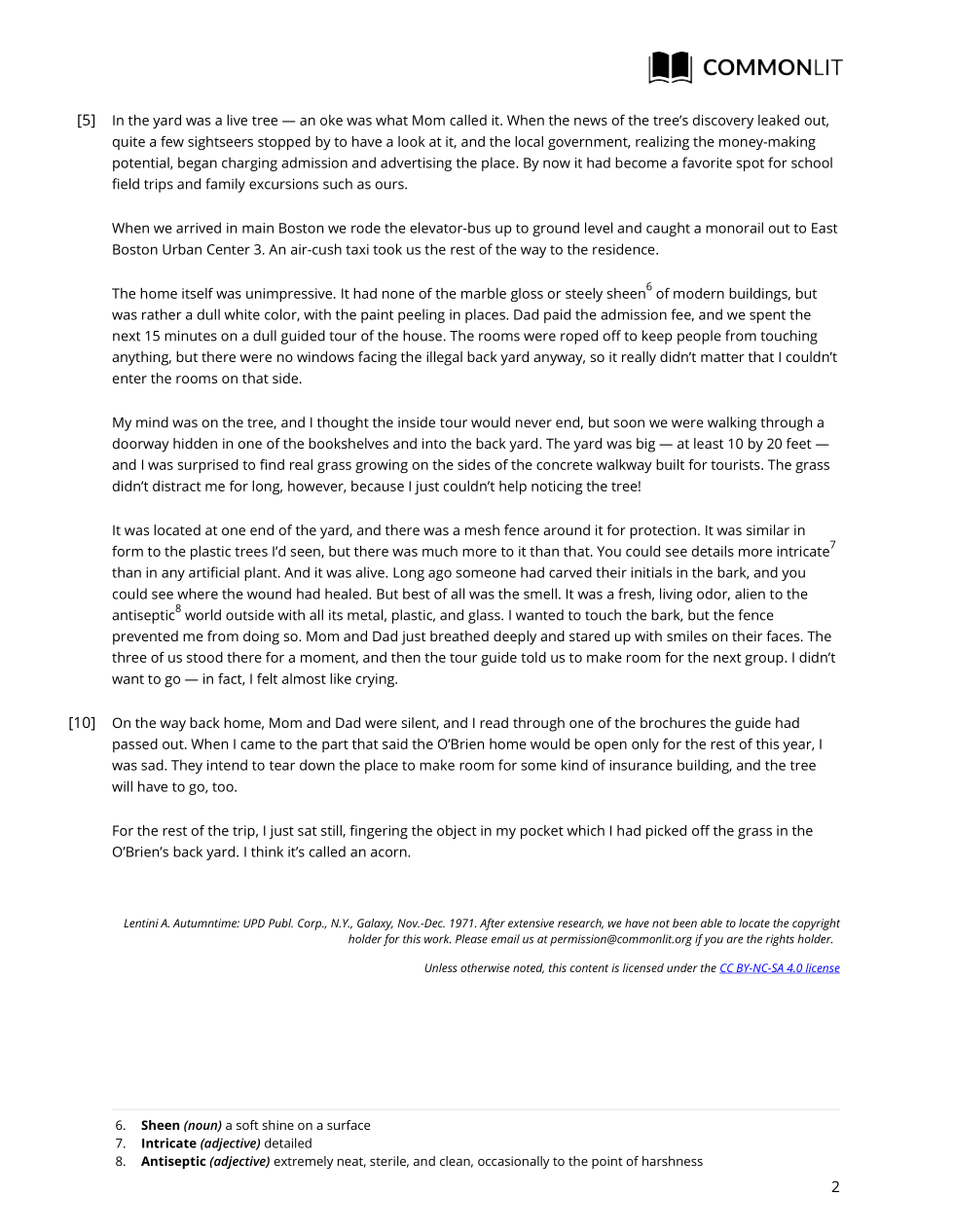
What is the central theme of the story Autumntime?
In paragraph 5, the author mispells the word "oak" as "oke" in order to...
How does visiting the tree affect the narrator?
Why does the author include the detail about the acorn at the end?
In a complete Constructed Response citing the text at least ONCE in your answer, respond:
Considering the purpose of dystopian literature, what do you think is the author's deeper meaning/purpose in writing Autumntime?
Based on the STEAL chart resource, Beatty would be considered a ______ character.
Based on the STEAL chart resource, Montag would be considered a ______ character.
Based on the STEAL chart resource, Clarisse would be considered a ______ character.
Based on the STEAL chart resource, Mildred would be considered a ______ character.
In excerpt 1, why is the number 451 on his helmet "symbolic"?
(consider the title of the book)
In Excerpt 1, Montag sees fire as...
The evidence that BEST supports my answer to the previous question is...
In Excerpt 2, Montag sees fire as...
The evidence that BEST supports my answer to the previous question is...