Period 1, Day 1 Classwork: Pre-Columbian Civilizations
star
star
star
star
star
Last updated about 2 years ago
8 Nsɛmmisa
Hyɛ no nsow a efi ɔkyerɛwfo no hɔ:
Ɛhia
1
Ɛhia
1
Ɛhia
0
Ɛhia
1
Ɛhia
1
Ɛhia
1
Ɛhia
0
Ɛhia
0
Content Objective: I will be able to recognize that indigenous people were living in the Americas before European arrival.
Standard Objective: I will be able to identify explicitly stated central ideas or themes in text.
Absent? Just want to review the notes? Click here for the slides.
Content Objective: I will be able to recognize that indigenous people were living in the Americas before European arrival.
Standard Objective: I will be able to identify explicitly stated central ideas or themes in text.
Absent? Just want to review the notes? Click here for the slides.
One interesting historical fact I learned is…
If you didn't do the reading, come back to this question by the end of the lesson.
Do you or any friends/family speak Spanish? What do you know about your/their cultural background?
Please rate how well you understood the reading on a scale from 1 to 4
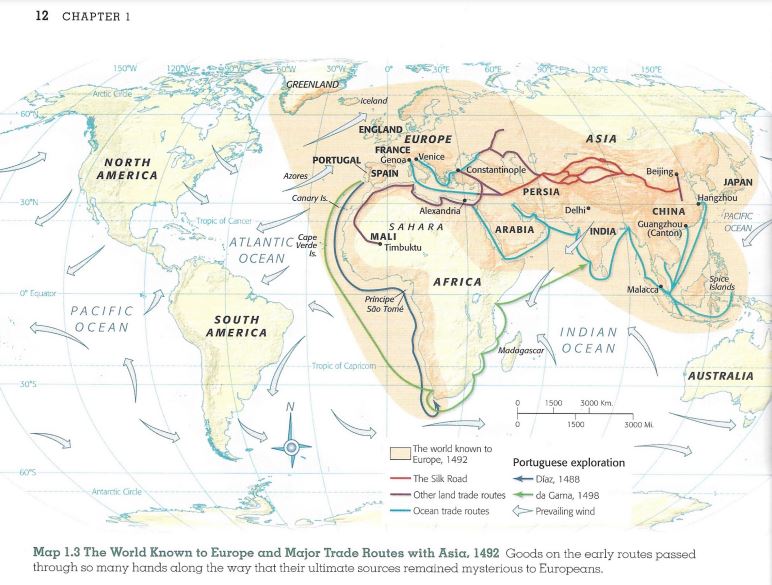
What do you notice about the map [on right] of trade routes prior to 1492?
What can this map tell us about Europe, Africa, and Asia’s awareness of the western hemisphere of the world?
This map tells us that there were
Exit Ticket: Did anyone in the class or your table group help you understand a question on the reading or EdPuzzle video that you missed? Explain how they were able to improve your understanding of history.
OR
Did you help anyone in the class or your table group? Explain how!
Exit Ticket: Please evaluate how well you understood today’s lesson on a scale from 1 to 4.